
Pulp Fiction, 1956 · page 42 of 162
Authentic Science Fiction Monthly, No. 67 — page 42: what you’re looking at
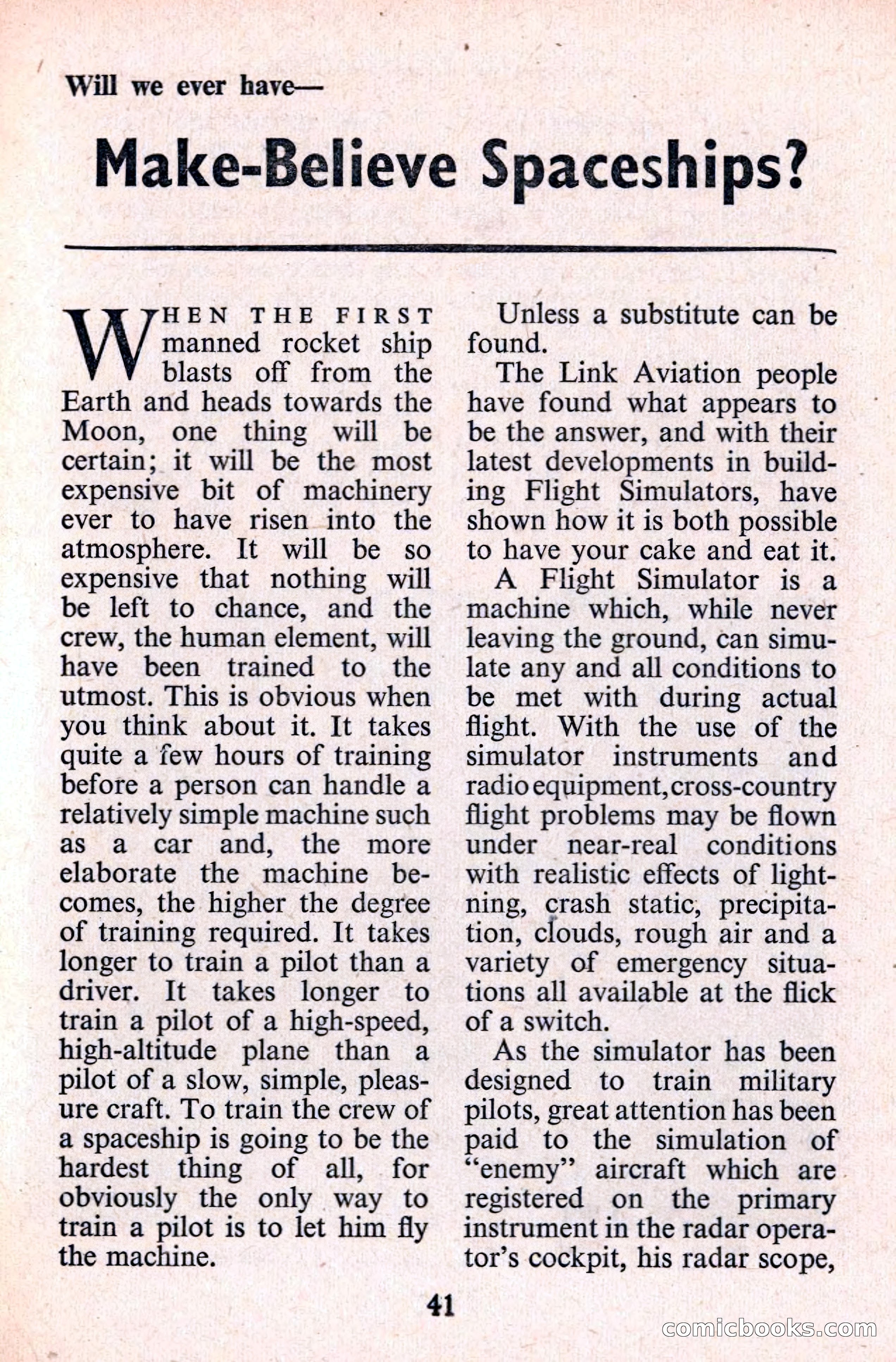
A restored page from Pulp Fiction, 1956. Page through the whole issue in the reader above.
📄 Transcribed text from this page (OCR, searchable)
Machine-transcribed from the original scan — historical spelling and the odd misread are preserved.
Will we ever have— Make-Believe Spaceships? HEN THE FIRST VV manned rocket ship blasts off from the Earth and heads towards the Moon, one thing will be certain; it will be the most expensive bit of machinery ever to have risen into the atmosphere. It will be so expensive that nothing will be left to chance, and the crew, the human element, will have been trained to the utmost. This is obvious when you think about it. It takes quite a few hours of training before a person can handle a relatively simple machine such as a car and, the more elaborate the machine be- comes, the higher the degree of training required. It takes longer to train a pilot than a driver. It takes longer to train a pilot of a high-speed, high-altitude plane than a pilot of a slow, simple, pleas- ure craft. To train the crew of a spaceship is going to be the hardest thing of all, for obviously the only way to train a pilot is to let him fly the machine. 41 Unless a substitute can be found. The Link Aviation people have found what appears to be the answer, and with their latest developments in build- - ing Flight Simulators, have shown how it is both possible to have your cake and eat it. A Flight Simulator is a machine which, while never leaving the ground, can simu- late any and all conditions to be met with during actual flight. With the use of the simulator instruments and > radio equipment, cross-country flight problems may be flown under near-real conditions with realistic effects of light- ning, crash static, precipita- tion, clouds, rough air and a variety of emergency situa- tions all available at the flick of a switch. As the simulator has been designed to train military pilots, great attention has been paid to the simulation of “enemy” aircraft which are. registered on the primary instrument in the radar opera- tor’s cockpit, his radar scope, comiclbooks.corn