
Pulp Fiction, 1956 · page 125 of 162
Authentic Science Fiction Monthly, No. 67 — page 125: what you’re looking at
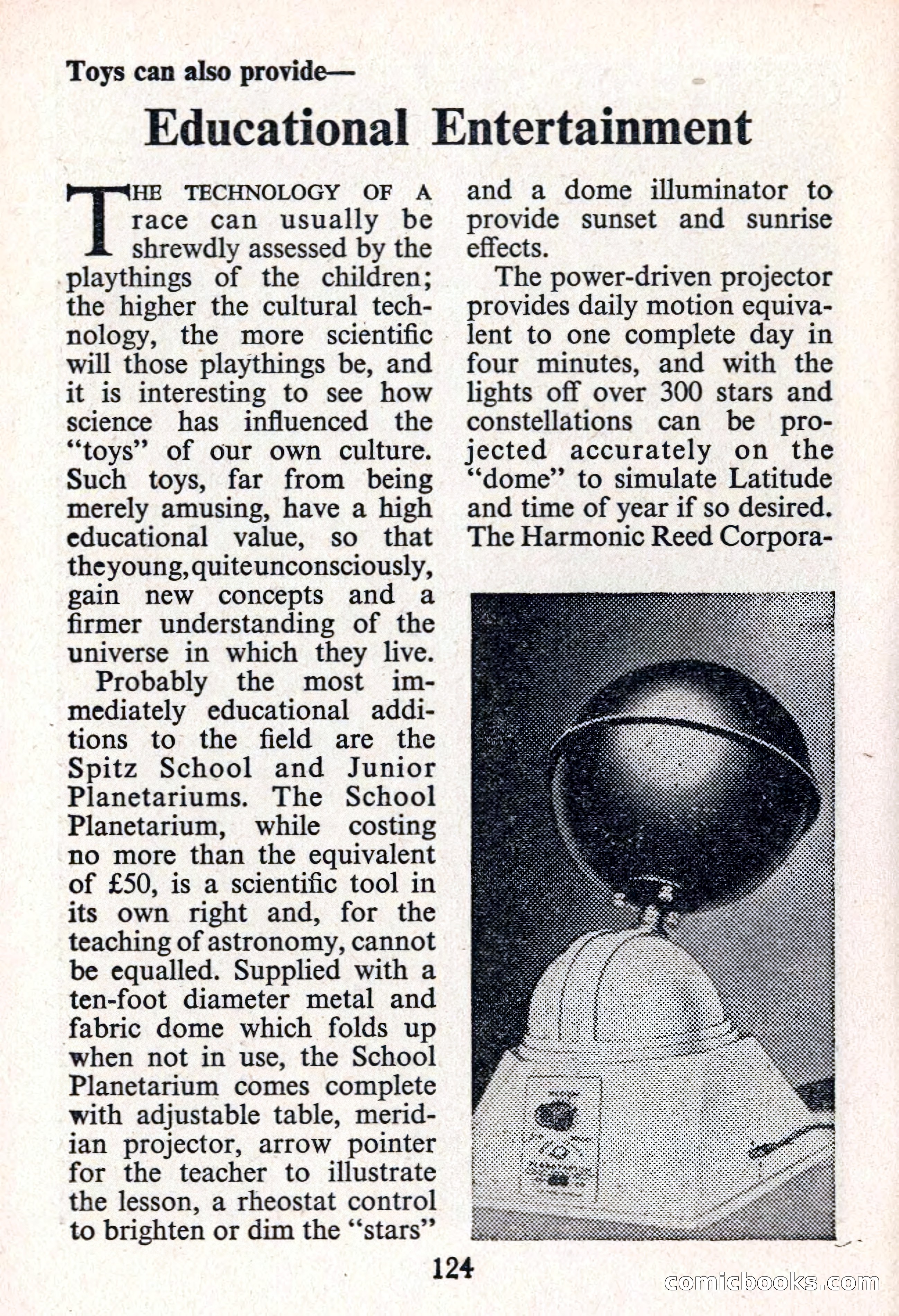
A restored page from Pulp Fiction, 1956. Page through the whole issue in the reader above.
📄 Transcribed text from this page (OCR, searchable)
Machine-transcribed from the original scan — historical spelling and the odd misread are preserved.
Toys can also provide— Educational Entertainment HE TECHNOLOGY OF A race can usually be shrewdly assessed by the playthings of the children; the higher the cultural tech- nology, the more scientific will those playthings be, and it is interesting to see how science has influenced the “toys” of our own culture. Such toys, far from being merely amusing, have a high educational value, so_ that theyoung, quiteunconsciously, gain new concepts and a firmer understanding of the universe in which they live. Probably the most im- _mediately educational addi- tions to the field are the Spitz School and Junior Planetariums. The School Planetarium, while costing no more than the equivalent of £50, is a scientific tool in its own right and, for the teaching of astronomy, cannot be equalled. Supplied with a ten-foot diameter metal and fabric dome which folds up when not in use, the School Planetarium comes complete with adjustable table, merid- ian projector, arrow pointer for the teacher to illustrate the lesson, a rheostat control to brighten or dim the “‘stars”’ 124 and a dome illuminator to provide sunset and sunrise effects. The power-driven projector provides daily motion equiva- lent to one complete day in four minutes, and with the lights off over 300 stars and constellations can be pro- jected accurately on the “dome” to simulate Latitude and time of year if so desired. The Harmonic Reed Corpora- comicloooks.com