
Pulp Fiction, 1956 · page 98 of 162
Authentic Science Fiction Monthly, No. 66 — page 98: what you’re looking at
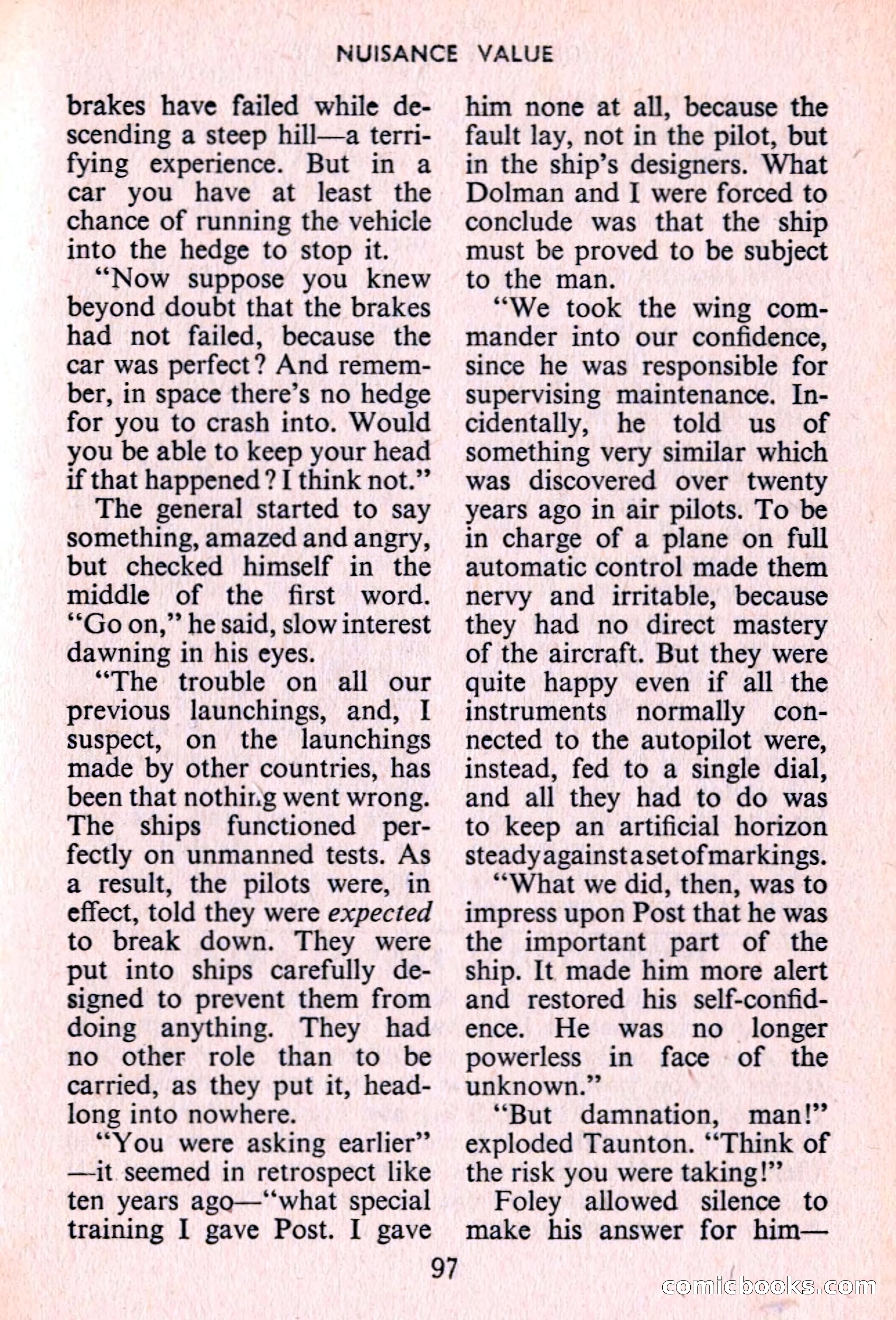
A restored page from Pulp Fiction, 1956. Page through the whole issue in the reader above.
📄 Transcribed text from this page (OCR, searchable)
Machine-transcribed from the original scan — historical spelling and the odd misread are preserved.
NUISANCE brakes have failed while de- scending a steep hill—a terri- fying experience. But in a car you have at least the chance of running the vehicle into the hedge to stop it. ““Now suppose you knew beyond doubt that the brakes had not failed, because the car was perfect? And remem- ber, in space there’s no hedge for you to crash into. Would you be able to keep your head if that happened ? I think not.” The general started to say something, amazed and angry, but checked himself in the middle of the first word. *“Go on,”’ he said, slow interest dawning in his eyes. “The trouble on all our previous launchings, and, I suspect, on the launchings made by other countries, has been that nothing went wrong. The ships functioned per- fectly on unmanned tests. As a result, the pilots were, in effect, told they were expected to break down. They were put into ships carefully de- signed to prevent them from doing anything. They had no other role than to be carried, as they put it, head- long into nowhere. ““You were asking earlier” —it seemed in retrospect like ten years ago—*‘what special training I gave Post. I gave 97 VALUE him none at all, because the fault lay, not in the pilot, but in the ship’s designers. What Dolman and I were forced to conclude was that the ship must be proved to be subject to the man. “We took the wing com- mander into our confidence, since he was responsible for supervising maintenance. In- cidentally, he told us of something very similar which was discovered over twenty years ago in air pilots. To be in charge of a plane on full automatic control made them nervy and irritable, because they had no direct mastery of the aircraft. But they were quite happy even if all the instruments normally con- nected to the autopilot were, instead, fed to a single dial, and all they had to do was to keep an artificial horizon steady againstasetofmarkings. “‘What we did, then, was to impress upon Post that he was the important part of the ship. It made him more alert and restored his self-confid- ence. He was no_ longer powerless in face of the unknown.” ‘‘But damnation, man!”’ exploded Taunton. “‘Think of the risk you were taking!”’ Foley allowed silence to make his answer for him— connicloooks.com