
Pulp Fiction, 1956 · page 83 of 162
Authentic Science Fiction Monthly, No. 66 — page 83: what you’re looking at
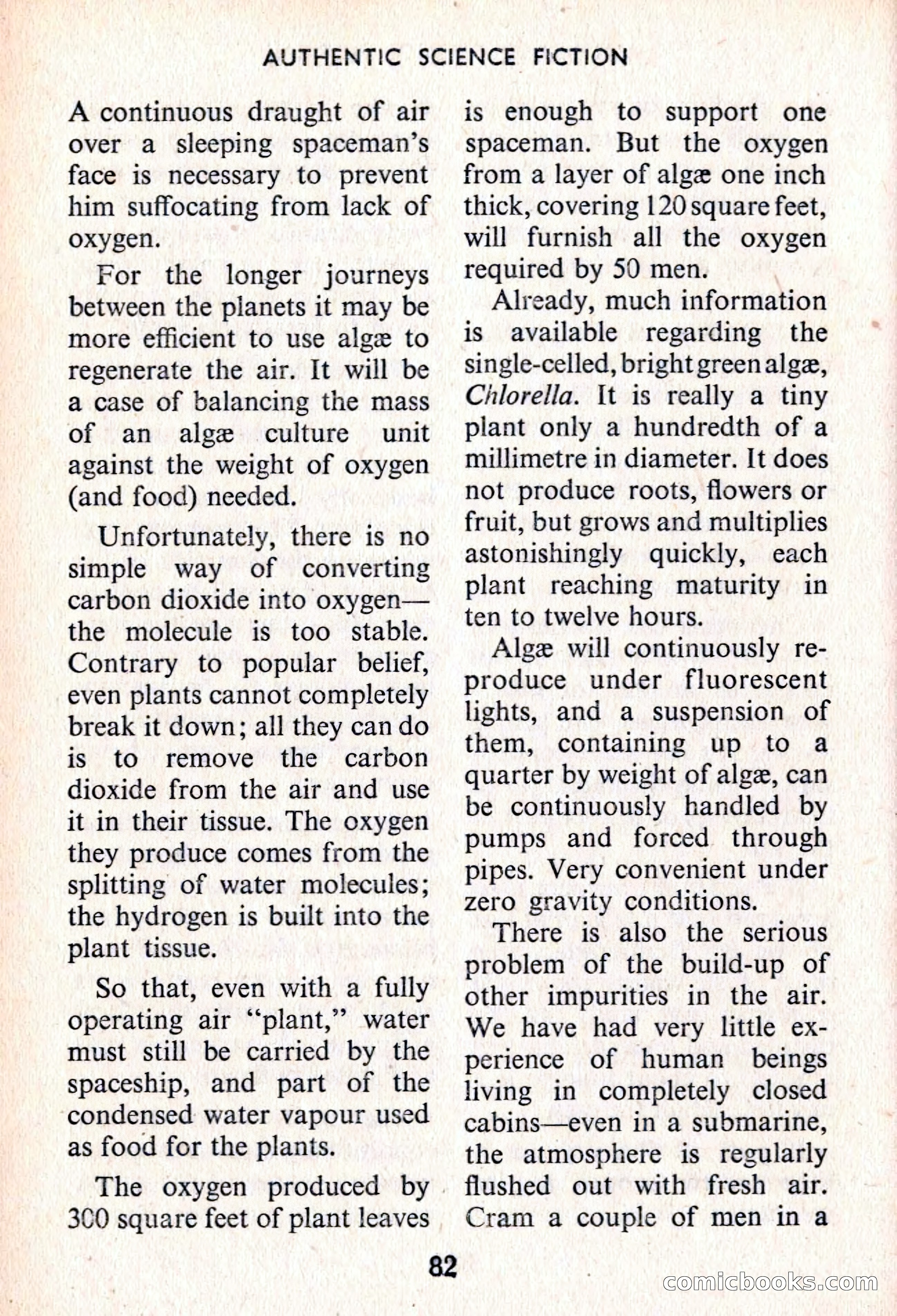
A restored page from Pulp Fiction, 1956. Page through the whole issue in the reader above.
📄 Transcribed text from this page (OCR, searchable)
Machine-transcribed from the original scan — historical spelling and the odd misread are preserved.
AUTHENTIC SCIENCE FICTION A continuous draught of air over a Sleeping spaceman’s face is necessary to prevent him suffocating from lack of oxygen. For the longer journeys between the planets it may be more efficient to use alge to regenerate the air. It will be a case of balancing the mass of an alge culture’ unit against the weight of oxygen (and food) needed. Unfortunately, there is no simple way of converting carbon dioxide into oxygen— the molecule is too stable. Contrary to popular belief, even plants cannot completely break it down; all they can do is to remove the carbon dioxide from the air and use it in their tissue. The oxygen they produce comes from the splitting of water molecules; the hydrogen is built into the plant tissue. So that, even with a fully operating air “‘plant,”’ water must still be carried by the spaceship, and part of the condensed water vapour used as food for the plants. The oxygen produced by . 3C0 square feet of plant leaves 82 is enough to support one spaceman. But the oxygen from a layer of alge one inch thick, covering 120 square feet, will furnish all the oxygen required by 50 men. Already, much information is available regarding the single-celled, bright greenalge, Chlorella. It is really a tiny plant only a hundredth of a millimetre in diameter. It does not produce roots, flowers or fruit, but grows and multiplies astonishingly quickly, each plant reaching maturity in ten to twelve hours. Alge will continuously re- produce under fluorescent lights, and a suspension of them, containing up to a quarter by weight of alge, can be continuously handled by pumps and forced through pipes. Very convenient under zero gravity conditions. There is also the serious problem of the build-up of other impurities in the air. We have had very little ex- perience of human _ beings living in completely closed cabins—even in a submarine, the atmosphere is regularly flushed out with fresh air. Cram a couple of men in a comicloooks.com