
Pulp Fiction, 1956 · page 43 of 162
Authentic Science Fiction Monthly, No. 66 — page 43: what you’re looking at
A restored page from Pulp Fiction, 1956. Page through the whole issue in the reader above.
📄 Transcribed text from this page (OCR, searchable)
Machine-transcribed from the original scan — historical spelling and the odd misread are preserved.
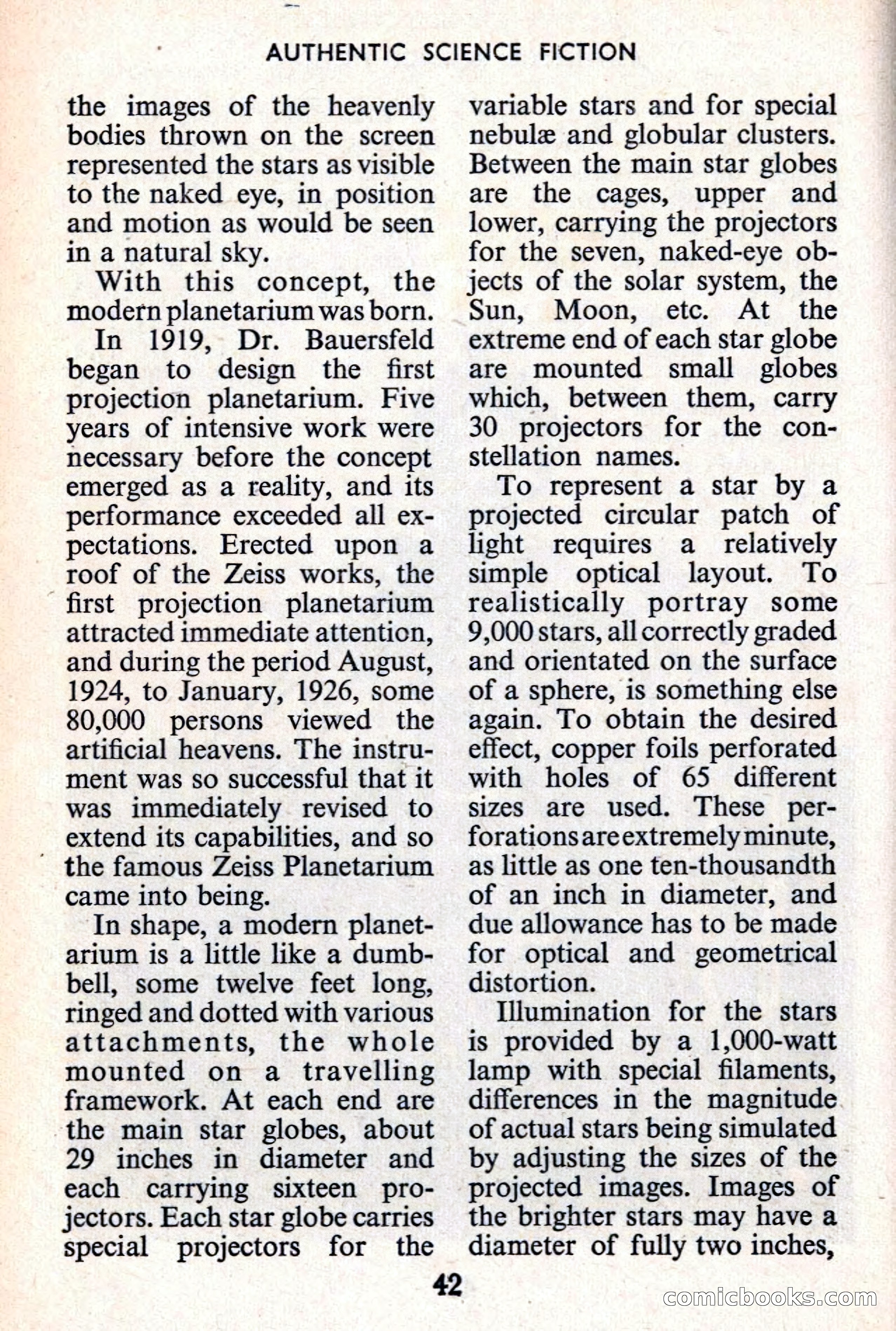
— AUTHENTIC SCIENCE FICTION the images of the heavenly bodies thrown on the screen represented the stars as visible to the naked eye, in position and motion as would be seen in a natural sky. With this concept, the modern planetarium was born. In 1919, Dr. Bauersfeld began to design the first projection planetarium. Five years of intensive work were necessary before the concept emerged as a reality, and its performance exceeded all ex- pectations. Erected upon a roof of the Zeiss works, the first projection planetarium attracted immediate attention, and during the period August, 1924, to January, 1926, some 80,000 persons viewed the artificial heavens. The instru- ment was so successful that it was immediately revised to extend its capabilities, and so - the famous Zeiss Planetarium came into being. In shape, a modern planet- arium is a little like a dumb- bell, some twelve feet long, ringed and dotted with various attachments, the whole mounted on a travelling framework. At each end are the main star globes, about 29 inches in diameter and each carrying sixteen pro- jectors. Each star globe carries special projectors for the 42 variable stars and for special nebule and globular clusters. Between the main star globes are the cages, upper and lower, carrying the projectors for the seven, naked-eye ob- jects of the solar system, the Sun, Moon, etc. At the extreme end of each star globe are mounted small globes which, between them, carry 30 projectors for the con- stellation names. To represent a star by a projected circular patch of light requires a_ relatively simple optical layout. To realistically portray some 9,000 stars, all correctly graded and orientated on the surface of a sphere, is something else again. To obtain the desired effect, copper foils perforated with holes of 65 different sizes are used. These per- forationsareextremely minute, as little as one ten-thousandth of an inch in diameter, and due allowance has to be made for optical and geometrical distortion. Illumination for the stars is provided by a 1,000-watt lamp with special filaments, differences in the magnitude of actual stars being simulated by adjusting the sizes of the projected images. Images of the brighter stars may have a diameter of fully two inches, comiclooks.comn