
Pulp Fiction, 1956 · page 120 of 162
Authentic Science Fiction Monthly, No. 66 — page 120: what you’re looking at
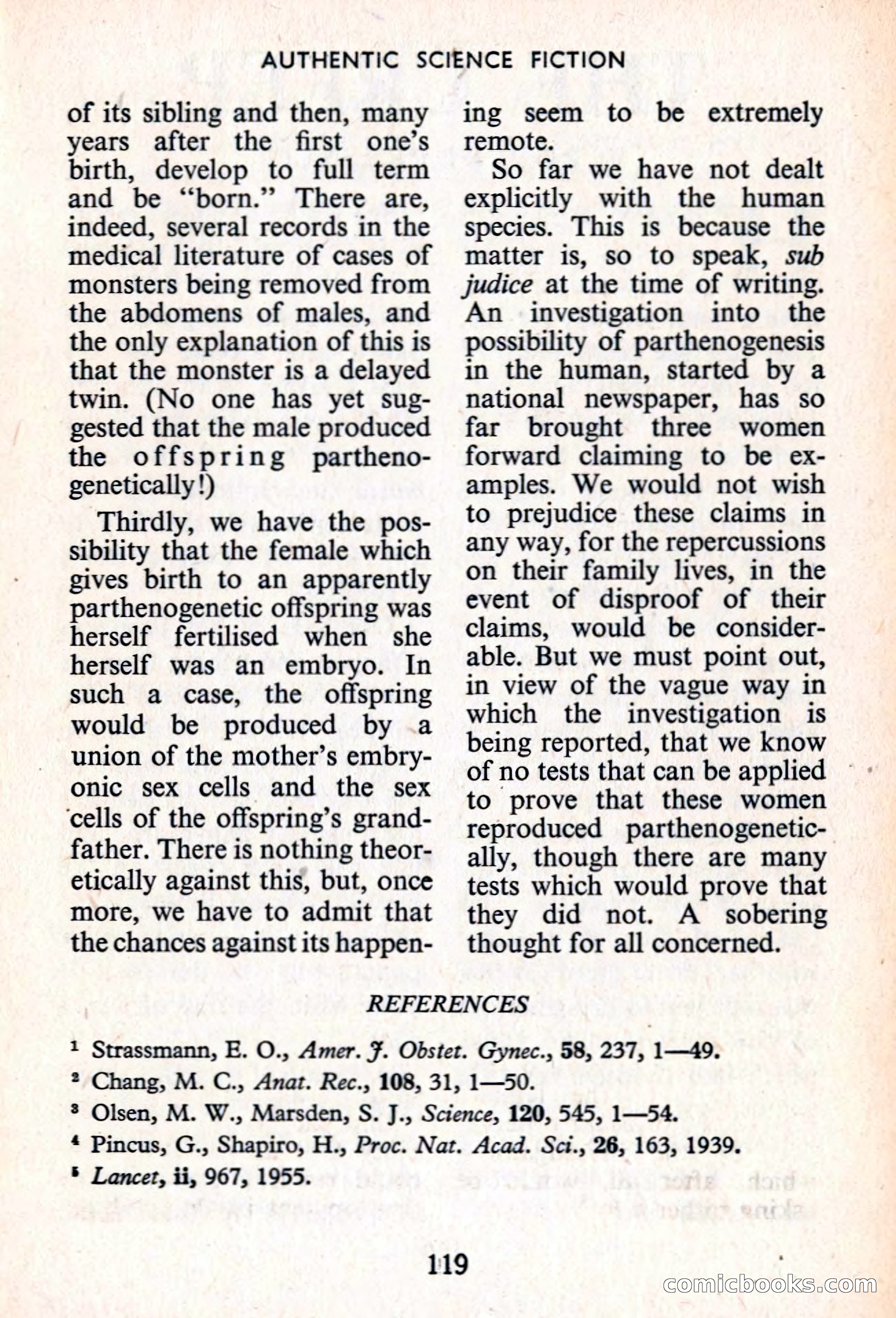
A restored page from Pulp Fiction, 1956. Page through the whole issue in the reader above.
📄 Transcribed text from this page (OCR, searchable)
Machine-transcribed from the original scan — historical spelling and the odd misread are preserved.
AUTHENTIC SCIENCE FICTION of its sibling and then, many years after the first one’s birth, develop to full term and be “born.” There are, indeed, several records in the medical literature of cases of monsters being removed from the abdomens of males, and the only explanation of this is that the monster is a delayed twin. (No one has yet sug- gested that the male produced the offspring partheno- genetically!) Thirdly, we have the pos- sibility that the female which gives birth to an apparently parthenogenetic offspring was herself fertilised when she herself was an embryo. In such a case, the offspring would be produced by a union of the mother’s embry- onic sex cells and the sex ‘cells of the offspring’s grand- father. There is nothing theor- etically against this, but, once more, we have to admit that the chances against its happen- ing seem to be extremely remote. So far we have not dealt explicitly with the human species. This is because the matter is, so to speak, sub judice at the time of writing. An investigation into the possibility of parthenogenesis in the human, started by a national newspaper, has so far brought three women forward claiming to be ex- amples. We would not wish to prejudice these claims in any way, for the repercussions on their family lives, in the event of disproof of their claims, would be consider- able. But we must point out, in view of the vague way in which the investigation is being reported, that we know of no tests that can be applied ~ - to prove that these women reproduced parthenogenetic- ally, though there are many tests which would prove that they did not. A_ sobering thought for all concerned. REFERENCES 1 Strassmann, E. O., Amer. F. Obstet. Gynec., 58, 237, 1—49. 2? Chang, M. C., Anat. Rec., 108, 31, 1—50. ® Olsen, M. W., Marsden, S. J., Science, 120, 545, 1—54. * Pincus, G., Shapiro, H., Proc. Nat. Acad. Sci., 26, 163, 1939. ® Lancet, ii, 967, 1955. 119 comicloooks.com