
Pulp Fiction, 1956 · page 109 of 162
Authentic Science Fiction Monthly, No. 66 — page 109: what you’re looking at
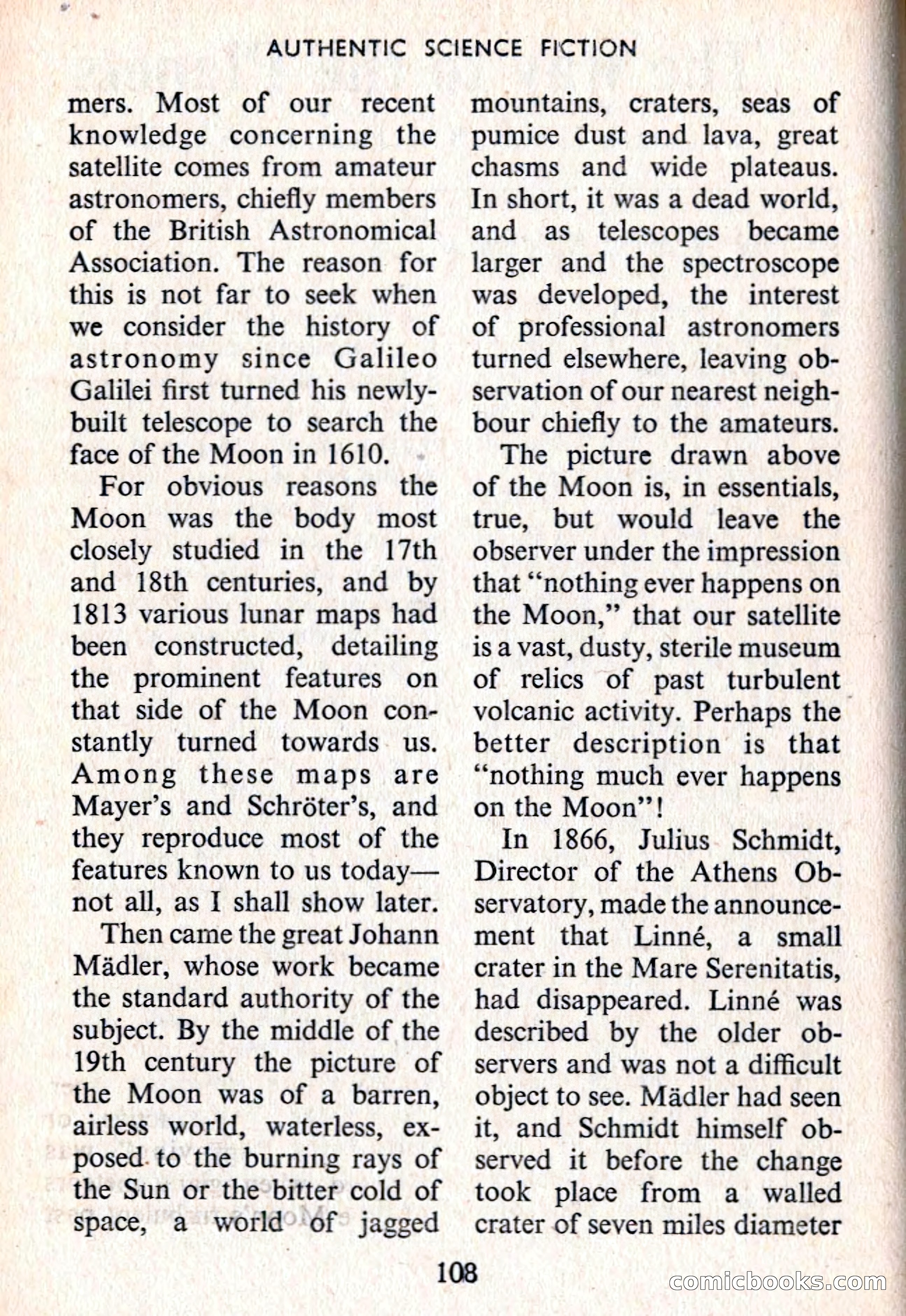
A restored page from Pulp Fiction, 1956. Page through the whole issue in the reader above.
📄 Transcribed text from this page (OCR, searchable)
Machine-transcribed from the original scan — historical spelling and the odd misread are preserved.
AUTHENTIC SCIENCE FICTION mers. Most of our recent knowledge concerning the satellite comes from amateur astronomers, chiefly members of the British Astronomical Association. The reason for this is not far to seek when we consider the history of astronomy since Galileo Galilei first turned his newly- built telescope to search the face of the Moon in 1610. For obvious reasons the Moon was the body most closely studied in the 17th and 18th centuries, and by 1813 various lunar maps had been constructed, detailing the prominent features on that side of the Moon con- stantly turned towards. us. Among these maps are Mayer’s and Schréter’s, and they reproduce most of the features known to us today— not all, as I shall show later. Then came the great Johann Madler, whose work became the standard authority of the subject. By the middle of the 19th century the picture of the Moon was of a barren, airless world, waterless, ex- posed.to the burning rays of the Sun or the bitter cold of space, a world’of jagged 108 mountains, craters, seas of pumice dust and lava, great chasms and wide plateaus. In short, it was a dead world, and as telescopes became larger and the spectroscope was developed, the interest of professional astronomers turned elsewhere, leaving ob- servation of our nearest neigh- bour chiefly to the amateurs. The picture drawn above of the Moon is, in essentials, true, but would leave the observer under the impression that “nothing ever happens on the Moon,” that our satellite is a vast, dusty, sterile museum of relics of past turbulent volcanic activity. Perhaps the better description is that “nothing much ever happens on the Moon’’! In 1866, Julius Schmidt, Director of the Athens Ob- servatory, made the announce- ment that Linné, a small crater in the Mare Serenitatis, had disappeared. Linné was described by the older ob- servers and was not a difficult object to see. Madler had seen it, and Schmidt himself ob- served it before the change took place from a_ walled crater of seven miles diameter comiclbooks.com *