
Pulp Fiction, 1956 · page 9 of 162
Authentic Science Fiction Monthly, No. 65 — page 9: what you’re looking at
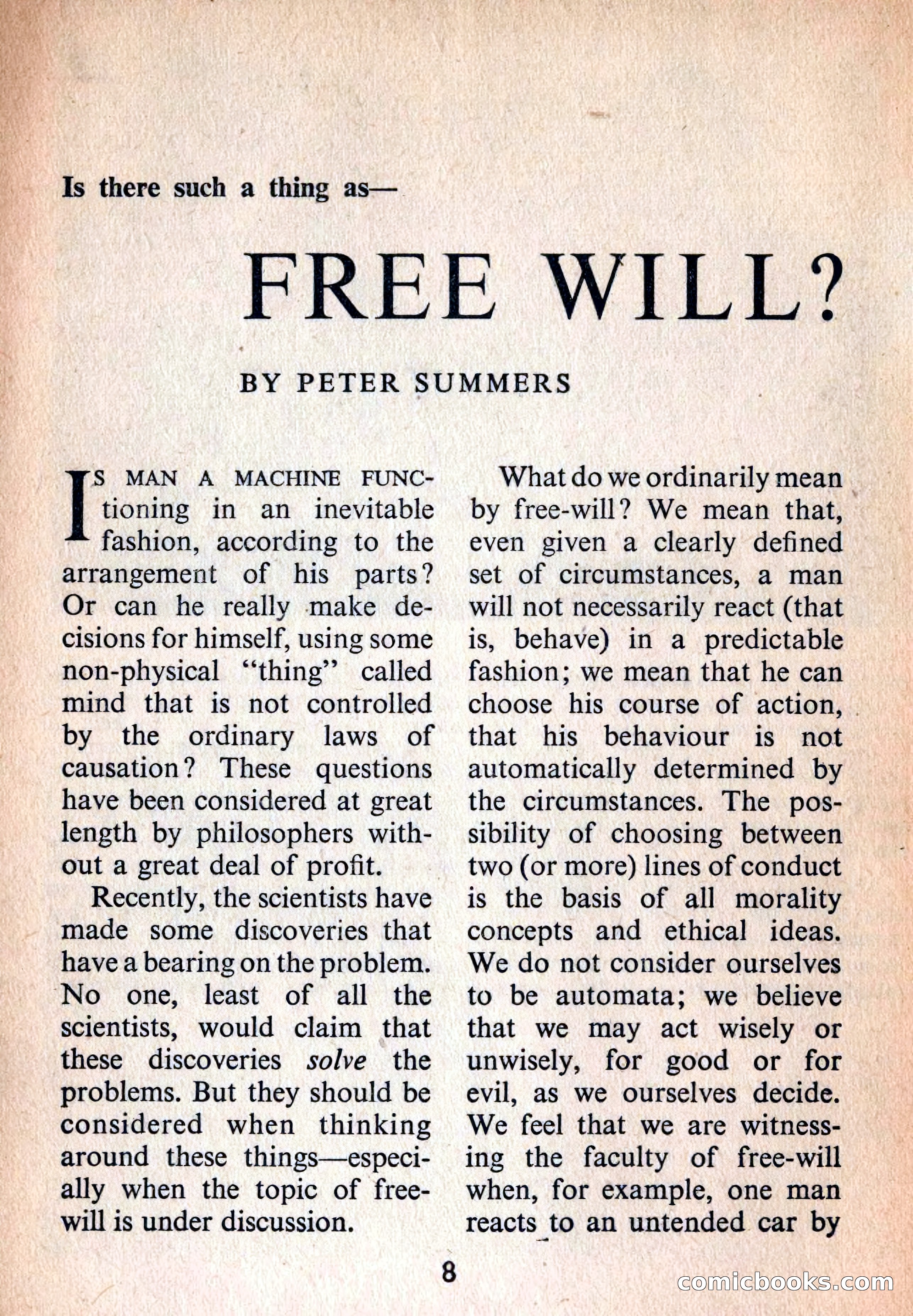
A restored page from Pulp Fiction, 1956. Page through the whole issue in the reader above.
📄 Transcribed text from this page (OCR, searchable)
Machine-transcribed from the original scan — historical spelling and the odd misread are preserved.
wt Sym ge rena tae ee a =; at . +4, Adee —— —L" “ ‘No. one, Is there such a thing as— FREE WILL? BY PETER SUMMERS S MAN A MACHINE FUNC- [ tioning in an inevitable fashion, according to the arrangement of his parts? Or can he really make de- cisions for himself, using some non-physical “‘thing’’ called mind that is not controlled by the ordinary laws of causation? These questions have been considered at great length by philosophers with- out a great deal of profit. Recently, the scientists have made some discoveries that have a bearing on the problem. least of all the scientists, would claim that these discoveries solve the problems. But they should be considered when thinking around these things—especi- ally when the topic of free- will is under discussion. What do we ordinarily mean - by free-will? We mean that, even given a clearly defined set of circumstances, a man will not necessarily react (that is, behave) in a predictable fashion; we mean that he can choose his course of action, . that his behaviour is not automatically determined by the circumstances. The pos- sibility of choosing between two (or more) lines of conduct is the basis of all morality concepts and ethical ideas. We do not consider ourselves to be automata; we believe that we may act wisely or unwisely, for good or for evil, as we ourselves decide. We feel that we are witness- ing the faculty of free-will when, for example, one man reacts to an untended car by Ccommicloooks.conn