
Pulp Fiction, 1956 · page 32 of 162
Authentic Science Fiction Monthly, No. 65 — page 32: what you’re looking at
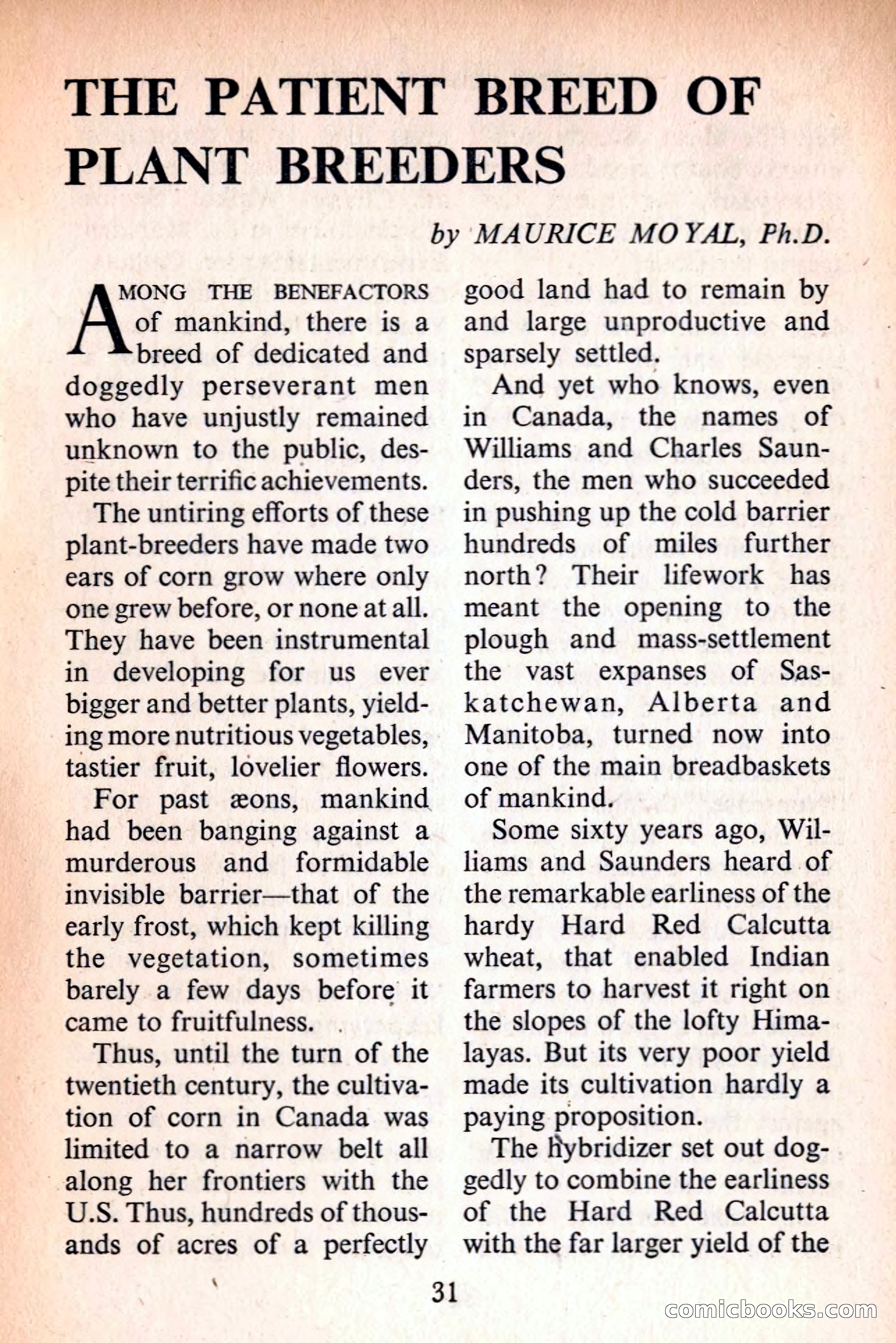
A restored page from Pulp Fiction, 1956. Page through the whole issue in the reader above.
📄 Transcribed text from this page (OCR, searchable)
Machine-transcribed from the original scan — historical spelling and the odd misread are preserved.
THE PATIENT BREED OF PLANT BREEDERS MONG THE BENEFACTORS Aw mankind, there is a breed of dedicated and doggedly perseverant men who have unjustly remained unknown to the public, des- pite their terrific achievements. The untiring efforts of these plant-breeders have made two ears of corn grow where only one grew before, or none at all. They have been instrumental in developing for us ever bigger and better plants, yield- ing more nutritious vegetables, tastier fruit, lovelier flowers. For past eons, mankind had been banging against a murderous and _ formidable invisible barrier—that of the early frost, which kept killing the vegetation, sometimes barely a few days before it came to fruitfulness. . Thus, until the turn of the twentieth century, the cultiva- tion of corn in Canada was limited to a narrow belt all along her frontiers with the U.S. Thus, hundreds of thous- ands of acres of a perfectly \ 31 by MAURICE MOYAL, Ph.D. good land had to remain by and large unproductive and sparsely settled. And yet who knows, even in Canada, the names of Williams and Charles Saun- ders, the men who succeeded in pushing up the cold barrier hundreds of miles further north? Their lifework has meant the opening to the plough and mass-settlement the vast expanses of Sas- katchewan, Alberta and Manitoba, turned now into one of the main breadbaskets of mankind. Some sixty years ago, Wil- liams and Saunders heard of the remarkable earliness of the hardy Hard Red Calcutta wheat, that enabled Indian farmers to harvest it right on the slopes of the lofty Hima- layas. But its very poor yield made its cultivation hardly a paying proposition. The Hybridizer set out dog- gedly to combine the earliness of the Hard Red Calcutta with the far larger yield of the comiclooks.cormn