
Pulp Fiction, 1956 · page 104 of 162
Authentic Science Fiction Monthly, No. 65 — page 104: what you’re looking at
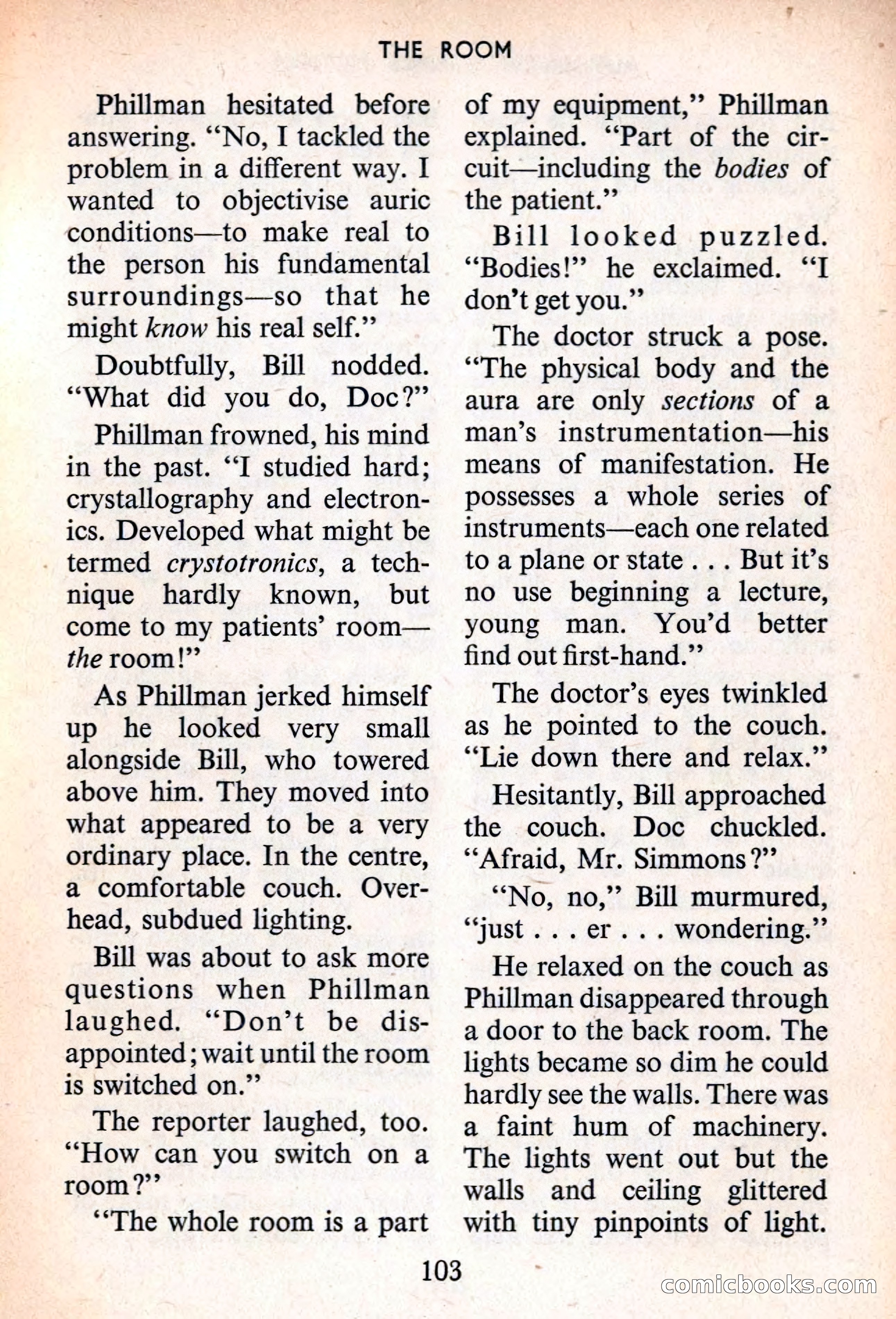
A restored page from Pulp Fiction, 1956. Page through the whole issue in the reader above.
📄 Transcribed text from this page (OCR, searchable)
Machine-transcribed from the original scan — historical spelling and the odd misread are preserved.
THE ROOM Phillman hesitated before answering. ‘““No, I tackled the problem in a different way. I wanted to objectivise auric conditions—to make real to the person his fundamental surroundings—so that he might know his real self.” Doubtfully, Bill nodded. “What did you do, Doc?” Phillman frowned, his mind in the past. “I studied hard; crystallography and electron- ics. Developed what might be . termed crystotronics, a tech- nique hardly known, but come to my patients’ room— the room!” As Phillman jerked himself up he looked very small alongside Bill, who towered above him. They moved into what appeared to be a very ordinary place. In the centre, a comfortable couch. Over- head, subdued lighting. Bill was about to ask more questions when Phillman laughed. “Don’t be dis- appointed; wait until the room is switched on.” The reporter laughed, too. ““How can you switch on a room ?”’ **The whole room is a part 103 of my equipment,’ Phillman explained. “‘Part of the cir- cuit—including the bodies of the patient.” Bill looked puzzled. “Bodies!” he exclaimed. “TI don’t get you.” The doctor struck a pose. “The physical body and the aura are only sections of a man’s instrumentation—his means of manifestation. He possesses a whole series of instruments—each one related to a plane or state... But it’s no use beginning a lecture, young man. You'd better find out first-hand.”’ The doctor’s eyes twinkled as he pointed to the couch. “Lie down there and relax.” Hesitantly, Bill approached the couch. Doc chuckled. ‘Afraid, Mr. Simmons ?’’ “No, no,” Bill murmured, ““just...er... wondering.”’ He relaxed on the couch as Phillman disappeared through a door to the back room. The lights became so dim he could hardly see the walls. There was a faint hum of machinery. The lights went out but the walls and ceiling glittered with tiny pinpoints of light. comicloooks.conm