
Pulp Fiction, 1955 · page 85 of 146
Authentic Science Fiction Monthly, No. 56 — page 85: what you’re looking at
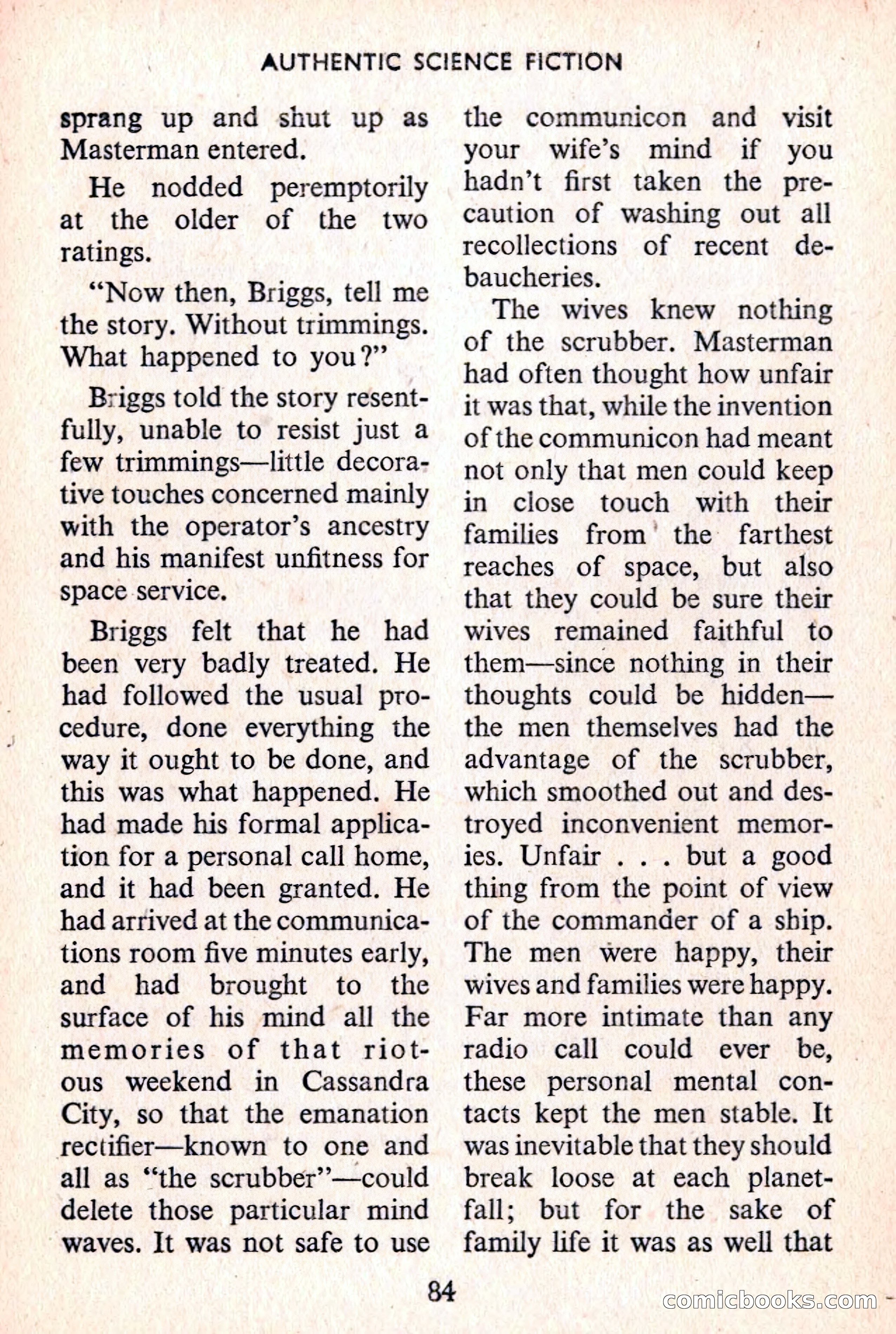
A restored page from Pulp Fiction, 1955. Page through the whole issue in the reader above.
📄 Transcribed text from this page (OCR, searchable)
Machine-transcribed from the original scan — historical spelling and the odd misread are preserved.
AUTHENTIC SCIENCE FICTION sprang up and shut up as Masterman entered. He nodded peremptorily at the older of the two ratings. *‘Now then, Briggs, tell me the story. Without trimmings. What happened to you?” Briggs told the story resent- fully, unable to resist just a few trimmings—little decora- tive touches concerned mainly with the operator’s ancestry and his manifest unfitness for space service. Briggs felt that he had been very badly treated. He had followed the usual pro- cedure, done everything the way it ought to be done, and this was what happened. He had made his formal applica- tion for a personal call home, and it had been granted. He had arrived at the communica- tions room five minutes early, and had brought to the surface of his mind all the memories of that riot- ous weekend in Cassandra City, so that the emanation rectifier—known to one and all as “‘the scrubber’—could delete those particular mind waves. It was not safe to use 84 the communicon and visit your wife’s mind if you hadn’t first taken the pre- caution of washing out all recollections of recent de- baucheries. The wives knew nothing of the scrubber. Masterman had often thought how unfair it was that, while the invention of the communicon had meant not only that men could keep in close touch with their families from’ the farthest reaches of space, but also that they could be sure their wives remained faithful to them—since nothing in their thoughts could be hidden— the men themselves had the advantage of the scrubber, which smoothed out and des- troyed inconvenient memor- ies. Unfair . . . but a good thing from the point of view of the commander of a ship. The men were happy, their wives and families were happy. Far more intimate than any radio call could ever be, these personal mental con- tacts kept the men stable. It was inevitable that they should break loose at each planet- fall; but for the sake of family life it was as well that comiclbooks.com =