
Pulp Fiction, 1955 · page 43 of 146
Authentic Science Fiction Monthly, No. 56 — page 43: what you’re looking at
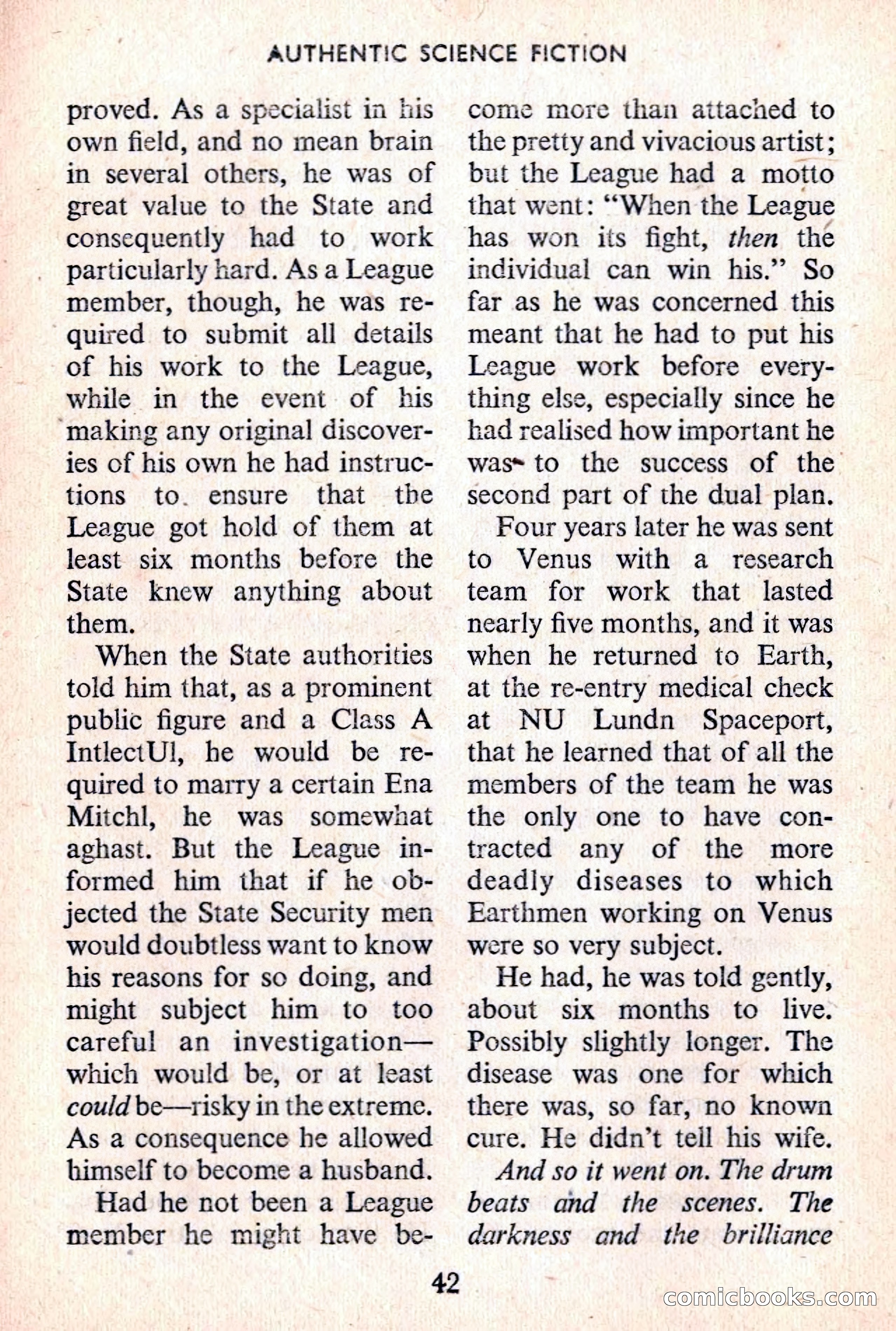
A restored page from Pulp Fiction, 1955. Page through the whole issue in the reader above.
📄 Transcribed text from this page (OCR, searchable)
Machine-transcribed from the original scan — historical spelling and the odd misread are preserved.
AUTHENTIC SCIENCE FICTION proved. As a specialist in his own field, and no mean brain in several others, he was of great value to the State and consequently had to work particularly hard. As a League member, though, he was re- quired to submit all details of his work to the League, while in the event of his ‘making any original discover- ies of his own he had instruc- tions to. ensure that the League got hold of them at least six months before the State knew anything about them. : When the State authorities told him that, as a prominent public figure and a Class A IntlectUl, he would be re- quired to marry a certain Ena Mitchl, he was somewhat aghast. But the League in- formed him that if he ob- jected the State Security men would doubtless want to know his reasons for so doing, and might subject him to too careful an investigation— which would be, or at least could be—risky in the extreme. As a consequence he allowed himself to become a husband. Had he not been a League member he might have be- 42 come more than attached to the pretty and vivacious artist; but the League had a motto that went: “When the League has won its fight, then the individual can win his.” So far as he was concerned this meant that he had to put his League work before every- thing else, especially since he had realised how important he was to the success of the second part of the dual plan. Four years later he was sent to Venus with a_ research team for work that lasted nearly five months, and it was when he returned to Earth, at the re-entry medical check at NU Lundn Spaceport, that he learned that of all the members of the team he was the only one to have con- tracted any of the more deadly diseases to which Earthmen working on Venus were so very subject. He had, he was told gently, about six months to live. Possibly slightly longer. The disease was one for which there was, so far, no known cure. He didn’t teil his wife. And so it went on. The drum beats and the scenes. The darkness and the brilliance comiclooks.corn