
Pulp Fiction, 1955 · page 115 of 146
Authentic Science Fiction Monthly, No. 56 — page 115: what you’re looking at
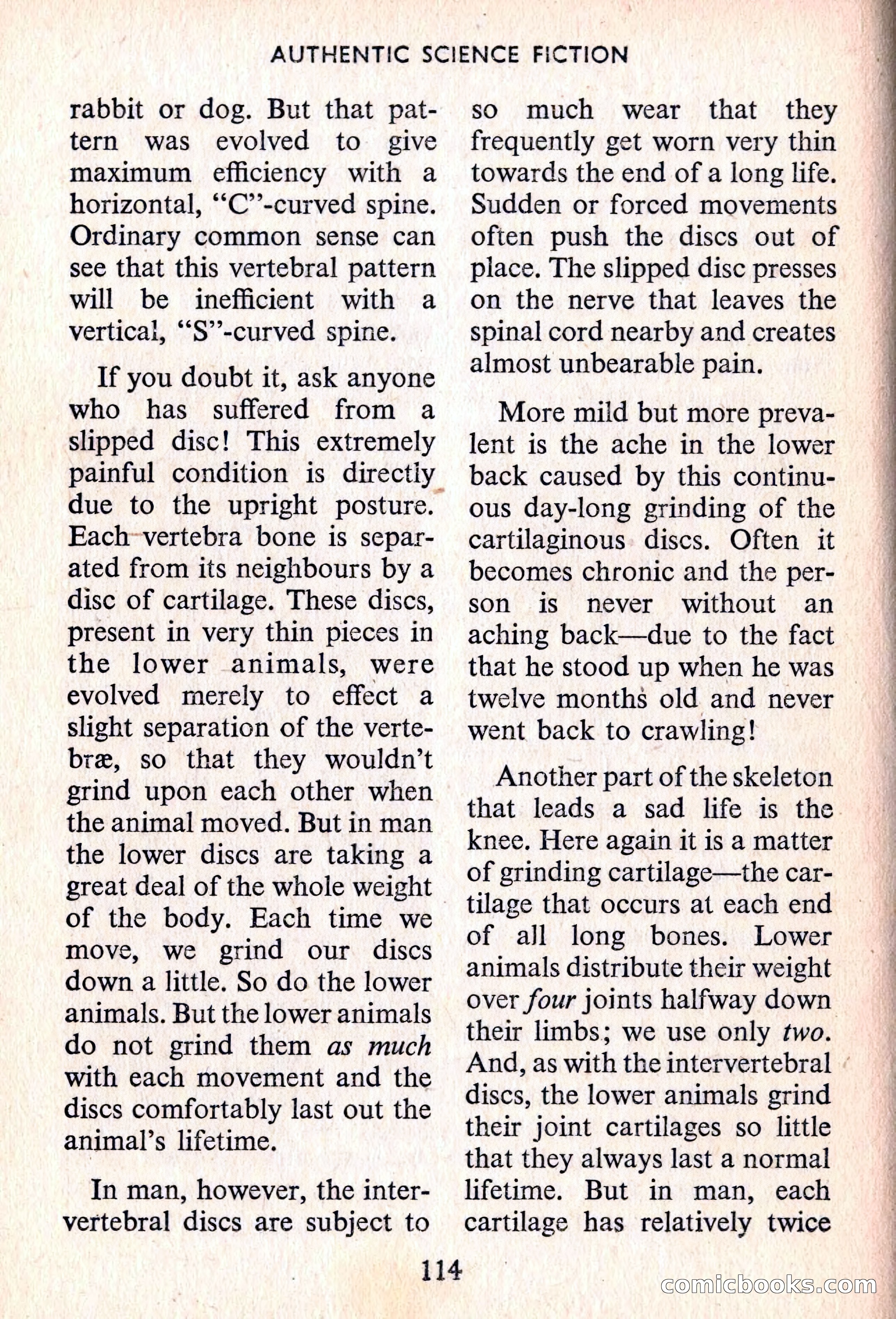
A restored page from Pulp Fiction, 1955. Page through the whole issue in the reader above.
📄 Transcribed text from this page (OCR, searchable)
Machine-transcribed from the original scan — historical spelling and the odd misread are preserved.
AUTHENTIC SCIENCE FICTION rabbit or dog. But that pat- tern was evolved to give maximum efficiency with a horizontal, ‘“‘C’’-curved spine. Ordinary common sense can see that this vertebral pattern will be inefficient with a vertical, ““S’’-curved spine. If you doubt it, ask anyone who has suffered from a slipped disc! This extremely painful condition is directiy due to the upright posture. Each~-vertebra bone is separ- ated from its neighbours by a disc of cartilage. These discs, present in very thin pieces in the lower animals, were evolved merely to effect a slight separation of the verte- bre, so that they wouldn’t grind upon each other when the animal moved. But in man the lower discs are taking a great deal of the whole weight of the body. Each time we move, we grind our discs down a little. So do the lower animals. But the lower animals do not grind them as much with each movement and the discs comfortably last out the animal’s lifetime. In man, however, the inter- vertebral discs are subject to 114 so much wear that they frequently get worn very thin towards the end of a long life. Sudden or forced movements often push the discs out of place. The slipped disc presses on the nerve that leaves the spinal cord nearby and creates almost unbearable pain. More mild but more preva- lent is the ache in the lower back caused by this continu- ous day-long grinding of the cartilaginous. discs. Often it becomes chronic and the per- son is never without an aching back—due to the fact that he stood up when he was twelve months old and never went back to crawling! Another part of the skeleton that leads a sad life is the knee. Here again it is a matter of grinding cartilage—the car- tilage that occurs at each end of aJl long bones. Lower animals distribute their weight over four joints halfway down their limbs; we use only two. And, as with the intervertebral « discs, the lower animals grind their joint cartilages so little that they always last a normal lifetime. But in man, each cartilage has relatively twice comicbhooks.com ¥