
Pulp Fiction, 1955 · page 140 of 146
Authentic Science Fiction Monthly No. 54 — page 140: what you’re looking at
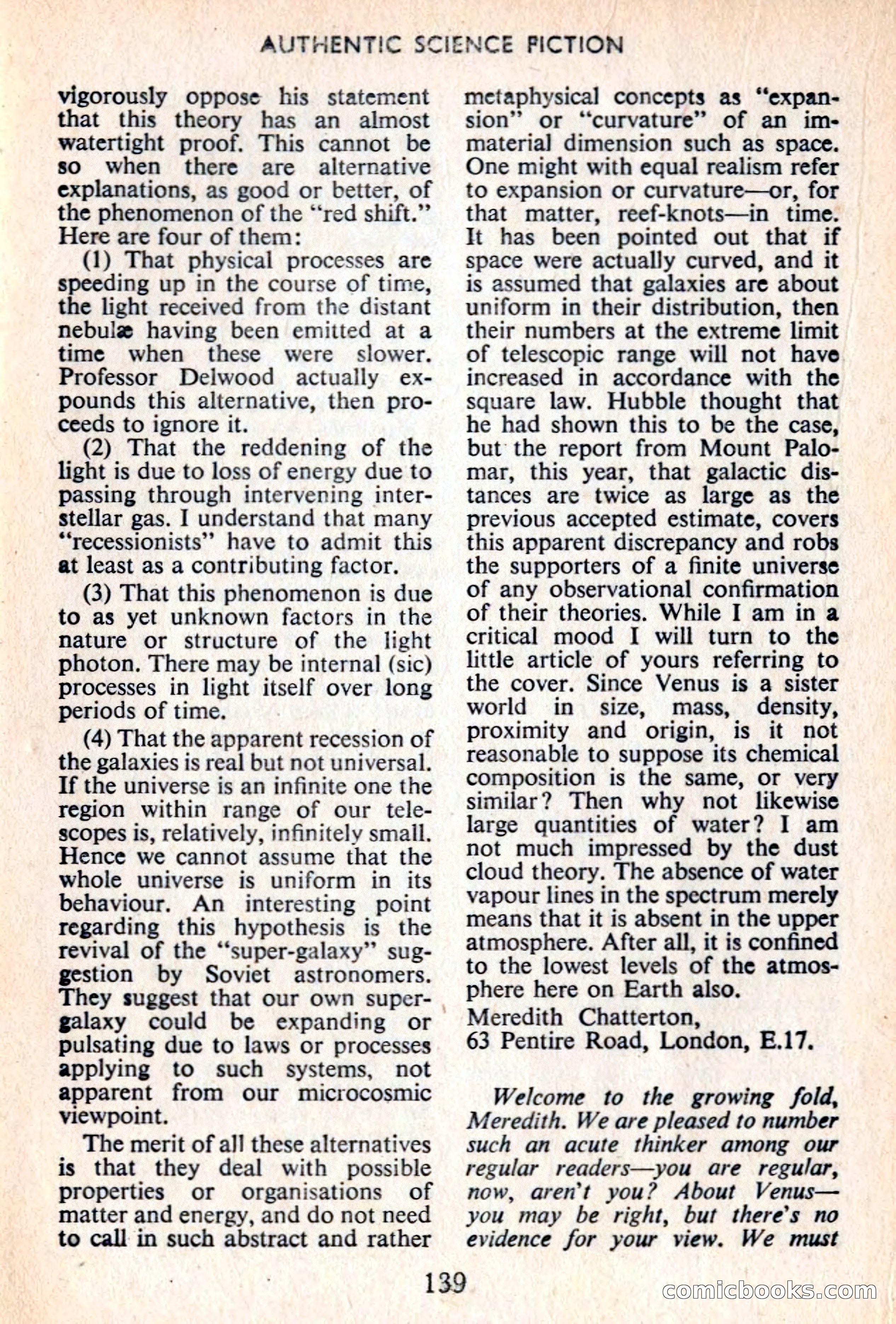
A restored page from Pulp Fiction, 1955. Page through the whole issue in the reader above.
📄 Transcribed text from this page (OCR, searchable)
Machine-transcribed from the original scan — historical spelling and the odd misread are preserved.
AUTHENTIC SCIENCE FICTION vigorously oppose his statement that this theory has an almost watertight proof. This cannot be so when there are alternative explanations, as good or better, of the phenomenon of the “red shift.” Here are four of them: (1) That physical processes are speeding up in the course of time, the light received from the distant nebulz having been emitted at a time when these were slower. Professor Delwood actually ex- pounds this alternative, then pro- ceeds to ignore it. (2) That the reddening of the light is due to loss of energy due to passing through intervening inter- stellar gas. I understand that many “‘recessionists’’ have to admit this at least as a contributing factor. (3) That this phenomenon is due to as yet unknown factors in the Mature or structure of the light photon. There may be internal (sic) processes in light itself over long periods of time, (4) That the apparent recession of the galaxies is real but not universal. If the universe is an infinite one the region within range of our tele- scopes is, relatively, infinitely smail. Hence we cannot assume that the whole universe is uniform in its behaviour. An interesting point regarding this hypothesis is the revival of the “‘super-galaxy”’ sug- gestion by Soviet astronomers. They suggest that our own super- galaxy could be expanding or pulsating due to laws or processes applying to such systems, not apparent from our microcosmic viewpoint. The merit of all these alternatives is that they deal with possible properties or organisations of matter and energy, and do not need to call in such abstract and rather 139 metaphysical concepts as “‘expan- sion” or “curvature” of an im- material dimension such as space. One might with equal realism refer to expansion or curvature—or, for that matter, reef-knots—in time. It has been pointed out that if space were actually curved, and it is assumed that galaxies are about uniform in their distribution, then their numbers at the extreme limit of telescopic range will not have increased in accordance with the square law. Hubble thought that he had shown this to be the case, but the report from Mount Palo- mar, this year, that galactic dis- tances are twice as large as the previous accepted estimate, covers this apparent discrepancy and robs the supporters of a finite universe of any observational confirmation of their theories. While I am in a critical mood I will turn to the little article of yours referring to the cover. Since Venus is a sister world in size, mass, density, proximity and origin, is it not reasonable to suppose its chemical composition is the same, or very similar? Then why not likewise large quantities of water? I am not much impressed by the dust cloud theory. The absence of water vapour lines in the spectrum merely means that it is absent in the upper atmosphere. After all, it is confined to the lowest levels of the atmos- phere here on Earth also. Meredith Chatterton, 63 Pentire Road, London, E.17. Welcome to the growing fold, Meredith. We are pleased to number such an acute thinker among our regular readers—you are regular, now, aren't you? About Venus— you may be right, but there’s no evidence for your view. We must commiclooolkks.com