
Pulp Fiction, 1955 · page 114 of 146
Authentic Science Fiction Monthly No. 54 — page 114: what you’re looking at
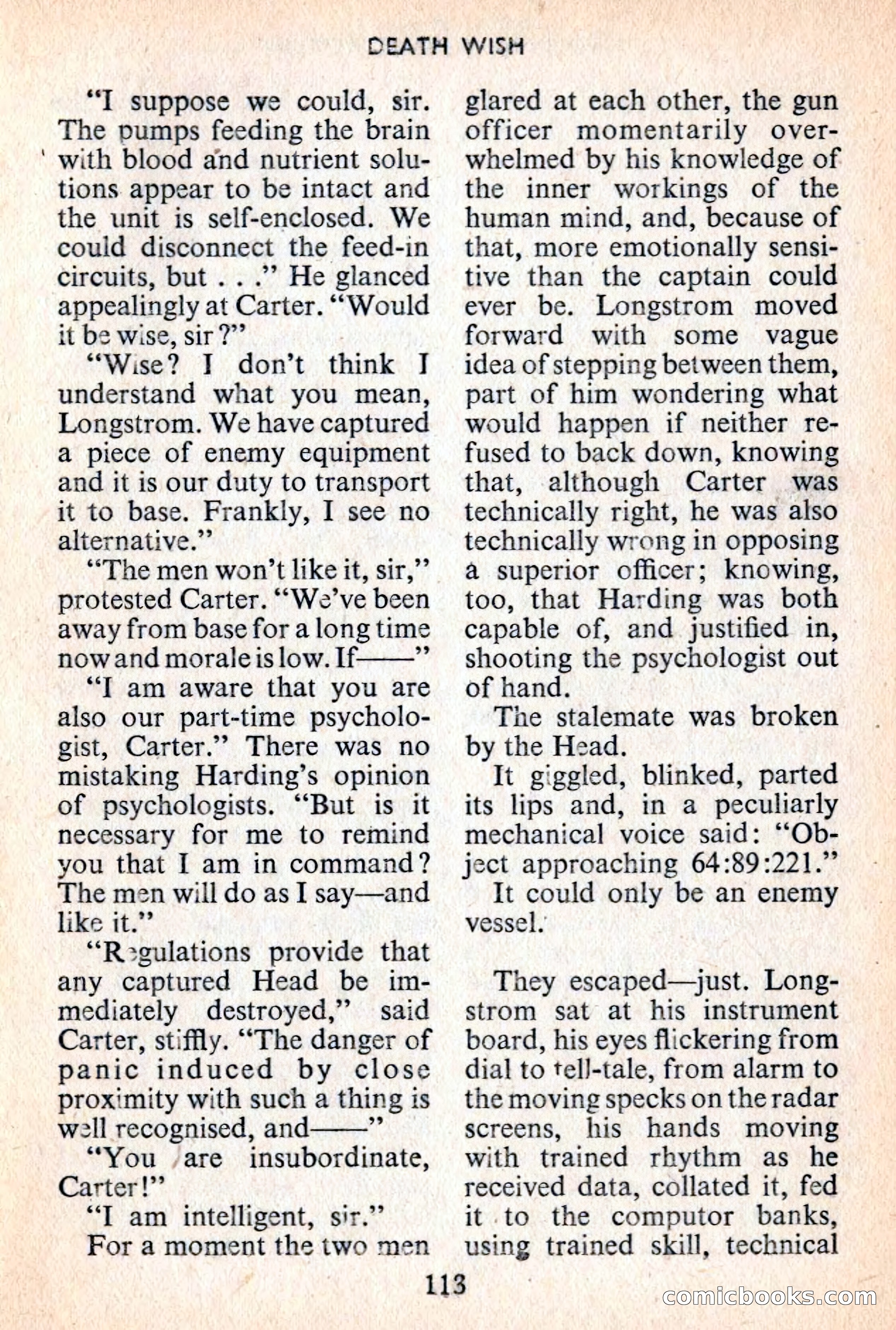
A restored page from Pulp Fiction, 1955. Page through the whole issue in the reader above.
📄 Transcribed text from this page (OCR, searchable)
Machine-transcribed from the original scan — historical spelling and the odd misread are preserved.
DEATH WISH “I suppose we could, sir. The pumps feeding the brain ‘ with blood and nutrient solu- tions appear to be intact and the unit is self-enclosed. We could disconnect the feed-in circuits, but . . .”” He glanced appealingly at Carter. ““Would it be wise, sir ?”’ “Wise? I don’t think I understand what you mean, Longstrom. We have captured a piece of enemy equipment and it is our duty to transport it to base. Frankly, I see no alternative.” “The men won’t like it, sir,”’ protested Carter. ““We’ve been away from base for a long time now and morale is low. If——’”’ “IT am aware that you are also our part-time psycholo- gist, Carter.”’ There was no mistaking Harding’s opinion of psychologists. “But is it necessary for me to remind you that I am in command? The men will do as I say—and like it.” “Regulations provide that any captured Head be im- mediately destroyed,” said Carter, stiffly. “The danger of panic induced by close proximity with such a thing is well recognised, and———”’ “You /are insubordinate, Carter!” “IT am intelligent, sir.” For a moment the two men 113 glared at each other, the gun officer momentarily over- whelmed by his knowledge of the inner workings of the human mind, and, because of that, more emotionally sensi- tive than the captain could ever be. Longstrom moved forward with some vague idea of stepping between them, part of him wondering what would happen if neither re- fused to back down, knowing that, although Carter was technically right, he was also technically wrong in opposing a superior officer; knowing, too, that Harding was both capable of, and justified in, shooting the psychologist out of hand. The stalemate was broken by the Head. It giggled, blinked, parted its lips and, in a peculiarly mechanical voice said: “‘Ob- ject approaching 64:89:221.” It could only be an enemy vessel. They escaped—just. Long- strom sat at his instrument board, his eyes flickering from dial to telJ-tale, from alarm to the moving specks on the radar screens, his hands moving with trained rhythm as he received data, collated it, fed it .to the computor banks, using trained skill, technical conniclooolkks.com