
Pulp Fiction, 1955 · page 110 of 146
Authentic Science Fiction Monthly No. 54 — page 110: what you’re looking at
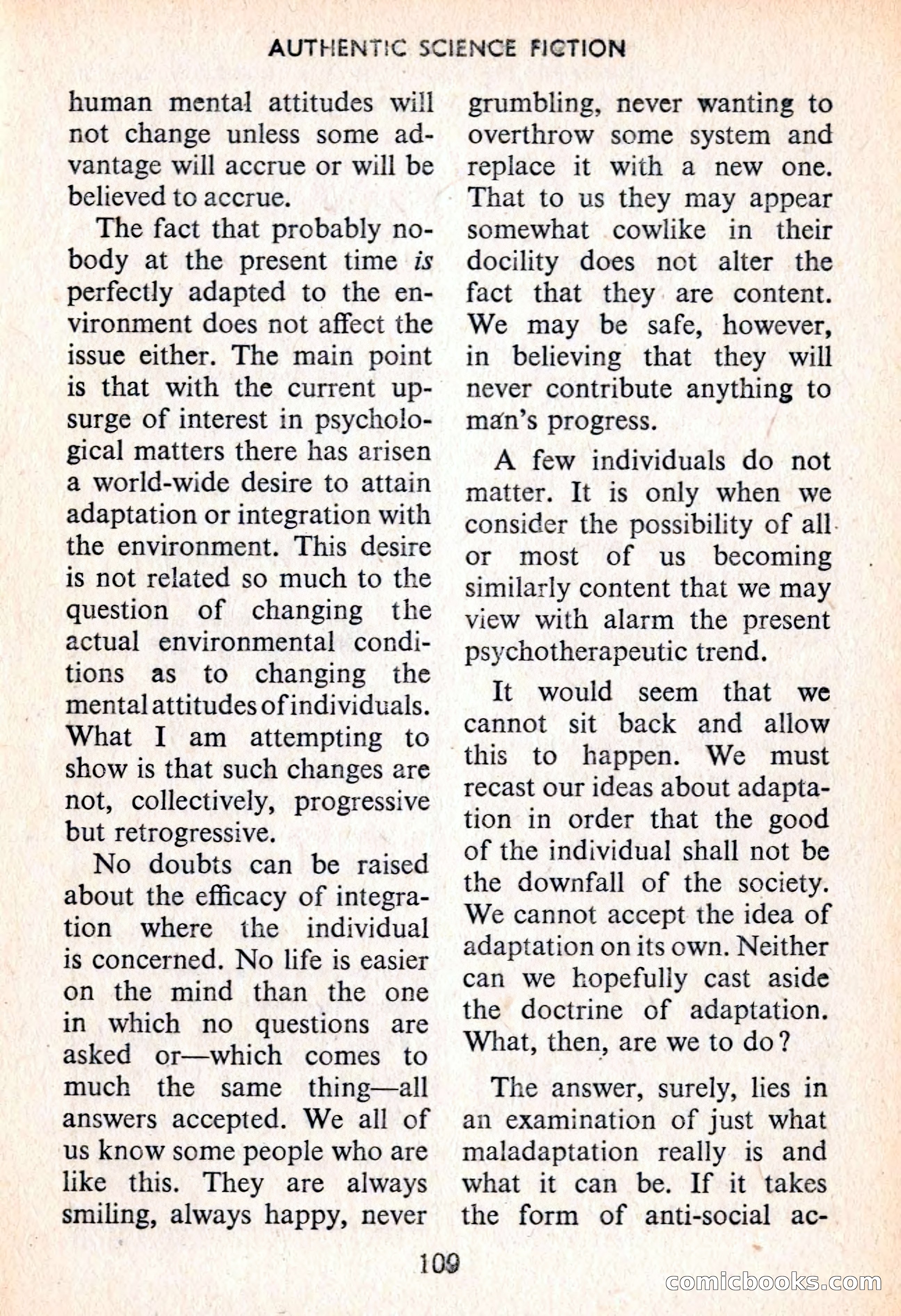
A restored page from Pulp Fiction, 1955. Page through the whole issue in the reader above.
📄 Transcribed text from this page (OCR, searchable)
Machine-transcribed from the original scan — historical spelling and the odd misread are preserved.
AUTHENTIC SCIENCE FICTION human mental attitudes will not change unless some ad- vantage will accrue or will be believed to accrue. The fact that probably no- body at the present time is perfectly adapted to the en- vironment does not affect the issue either. The main point is that with the current up- surge of interest in psycholo- gical matters there has arisen a world-wide desire to attain adaptation or integration with the environment. This desire is not related so much to the question of changing the actual environmental condi- tions as to changing the mental attitudes of individuals. What I am attempting to show is that such changes are not, collectively, progressive but retrogressive. No doubis can be raised about the efficacy of integra- tion where the individual is concerned. No life is easier on the mind than the one in which no questions are asked or—which comes to much the same _ thing—all answers accepted. We all of us know some people who are like this. They are always smiling, always happy, never 109 grumbling, never wanting to overthrow some system and replace it with a new one. That to us they may appear somewhat cowlike in their docility does not alter the fact that they are content. We may be safe, however, in believing that they will never contribute anything to man’s progress. A few individuals do not matter. It is only when we consider the possibility of all. or most of us becoming similarly content that we may view with alarm the present psychotherapeutic trend. It would seem that we cannot sit back and allow this to happen. We must recast our ideas about adapta- tion in order that the good of the individual shall not be the downfall of the society. We cannot accept the idea of adaptation on its own. Neither can we hopefully cast aside the doctrine of adaptation. What, then, are we to do? The answer, surely, lies in an examination of just what maladaptation really is and what it can be. If it takes the form of anti-social ac- comicloooks.conm