
Pulp Fiction, 1954 · page 96 of 146
Authentic Science Fiction Monthly No. 52 — page 96: what you’re looking at
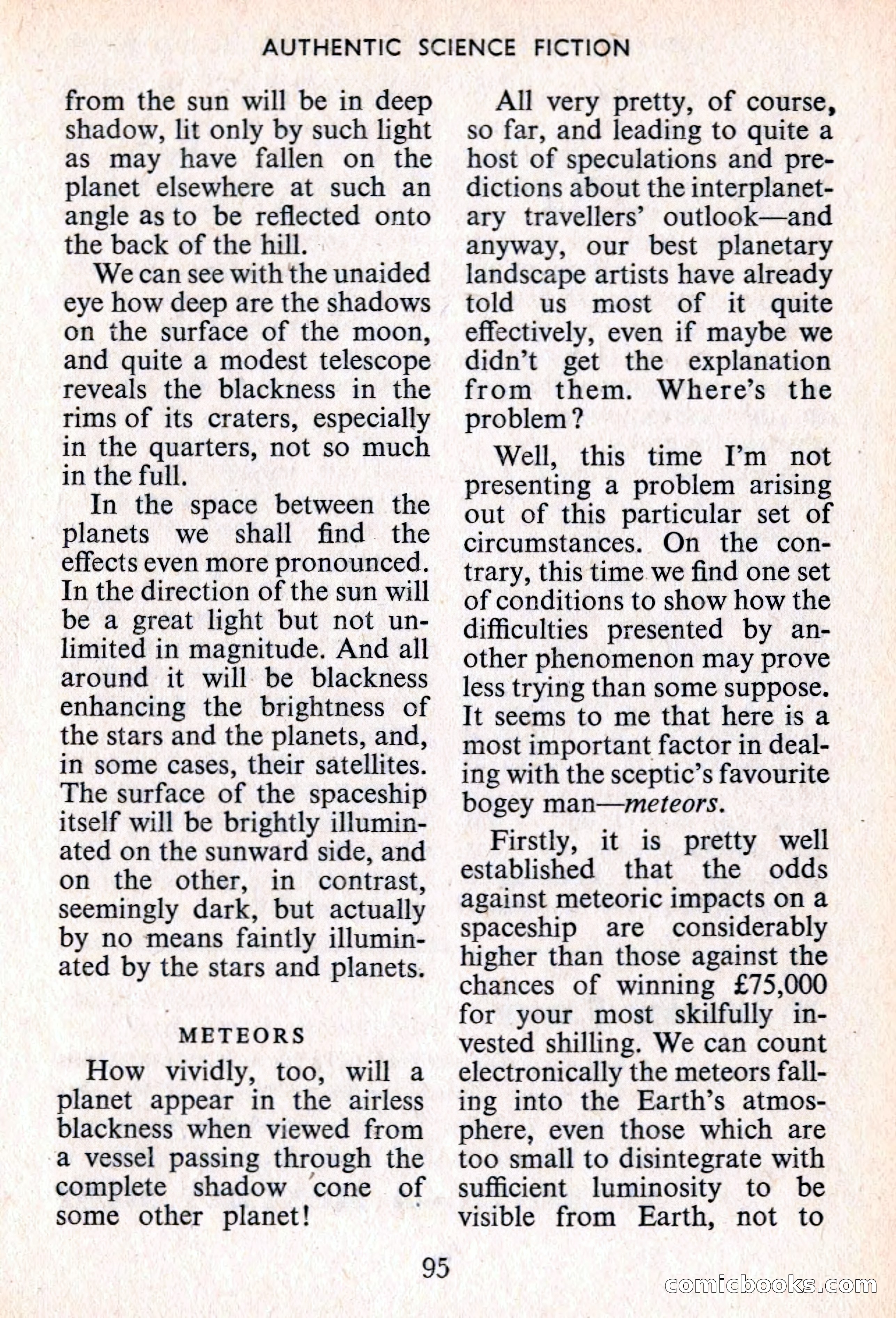
A restored page from Pulp Fiction, 1954. Page through the whole issue in the reader above.
📄 Transcribed text from this page (OCR, searchable)
Machine-transcribed from the original scan — historical spelling and the odd misread are preserved.
AUTHENTIC SCIENCE FICTION from the sun will be in deep shadow, lit only by such light as may have fallen on the planet elsewhere at such an angle as to be reflected onto the back of the hill. - We can see with the unaided eye how deep are the shadows on the surface of the moon, and quite a modest telescope reveals the blackness in the rims of its craters, especially in the quarters, not so much in the full. In the space between the planets we shall find the effects even more pronounced. In the direction of the sun will be a great light but not un- limited in magnitude. And all around it will be blackness enhancing the brightness of the stars and the planets, and, in some cases, their satellites. The surface of the spaceship itself will be brightly illumin- ated on the sunward side, and on the other, in contrast, seemingly dark, but actually by no means faintly illumin- ated by the stars and planets. METEORS How vividly, too, will a planet appear in the airless blackness when viewed from a vessel passing through the complete shadow ‘cone of some other planet! 95 All very pretty, of course, so far, and leading to quite a host of speculations and pre- dictions about the interplanet- ary travellers’ outlook—and anyway, our best planetary landscape artists have already told us most of it quite effectively, even if maybe we didn’t get the explanation from them. Where’s the problem ? Well, this time I’m not presenting a problem arising out of this particular set of circumstances. On the con- — trary, this time we find one set of conditions to show how the difficulties presented by an- other phenomenon may prove less trying than some suppose. It seems to me that here is a most important factor in deal- ing with the sceptic’s favourite bogey man—ymeteors. Firstly, it is pretty well established that the odds against meteoric impacts on a spaceship are considerably higher than those against the chances of winning £75,000 for your most skilfully in- vested shilling. We can count electronically the meteors fall- ing into the Earth’s atmos- phere, even those which are too small to disintegrate with sufficient luminosity to be visible from Earth, not to comiclbooks.corn