
Pulp Fiction, 1954 · page 48 of 146
Authentic Science Fiction Monthly No. 52 — page 48: what you’re looking at
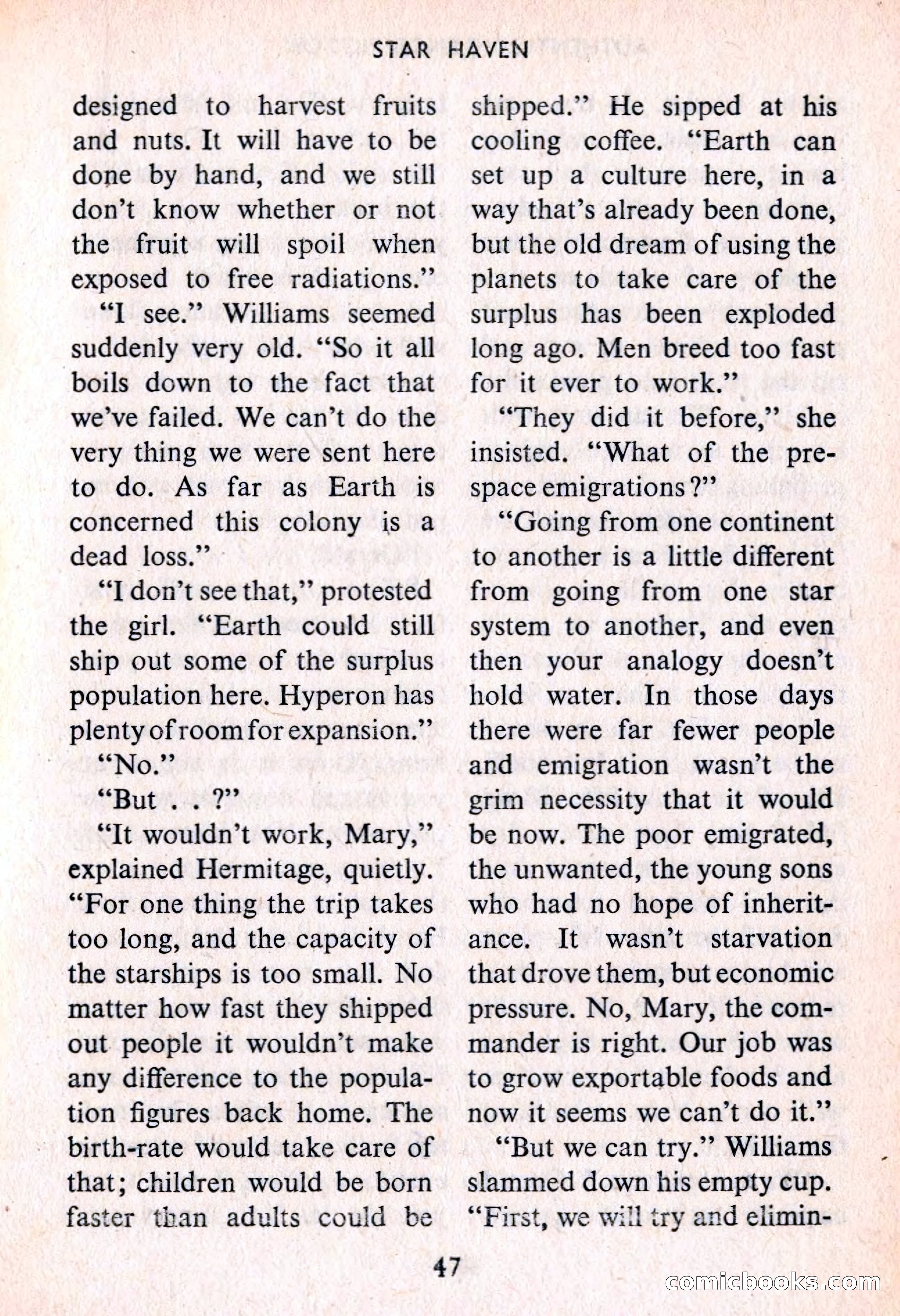
A restored page from Pulp Fiction, 1954. Page through the whole issue in the reader above.
📄 Transcribed text from this page (OCR, searchable)
Machine-transcribed from the original scan — historical spelling and the odd misread are preserved.
STAR HAVEN designed to harvest fruits and nuts. It will have to be done by hand, and we still don’t know whether or not the fruit will spoil when exposed to free radiations.” “I see.’ Williams seemed suddenly very old. “So it all boils down to the fact that we’ve failed. We can’t do the very thing we were sent here to do. As far as Earth is concerned this colony is a dead loss.” “I don’t see that,”’ protested the girl. “Earth could still ship out some of the surplus population here. Hyperon has plenty of room for expansion.” “No.” “Buti ch?" “It wouldn’t work, Mary,” explained Hermitage, quietly. “For one thing the trip takes too long, and the capacity of the starships is too small. No matter how fast they shipped out people it wouldn’t make any difference to the popula- tion figures back home. The _ birth-rate would take care of that; children would be born faster than adults could be 47 shipped.” He sipped at his cooling coffee. “Earth can set up a culture here, in a way that’s already been done, but the old dream of using the planets to take care of the surplus has been exploded long ago. Men breed too fast for it ever to work.” “They did it before,” she insisted. ““What of the pre- space emigrations ?”’ “Going from one continent to another is a little different from going from one star system to another, and even then your analogy doesn’t hold water. In those days there were far fewer people and emigration wasn’t the grim necessity that it would be now. The poor emigrated, the unwanted, the young sons who had no hope of inherit- ance. It wasn’t starvation that drove them, but economic pressure. No, Mary, the com- mander is right. Our job was to grow exportable foods and now it seems we can’t do it.” “But we can try.’’ Williams slammed down his empty cup. “First, we will try and elimin- connicloooks.con