
Pulp Fiction, 1954 · page 45 of 146
Authentic Science Fiction Monthly No. 52 — page 45: what you’re looking at
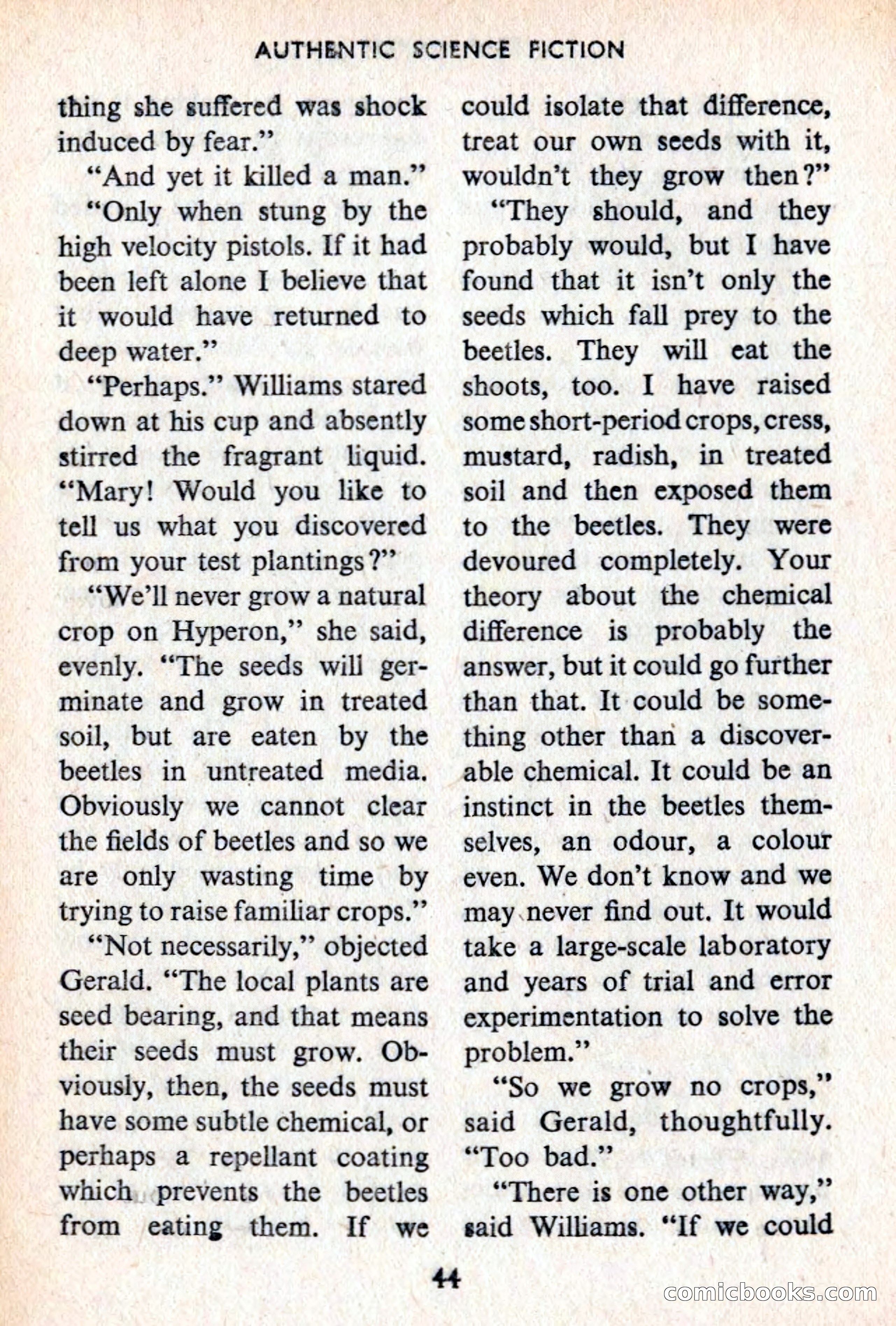
A restored page from Pulp Fiction, 1954. Page through the whole issue in the reader above.
📄 Transcribed text from this page (OCR, searchable)
Machine-transcribed from the original scan — historical spelling and the odd misread are preserved.
AUTHENTIC SCIENCE FICTION thing she suffered was shock induced by fear.” “And yet it killed a man.” “Only when stung by the high velocity pistols. If it had been left alone I believe that it would have returned to deep water.” *“‘Perhaps.”’ Williams stared down at his cup and absently stirred the fragrant liquid. *‘Mary! Would you like to tell us what you discovered from your test plantings?” **“We’ll never grow a natural crop on Hyperon,” she said, evenly. “The seeds will ger- minate and grow in treated soil, but are eaten by the beetles in untreated media. Obviously we cannot clear the fields of beetles and so we are only wasting time by trying to raise familiar crops.” “Not necessarily,” objected Gerald. “‘The local plants are seed bearing, and that means their seeds must grow. Ob- viously, then, the seeds must have some subtle chemical, or perhaps a repellant coating which, prevents the beetles from eating them. If we could isolate that difference, treat our own seeds with it, wouldn’t they grow then?” “They should, and they probably would, but I have found that it isn’t only the seeds which fall prey to the beetles. They will eat the shoots, too. I have raised some short-period crops, cress, mustard, radish, in treated soil and then exposed them to the beetles. They were devoured completely. Your theory about the chemical difference is probably the answer, but it could go further than that. It could be some- thing other than a discover- able chemical. It could be an instinct in the beetles them- selves, an odour, a colour even. We don’t know and we may-.never find out. It would take a large-scale laboratory and years of trial and error experimentation to solve the problem.” “So we grow no crops,” said Gerald, thoughtfully. “Too bad.” “There is one other way,” said Williams. “If we could comiclbooks.conn