
Pulp Fiction, 1954 · page 133 of 146
Authentic Science Fiction Monthly No. 52 — page 133: what you’re looking at
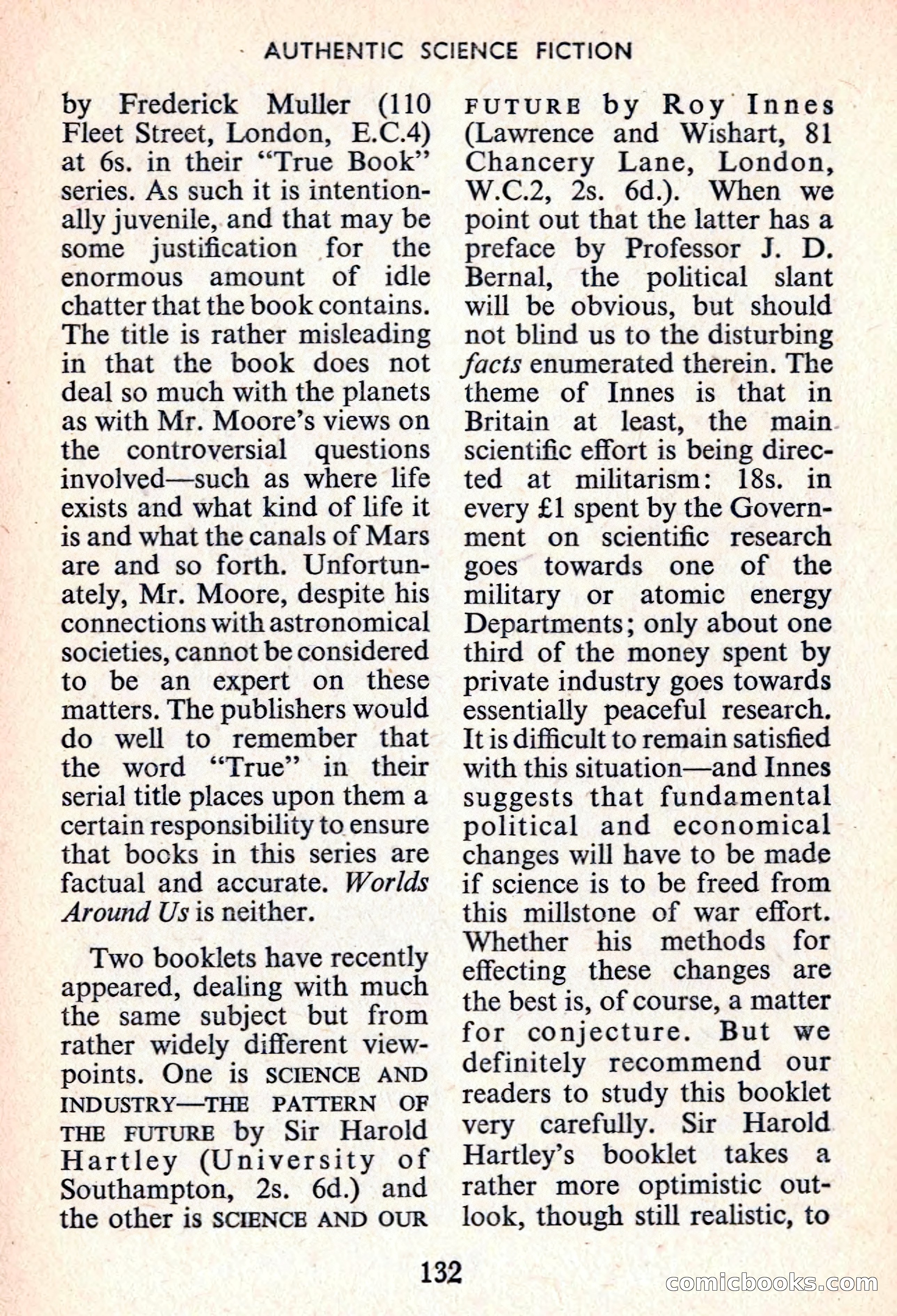
A restored page from Pulp Fiction, 1954. Page through the whole issue in the reader above.
📄 Transcribed text from this page (OCR, searchable)
Machine-transcribed from the original scan — historical spelling and the odd misread are preserved.
- AUTHENTIC SCIENCE FICTION by Frederick Muller (110 Fleet Street, London, E.C.4) at 6s. in their ““True Book’”’ series. As such it is intention- ally juvenile, and that may be some justification for the enormous amount of idle chatter that the book contains. The title is rather misleading in that the book does not deal so much with the planets as with Mr. Moore’s views on the controversial questions involved—such as where life exists and what kind of life it is and what the canals of Mars are and so forth. Unfortun- ately, Mr. Moore, despite his connections with astronomical societies, cannot be considered to be an expert on these matters. The publishers would do well to remember that the word “True” in their serial title places upon them a certain responsibility to ensure that bocks in this series are factual and accurate. Worlds Around Us is neither. Two booklets have recently appeared, dealing with much the same subject but from rather widely different view- points. One is SCIENCE AND INDUSTRY—THE PATTERN OF THE FUTURE by Sir Harold Hartley (University of Southampton, 2s. 6d.) and the other is SCIENCE AND OUR 132 FUTURE by Roy Innes (Lawrence and Wishart, 81 Chancery Lane, London, W.C.2, 2s. 6d.). When we point out that the latter has a preface by Professor J. D. Bernal, the political slant will be obvious, but should not blind us to the disturbing facts enumerated therein. The theme of Innes is that in Britain at least, the main scientific effort is being direc- ted at militarism: 18s. in every £1 spent by the Govern- ment on scientific research goes towards one of the military or atomic energy Departments; only about one third of the money spent by private industry goes towards essentially peaceful research. It is difficult to remain satisfied with this situation—and Innes suggests that fundamental political and economical changes will have to be made if science is to be freed from this millstone of war effort. Whether his methods for effecting these changes are the best is, of course, a matter for conjecture. But we definitely recommend our readers to study this booklet very carefully. Sir Harold Hartley’s booklet takes a rather more optimistic out- look, though still realistic, to comiclooks.cormn