
Pulp Fiction, 1954 · page 91 of 146
Authentic Science Fiction Monthly No. 50 — page 91: what you’re looking at
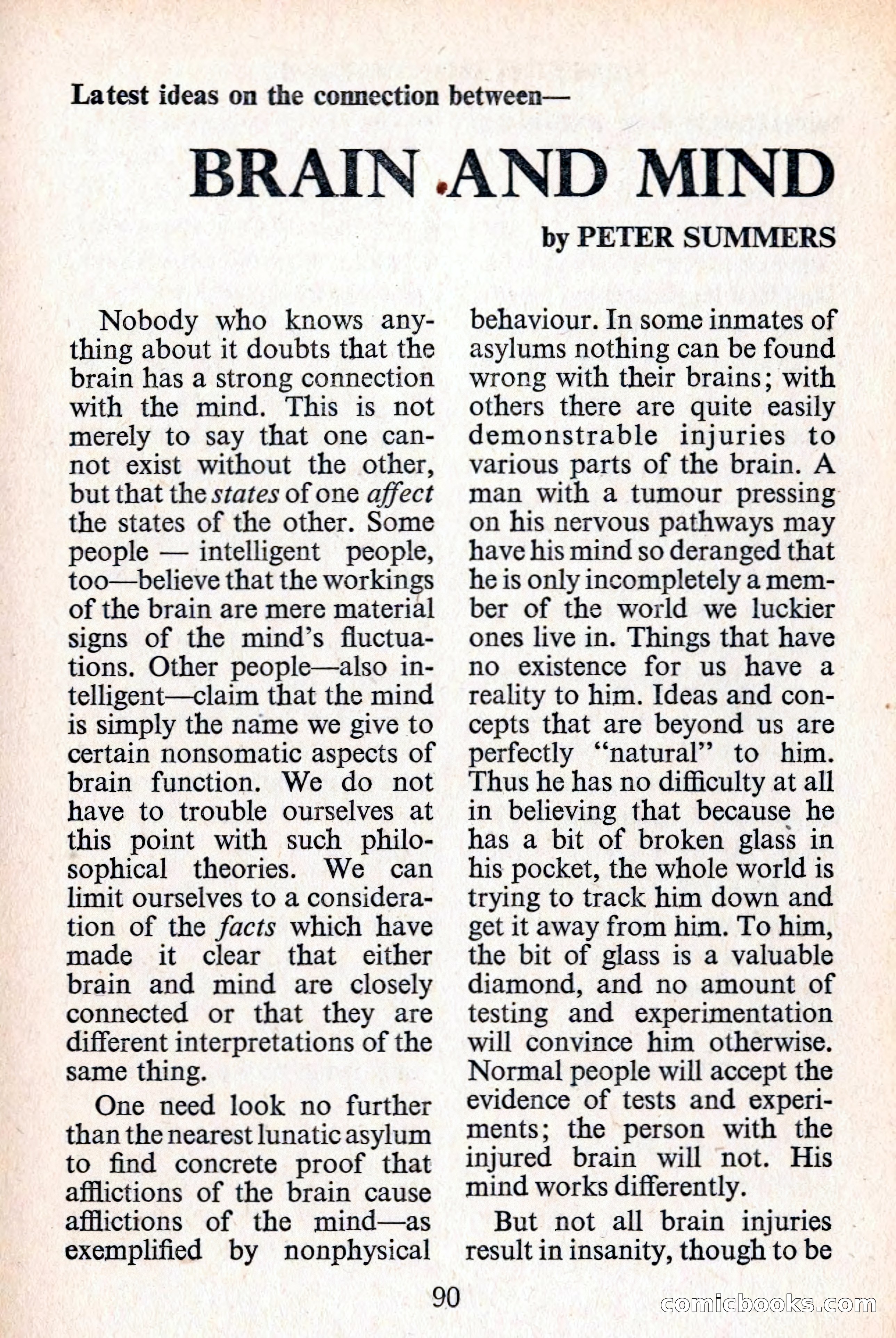
A restored page from Pulp Fiction, 1954. Page through the whole issue in the reader above.
📄 Transcribed text from this page (OCR, searchable)
Machine-transcribed from the original scan — historical spelling and the odd misread are preserved.
Latest ideas on the connection between— BRAIN AND MIND Nobody who knows any- thing about it doubts that the brain has a strong connection with the mind. This is not merely to say that one can- not exist without the other, but that the states of one affect the states of the other. Some people — intelligent people, too—believe that the workings of the brain are mere material signs of the mind’s fluctua- tions. Other people—also in- telligent—claim that the mind is simply the name we give to certain nonsomatic aspects of brain function. We do not have to trouble ourselves at this point with such philo- sophical theories. We can limit ourselves to a considera- tion of the facts which have made it clear that either brain and mind are closely connected or that they are different interpretations of the same thing. One need look no further than the nearest lunatic asylum to find concrete proof that afflictions of the brain cause afflictions of the mind—as exemplified by nonphysical 90 by PETER SUMMERS behaviour. In some inmates of asylums nothing can be found wrong with their brains; with others there are quite easily demonstrable injuries to various parts of the brain. A man with a tumour pressing on his nervous pathways may have his mind so deranged that he is only incompletely a mem- ber of the world we luckier ones live in. Things that have no existence for us have a reality to him. Ideas and con- cepts that are beyond us are perfectly ‘“‘natural’’ to him. Thus he has no difficulty at all in believing that because he has a bit of broken glass in his pocket, the whole world is trying to track him down and get it away from him. To him, the bit of glass is a valuable diamond, and no amount of testing and experimentation will convince him otherwise. Normal people will accept the evidence of tests and experi- ments; the person with the injured brain will not. His mind works differently. But not all brain injuries result in insanity, though to be conmicloooks.conm