
Pulp Fiction, 1954 · page 130 of 146
Authentic Science Fiction Monthly No. 50 — page 130: what you’re looking at
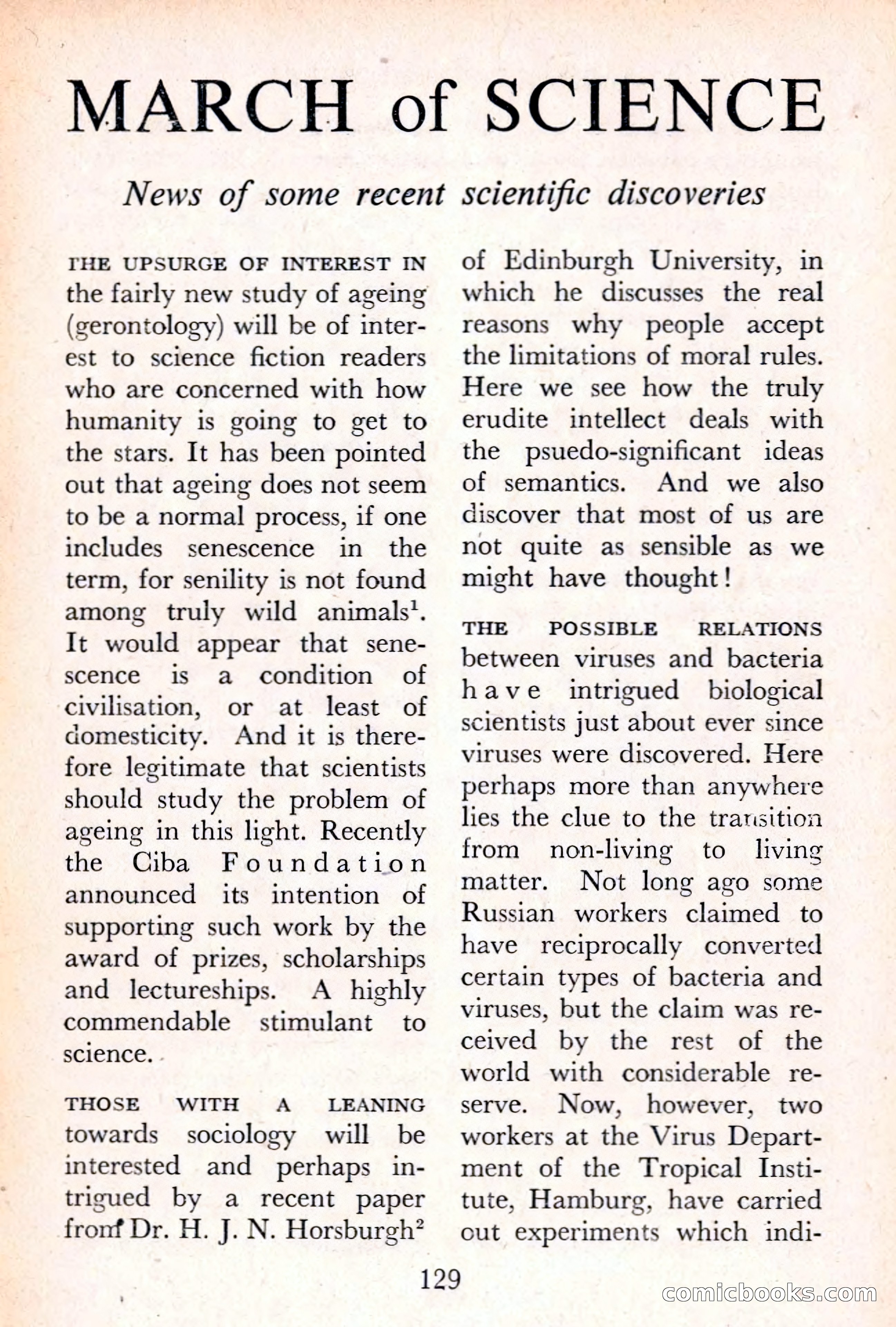
A restored page from Pulp Fiction, 1954. Page through the whole issue in the reader above.
📄 Transcribed text from this page (OCR, searchable)
Machine-transcribed from the original scan — historical spelling and the odd misread are preserved.
MARCH of SCIENCE News of some recent scientific discoveries THE UPSURGE OF INTEREST IN the fairly new study of ageing (gerontology) will be of inter- est to science fiction readers who are concerned with how humanity is going to get to the stars. It has been pointed out that ageing does not seem to be a normal process, if one includes senescence in the term, for senility is not found among truly wild animals’. It would appear that sene- scence is a condition of civilisation, or at least of domesticity. And it is there- fore legitimate that scientists should study the problem of ageing in this light. Recently the Ciba Foundation announced its intention of supporting such work by the award of prizes, scholarships and lectureships. <A _ highly commendable stimulant to science. THOSE WITH A_ LEANING towards sociology will be interested and perhaps in- trigued by a recent paper fronf Dr. H. J. N. Horsburgh? 129 of Edinburgh University, in which he discusses the real reasons why people accept the limitations of moral rules. Here we see how the truly erudite intellect deals with the psuedo-significant ideas of semantics. And we also discover that most of us are not quite as sensible as we might have thought! THE POSSIBLE RELATIONS between viruses and bacteria have intrigued biological scientists just about ever since viruses were discovered. Here perhaps more than anywhere lies the clue to the transition from non-living to living matter. Not long ago some Russian workers claimed to have reciprocally converted certain types of bacteria and viruses, but the claim was re- ceived by the rest of the world with considerable re- serve. Now, however, two workers at the Virus Depart- ment of the Tropical Insti- tute, Hamburg, have carried out experiments which indi- comicloooks.com