
Pulp Fiction, 1954 · page 113 of 146
Authentic Science Fiction Monthly No. 50 — page 113: what you’re looking at
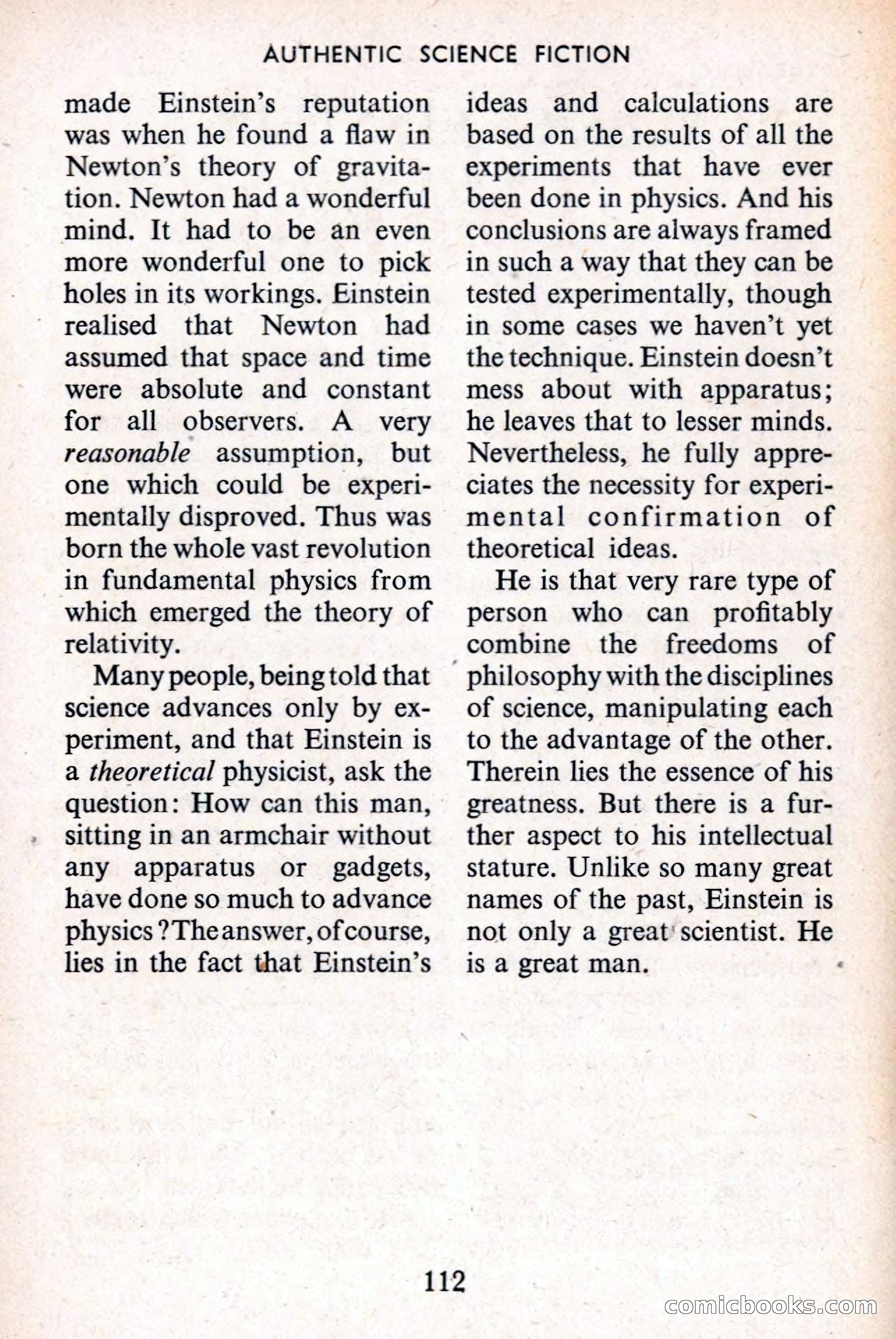
A restored page from Pulp Fiction, 1954. Page through the whole issue in the reader above.
📄 Transcribed text from this page (OCR, searchable)
Machine-transcribed from the original scan — historical spelling and the odd misread are preserved.
AUTHENTIC SCIENCE FICTION made Einstein’s reputation was when he found a flaw in Newton’s theory of gravita- tion. Newton had a wonderful mind. It had to be an even more wonderful one to pick holes in its workings. Einstein realised that Newton had assumed that space and time were absolute and constant for all observers. A very reasonable assumption, but one which could be experi- mentally disproved. Thus was born the whole vast revolution in fundamental physics from which emerged the theory of relativity. Many people, being told that science advances only by ex- periment, and that Einstein is a theoretical physicist, ask the question: How can this man, sitting in an armchair without any apparatus or gadgets, have done so much to advance physics ?Theanswer, ofcourse, lies in the fact that Einstein’s 112 ideas and calculations are based on the results of all the experiments that have ever been done in physics. And his conclusions are always framed in such a way that they can be tested experimentally, though in some cases we haven’t yet the technique. Einstein doesn’t mess about with apparatus; he leaves that to lesser minds. Nevertheless, he fully appre- ciates the necessity for experi- mental confirmation of theoretical ideas. He is that very rare type of person who can profitably combine the freedoms of - philosophy with the disciplines of science, manipulating each to the advantage of the other. Therein lies the essence of his greatness. But there is a fur- ther aspect to his intellectual stature. Unlike so many great names of the past, Einstein is not only a great'scientist. He is a great man. ‘ comiclooks.corn