
Pulp Fiction, 1954 · page 102 of 146
Authentic Science Fiction Monthly No. 50 — page 102: what you’re looking at
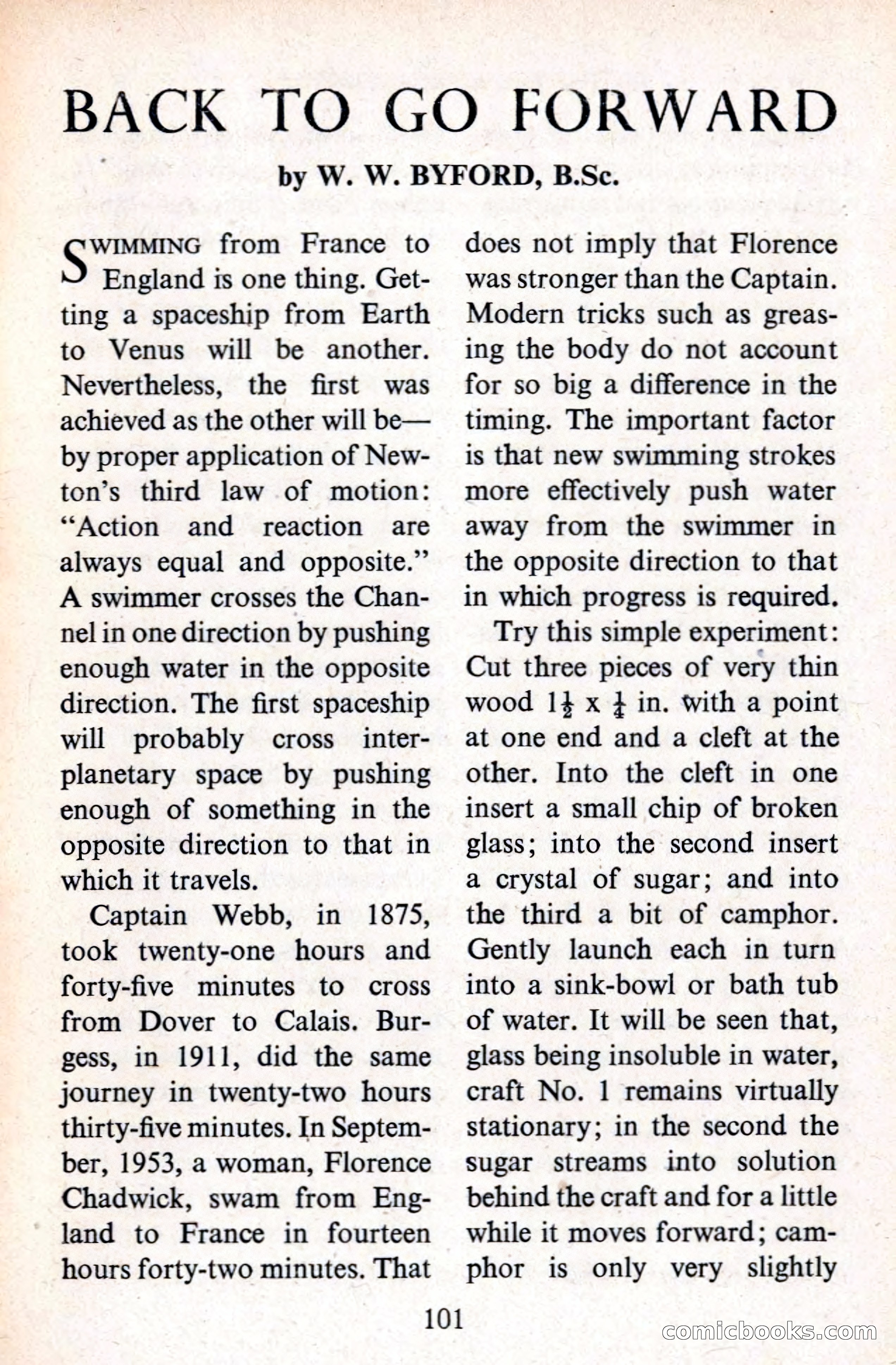
A restored page from Pulp Fiction, 1954. Page through the whole issue in the reader above.
📄 Transcribed text from this page (OCR, searchable)
Machine-transcribed from the original scan — historical spelling and the odd misread are preserved.
BACK TO GO FORWARD by W. W. BYFORD, B.Sc. WIMMING from France to England is one thing. Get- ting a spaceship from Earth to Venus will be another. Nevertheless, the first was achieved as the other will be— by proper application of New- ton’s third law of motion: “Action and reaction are always equal and opposite.” A swimmer crosses the Chan- nel in one direction by pushing enough water in the opposite direction. The first spaceship will probably cross inter- planetary space by pushing enough of something in the opposite direction to that in which it travels. Captain Webb, in 1875, took twenty-one hours and forty-five minutes to cross from Dover to Calais. Bur- gess, in 1911, did the same journey in twenty-two hours thirty-five minutes. In Septem- ber, 1953, a woman, Florence Chadwick, swam from Eng- land to France in fourteen hours forty-two minutes. That 101 does not imply that Florence was stronger than the Captain. Modern tricks such as greas- ing the body do not account for so big a difference in the timing. The important factor is that new swimming strokes more effectively push water away from the swimmer in the opposite direction to that in which progress is required. Try this simple experiment: Cut three pieces of very thin wood 14 x } in. With a point at one end and a cleft at the other. Into the cleft in one insert a small chip of broken glass; into the second insert a crystal of sugar; and into the third a bit of camphor. Gently launch each in turn into a sink-bowl or bath tub of water. It will be seen that, glass being insoluble in water, craft No. 1 remains virtually stationary; in the second the sugar streams into solution behind the craft and for a little while it moves forward; cam- phor is only very slightly comiclbooks.corn