
Pulp Fiction, 1954 · page 65 of 146
Authentic Science Fiction Monthly No. 48 — page 65: what you’re looking at
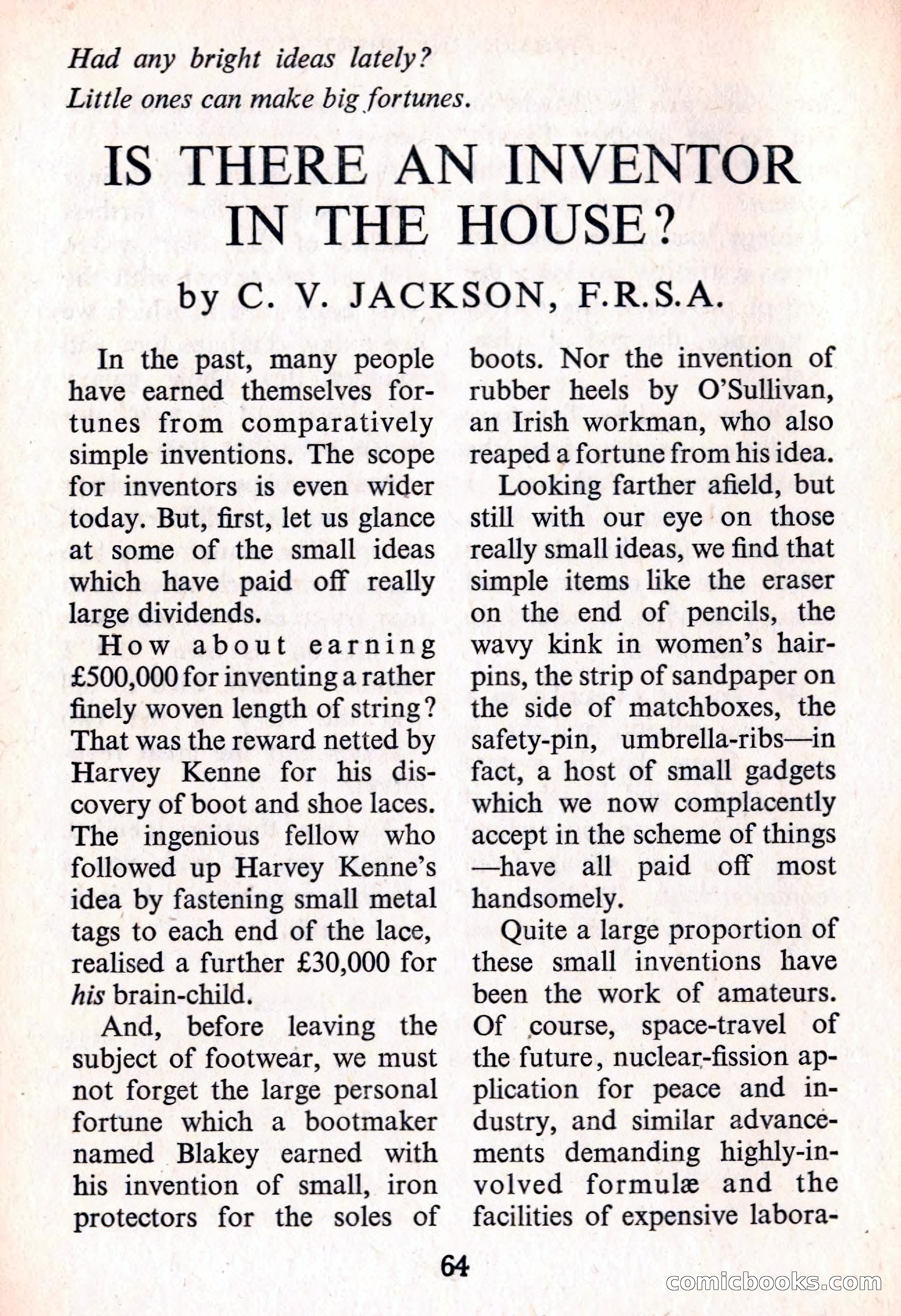
A restored page from Pulp Fiction, 1954. Page through the whole issue in the reader above.
📄 Transcribed text from this page (OCR, searchable)
Machine-transcribed from the original scan — historical spelling and the odd misread are preserved.
Had any bright ideas lately? Little ones can make big fortunes. IS THERE AN INVENTOR IN THE HOUSE? by C. V. JACKSON, F.R.S.A. In the past, many people have earned themselves for- tunes from comparatively simple inventions. The scope for inventors is even wider today. But, first, let us glance at some of the small ideas which have paid off really large dividends. How about earning £500,000 for inventing a rather finely woven length of string? That was the reward netted by Harvey Kenne for his dis- covery of boot and shoe laces. The ingenious fellow who followed up Harvey Kenne’s idea by fastening small metal tags to each end of the lace, realised a further £30,000 for his brain-child. And, before leaving the subject of footwear, we must not forget the large personal fortune which a bootmaker named Blakey earned with his invention of small, iron protectors for the soles of boots. Nor the invention of rubber heels by O’Sullivan, an Irish workman, who also reaped a fortune from his idea. Looking farther afield, but still with our eye on those really small ideas, we find that simple items like the eraser on the end of pencils, the wavy kink in women’s hair- pins, the strip of sandpaper on the side of matchboxes, the safety-pin, umbrella-ribs—in fact, a host of small gadgets which we now complacently accept in the scheme of things —have all paid off most handsomely. Quite a large proportion of these small inventions have been the work of amateurs. Of course, space-travel of the future, nuclear-fission ap- plication for peace and in- dustry, and similar advance- ments demanding highly-in- volved formule and the facilities of expensive labora- comicloooks.com