
Pulp Fiction, 1954 · page 131 of 146
Authentic Science Fiction Monthly No. 48 — page 131: what you’re looking at
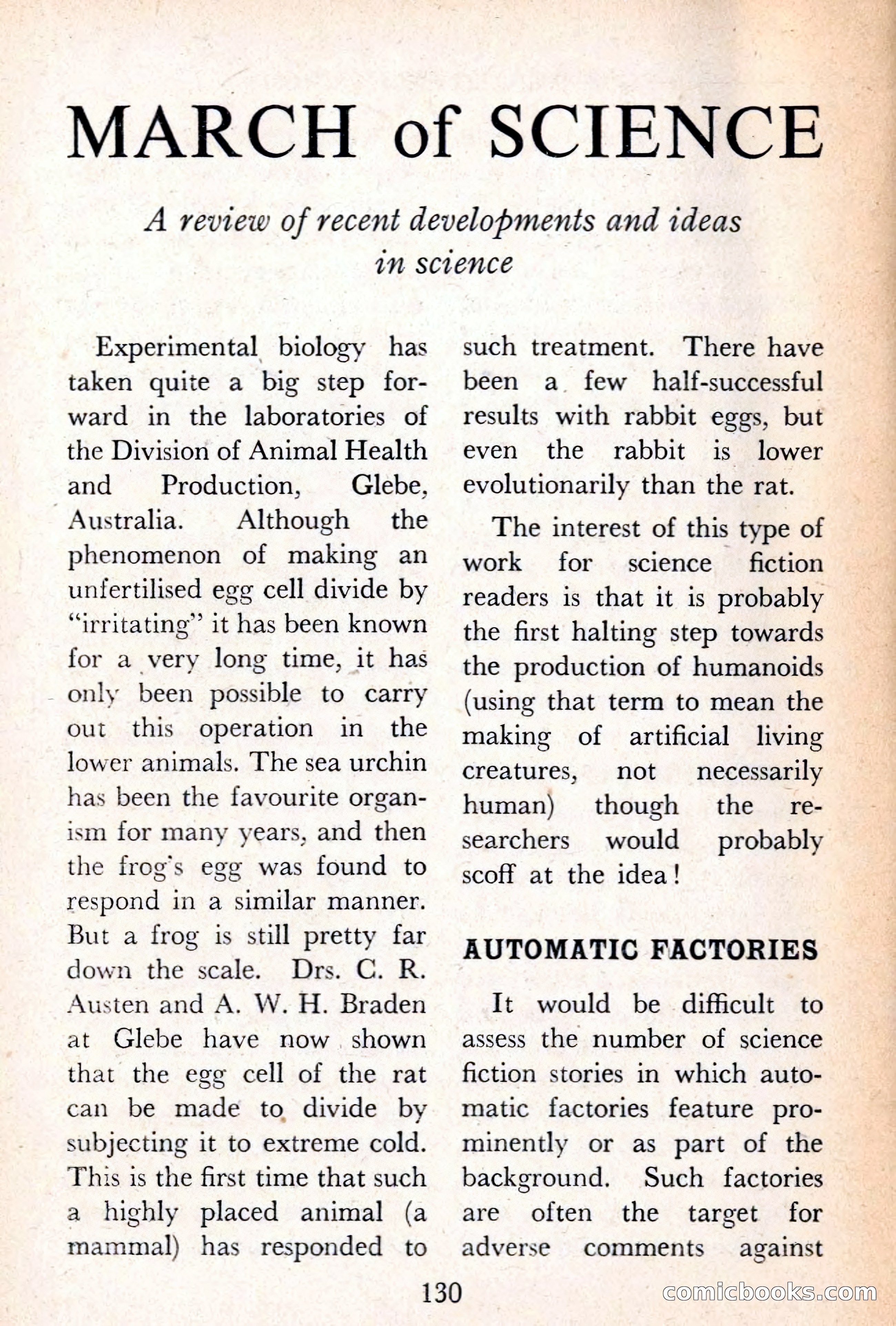
A restored page from Pulp Fiction, 1954. Page through the whole issue in the reader above.
📄 Transcribed text from this page (OCR, searchable)
Machine-transcribed from the original scan — historical spelling and the odd misread are preserved.
MARCH of SCIENCE A review of recent developments and ideas in Science Experimental biology has taken quite a big step for- ward in the laboratories of the Division of Animal Health and __s— Production, Glebe, Australia. Although the phenomenon of making an unfertilised egg cell divide by “irritating” it has been known for a very long time, it has only been possible to carry out this operation in the lower animals. The sea urchin has been the favourite organ- ism for many years, and then the frog’s egg was found to respond in a similar manner. But a frog is still pretty far down the scale. Drs. C. R. Austen and A. W. H. Braden at Glebe have now. shown that the egg cell of the rat can be made to divide by subjecting it to extreme cold. This is the first time that such a highly placed animal (a mammal) has responded to 130 such treatment. There have been a_ few half-successful results with rabbit eggs, but even the rabbit is lower evolutionarily than the rat. The interest of this type of work for science fiction readers is that it is probably the first halting step towards the production of humanoids (using that term to mean the making of artificial living creatures, not necessarily human) though the re- searchers would probably scoff at the idea! AUTOMATIC FACTORIES It would be difficult to assess the number of science fiction stories in which auto- matic factories feature pro- minently or as part of the background. Such factories are often the target for adverse comments against connicloooks. com -—