
Pulp Fiction, 1954 · page 129 of 146
Authentic Science Fiction Monthly No. 48 — page 129: what you’re looking at
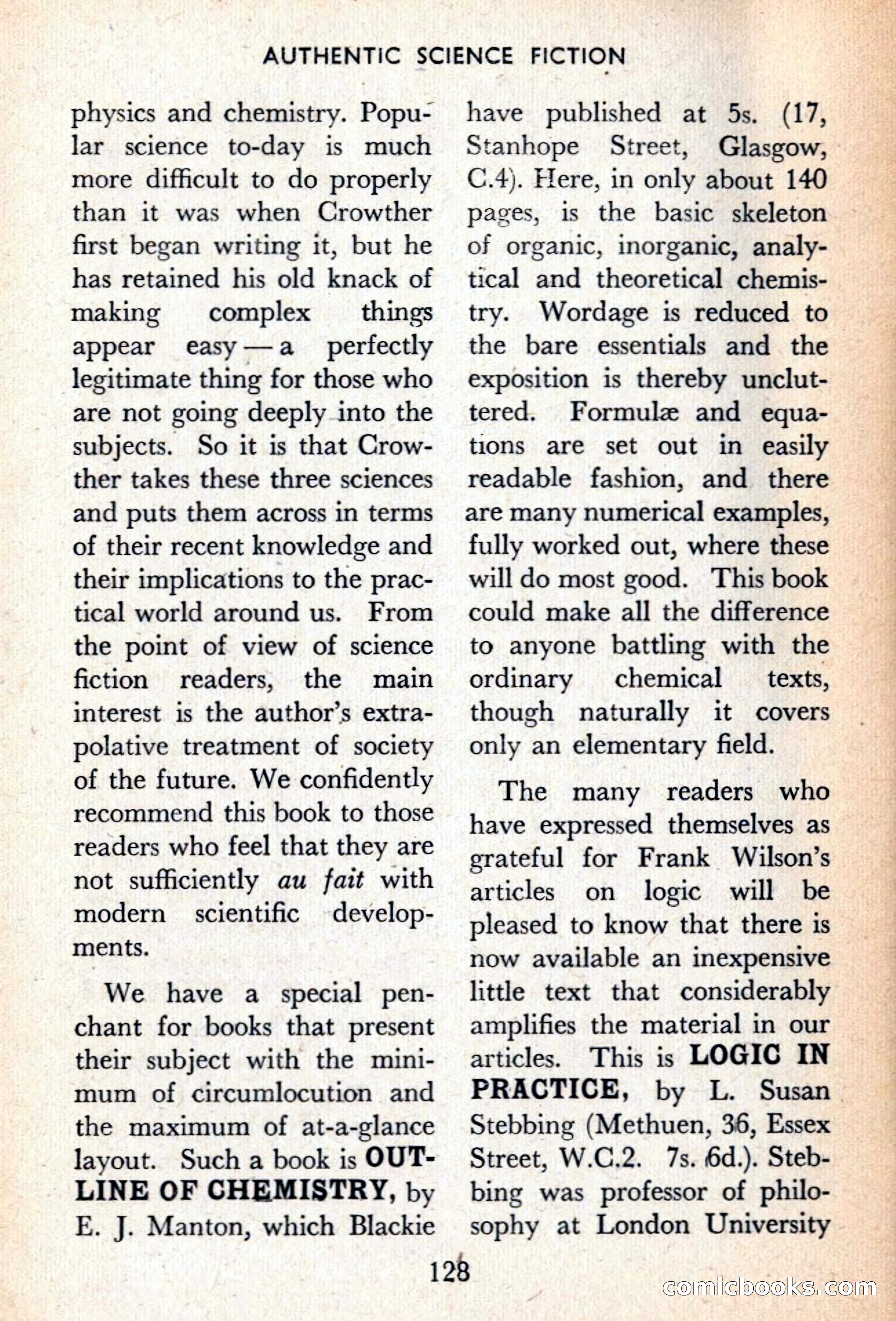
A restored page from Pulp Fiction, 1954. Page through the whole issue in the reader above.
📄 Transcribed text from this page (OCR, searchable)
Machine-transcribed from the original scan — historical spelling and the odd misread are preserved.
AUTHENTIC SCIENCE FICTION physics and chemistry. Popu- lar science to-day is much more difficult to do properly than it was when Crowther first began writing it, but he has retained his old knack of making complex _ things appear easy—a_ perfectly legitimate thing for those who are not going deeply into the subjects. So it is that Crow- ther takes these three sciences and puts them across in terms of their recent knowledge and their implications to the prac- tical world around us. From the point of view of science fiction readers, the main interest is the author’s extra- polative treatment of society of the future. We confidently recommend this book to those readers who feel that they are not sufficiently au fait with modern scientific develop- ments. We have a special pen- chant for books that present their subject with the mini- mum of circumlocution and the maximum of at-a-glance layout. Such a book is OUT- LINE OF CHEMISTRY, by E. J. Manton, which Blackie have published at 5s. (17, Stanhope Street, Glasgow, C.4). Here, in only about 140 pages, is the basic skeleton of organic, inorganic, analy- tical and theoretical chemis- try. Wordage is reduced to the bare essentials and the exposition is thereby unclut- tered. Formule and equa- tions are set out in easily readable fashion, and there are many numerical examples, fully worked out, where these will do most good. This book could make all the difference to anyone battling with the ordinary chemical _ texts, though naturally it covers only an elementary field. The many readers who have expressed themselves as srateful for Frank Wilson’s articles on logic will be pleased to know that there is now available an inexpensive little text that considerably amplifies the material in our articles. This is LOGIC IN PRACTICE, by L. Susan Stebbing (Methuen, 36, Essex Street, W.C.2. 7s. 6d.). Steb- bing was professor of philo- sophy at London University 128 comichbooks.com |