
Pulp Fiction, 1954 · page 64 of 146
Authentic Science Fiction Monthly No. 47 — page 64: what you’re looking at
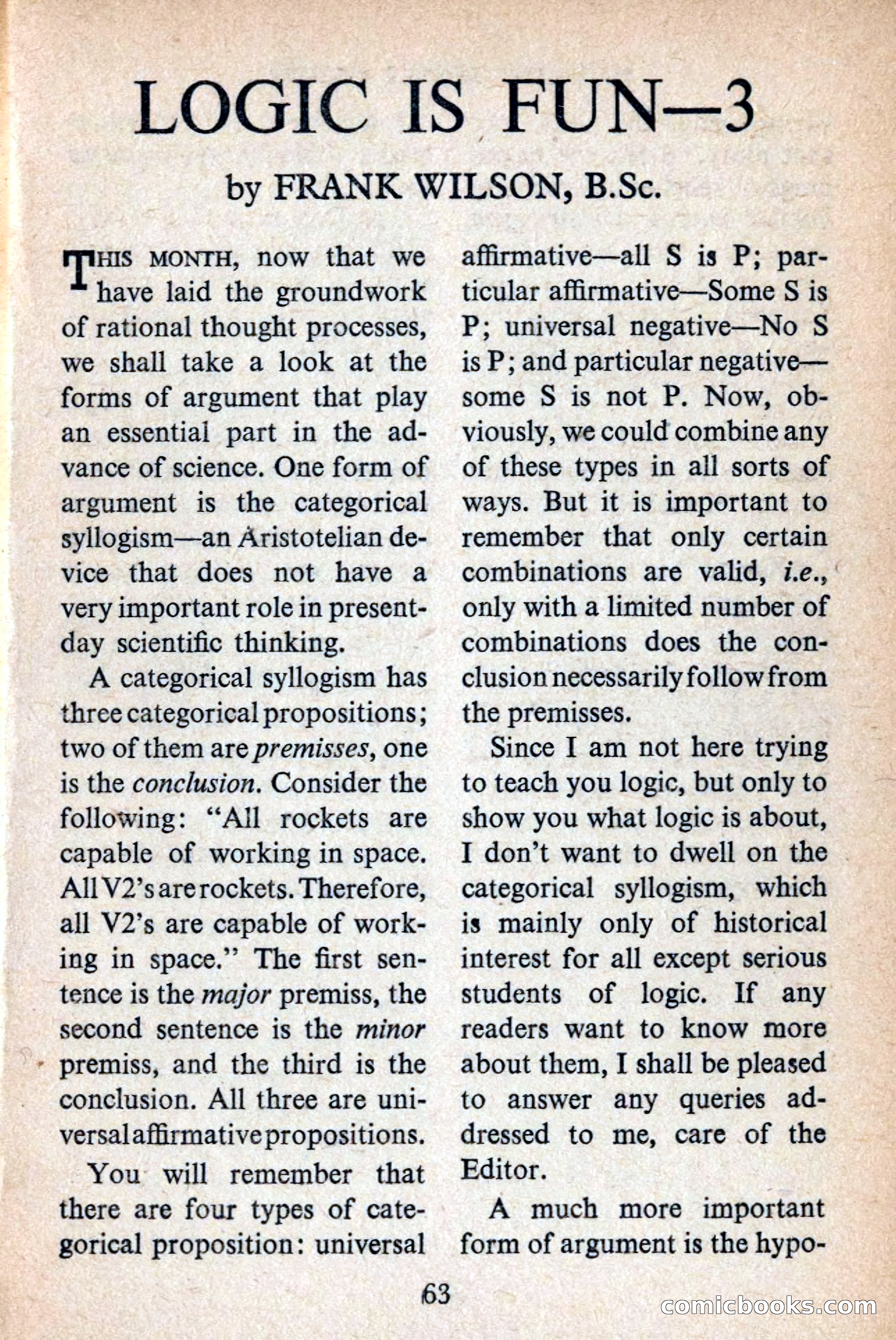
A restored page from Pulp Fiction, 1954. Page through the whole issue in the reader above.
📄 Transcribed text from this page (OCR, searchable)
Machine-transcribed from the original scan — historical spelling and the odd misread are preserved.
LOGIC IS FUN—3 by FRANK WILSON, B.Sc. HIS MONTH, now that we have laid the groundwork of rational thought processes, we shall take a look at the forms of argument that play an essential part in the ad- vance of science. One form of argument is the categorical syllogism—an Aristotelian de- vice that does not have a very important role in present- day scientific thinking. A categorical syllogism has three categorical propositions; two of them are premisses, one is the conclusion. Consider the following: “‘All rockets are capable of working in space. All V2’sarerockets. Therefore, all V2’s are capable of work- ing in space.’ The first sen- tence is the major premiss, the second sentence is the minor * premiss, and the third is the conclusion. All three are uni- versalaffirmative propositions. You will remember that there are four types of cate- gorical proposition: universal 63 affirmative—all S$ is P; par- ticular affirmative—Some § is P; universal negative—No §S is P; and particular negative— some § is not P. Now, ob- viously, we could combine any of these types in all sorts of ways. But it is important to remember that only certain combinations are valid, i.e.,' only with a limited number of combinations does the con- clusion necessarily follow from the premisses. Since I am not here trying to teach you logic, but only to show you what logic is about, I don’t want to dwell on the | categorical syllogism, which is mainly only of historical interest for all except serious students of logic. If any readers want to know more about them, I shall be pleased to answer any queries ad- dressed to me, care of the Editor. A much more important form of argument is the hypo- conniclooolkks.comn)