
Pulp Fiction, 1954 · page 44 of 146
Authentic Science Fiction Monthly No. 47 — page 44: what you’re looking at
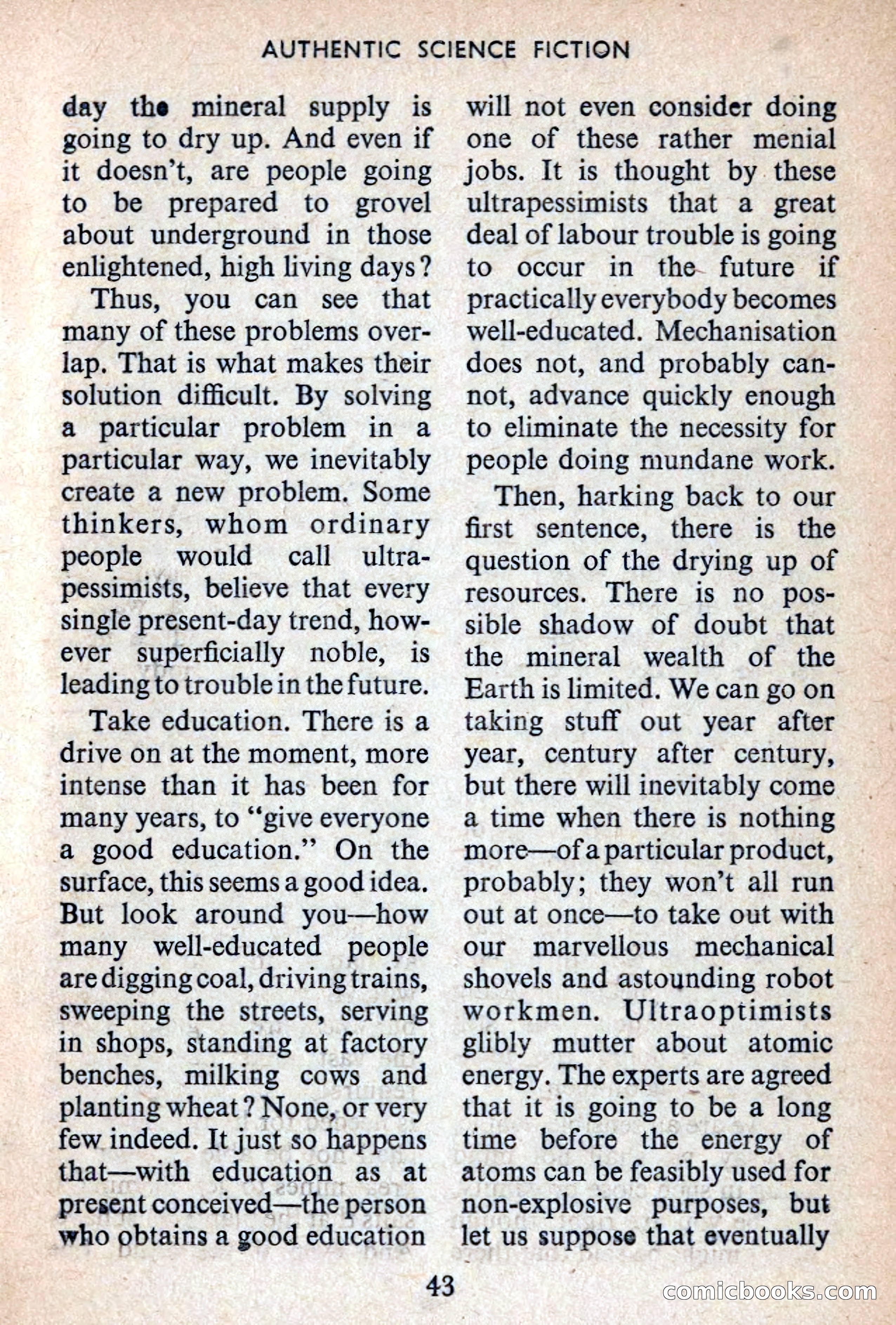
A restored page from Pulp Fiction, 1954. Page through the whole issue in the reader above.
📄 Transcribed text from this page (OCR, searchable)
Machine-transcribed from the original scan — historical spelling and the odd misread are preserved.
AUTHENTIC SCIENCE FICTION day the mineral supply is going to dry up. And even if it doesn’t, are people going to be prepared to grovel about underground in those enlightened, high living days? Thus, you can see that many of these problems over- lap. That is what makes their solution difficult. By solving a particular problem in a particular way, we inevitably create a new problem. Some thinkers, whom ordinary people would call ultra- pessimists, believe that every single present-day trend, how- ever superficially noble, is leading to trouble in the future. Take education. There is a drive on at the moment, more intense than it has been for many years, to “give everyone a good education.’ On the surface, this seems a good idea. But look around you—how many well-educated people are digging coal, driving trains, sweeping the streets, serving in shops, standing at factory benches, milking cows and planting wheat ? None, or very few indeed. It just so happens that—with education as at present conceived—the person who obtains a good education 43 will not even consider doing one of these rather menial jobs. It is thought by. these ultrapessimists that a great deal of labour trouble is going to occur in the future if practically everybody becomes well-educated. Mechanisation does not, and probably can- not, advance quickly enough to eliminate the necessity for people doing mundane work. Then, harking back to our first sentence, there is the question of the drying up of resources. There is no pos- sible shadow of doubt that the mineral wealth of the Earth is limited. We can go on taking stuff out year after year, century after century, but there will inevitably come a time when there is nothing more—ofa particular product, probably; they won’t all run out at once—to take out with our marvellous mechanical shovels and astounding robot workmen. Ultraoptimists glibly mutter about atomic energy. The experts are agreed that it is going to be a long time before the energy of atoms can be feasibly used for non-explosive purposes, but let us suppose that eventually conmicloooks.conn