
Pulp Fiction, 1954 · page 137 of 146
Authentic Science Fiction Monthly No. 47 — page 137: what you’re looking at
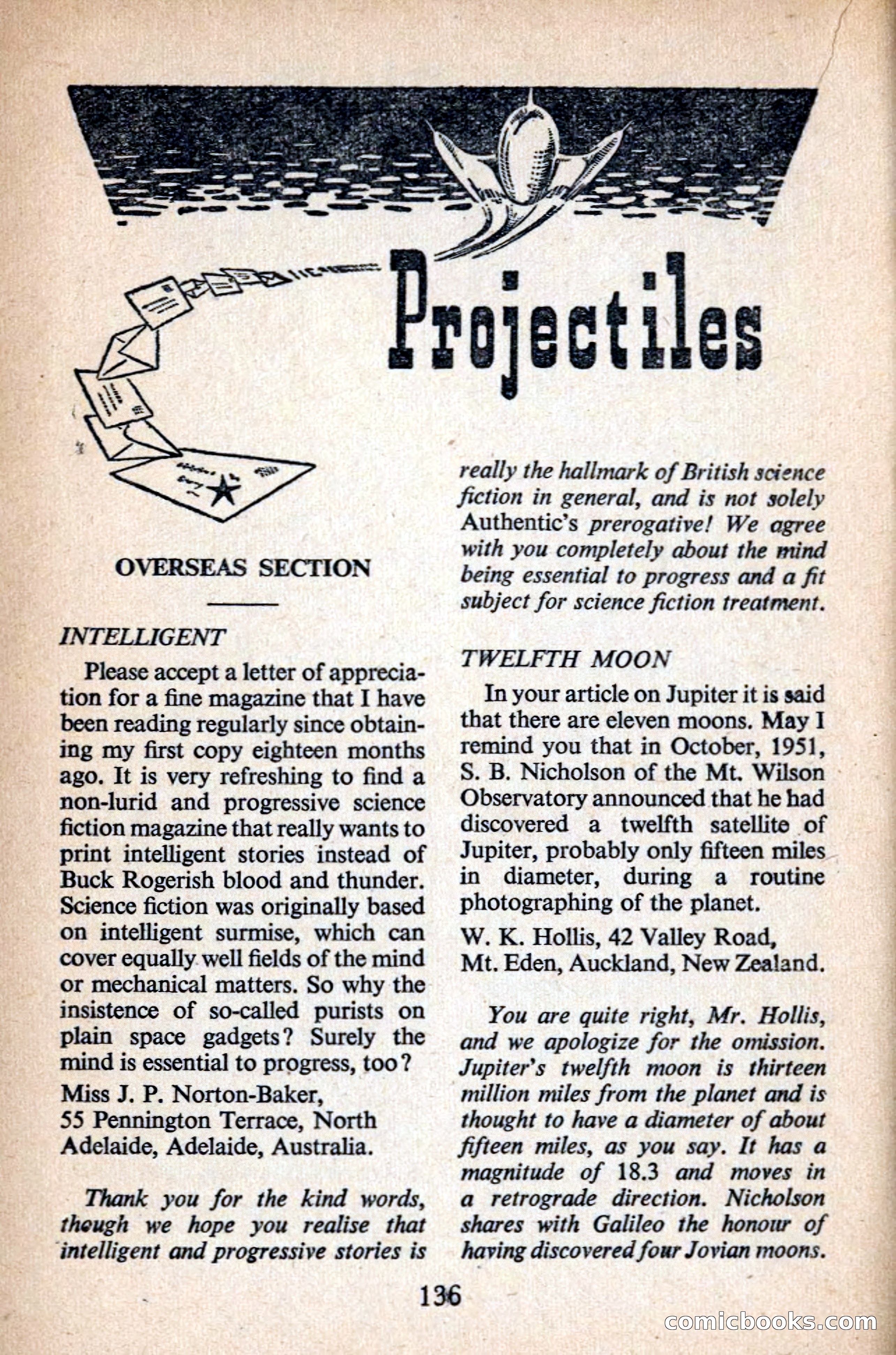
A restored page from Pulp Fiction, 1954. Page through the whole issue in the reader above.
📄 Transcribed text from this page (OCR, searchable)
Machine-transcribed from the original scan — historical spelling and the odd misread are preserved.
OVERSEAS SECTION INTELLIGENT Please accept a letter of apprecia- tion for a fine magazine that I have been reading regularly since obtain- ing my first copy eighteen months ago. It is very refreshing to find a non-lurid and progressive science fiction magazine that really wants to print intelligent stories instead of Buck Rogerish blood and thunder. Science fiction was originally based on intelligent surmise, which can cover equally well fields of the mind or mechanical matters. So why the insistence of so-called purists on plain space gadgets? Surely the mind is essential to progress, too? Miss J. P. Norton-Baker, 55 Pennington Terrace, North Adelaide, Adelaide, Australia. Thank you for the kind words, theugh we hope you realise that intelligent and progressive stories is 136 Projectiles really the hallmark of British science fiction in general, and is not solely Authentic’s prerogative! We agree with you completely about the mind being essential to progress and a fit subject for science fiction treatment. TWELFTH MOON In your article on Jupiter it is said that there are eleven moons. May I remind you that in October, 1951, S. B. Nicholson of the Mt. Wilson Observatory announced that he had discovered a twelfth satellite of Jupiter, probably only fifteen miles in diameter, during a _ routine photographing of the planet. W. K. Hollis, 42 Valley Road, Mt. Eden, Auckland, New Zealand. You are quite right, Mr. Hollis, and we apologize for the omission. Jupiter’s twelfth moon is thirteen million miles from the planet and is thought to have a diameter of about fifteen miles, as you say. It has a magnitude of 18.3 and moves in a retrograde direction. Nicholson shares with Galileo the honour of having discovered four Jovian moons. © ; -COMM|EDOOKS: oa