
Pulp Fiction, 1954 · page 116 of 146
Authentic Science Fiction Monthly No. 47 — page 116: what you’re looking at
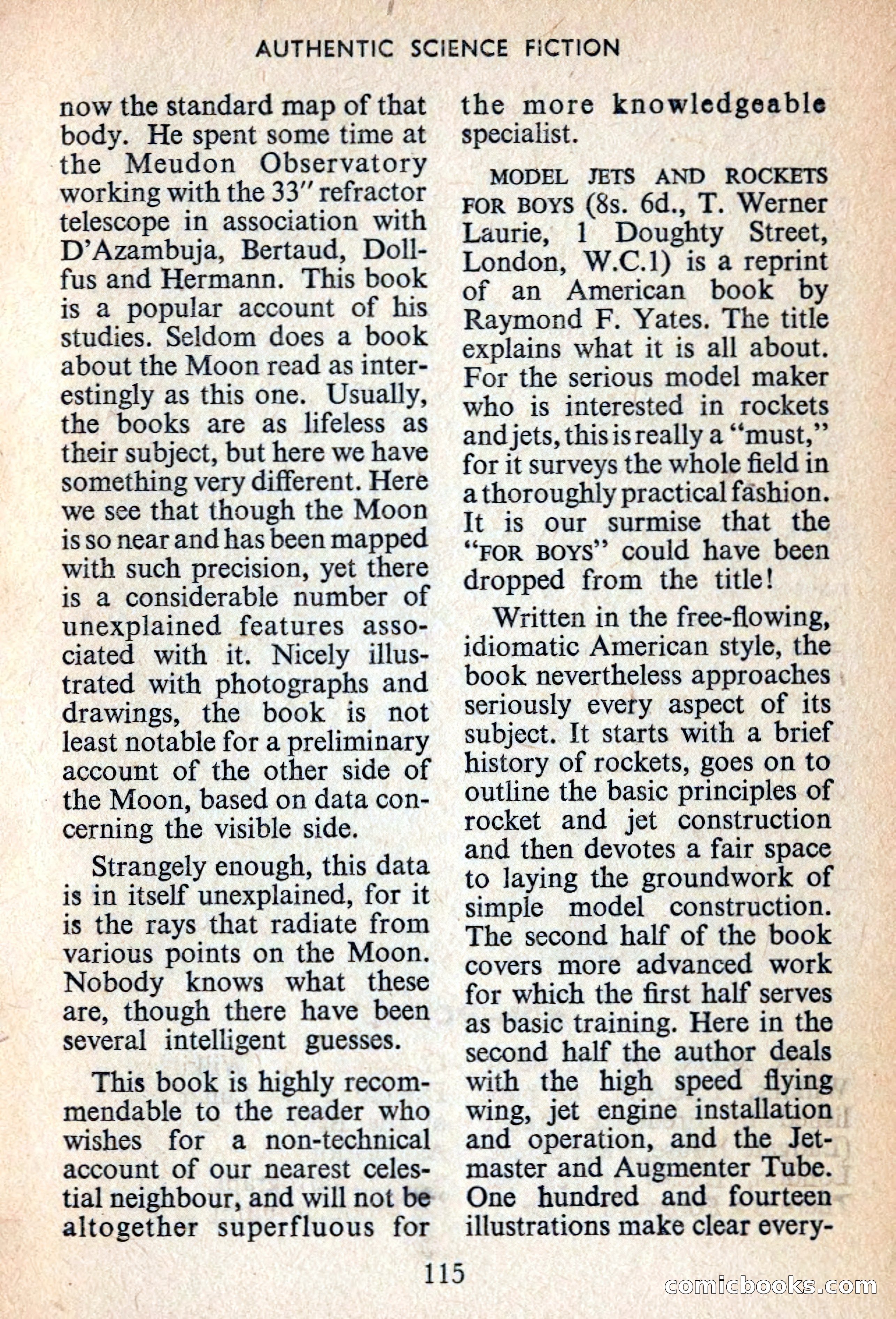
A restored page from Pulp Fiction, 1954. Page through the whole issue in the reader above.
📄 Transcribed text from this page (OCR, searchable)
Machine-transcribed from the original scan — historical spelling and the odd misread are preserved.
f AUTHENTIC SCIENCE FICTION now the standard map of that body. He spent some time at the Meudon Observatory working with the 33” refractor telescope in association with D’Azambuja, Bertaud, Doll- fus and Hermann. This book is a popular account of his studies. Seldom does a book about the Moon read as inter- estingly as this one. Usually, the books are as lifeless as their subject, but here we have something very different. Here we see that though the Moon is so near and has been mapped with such precision, yet there is a considerable number of unexplained features asso- ciated with it. Nicely illus- trated with photographs and drawings, the book is not least notable for a preliminary account of the other side of - the Moon, based on data con- cerning the visible side. Strangely enough, this data is in itself unexplained, for it is the rays that radiate from various points on the Moon. Nobody knows what these are, though there have been several intelligent guesses. This book is highly recom- mendable to the reader who wishes for a non-technical account of our nearest celes- tial neighbour, and will not be altogether superfluous for 115 the more knowledgeable specialist. MODEL JETS AND ROCKETS FOR BOYS (8s. 6d., T. Werner Laurie, 1 Doughty Street, London, W.C.1) is a reprint of an American book by Raymond F. Yates. The title explains what it is all about. For the serious model maker who is interested in rockets and jets, this is really a “‘must,”’ for it surveys the whole field in a thoroughly practical fashion. It is our surmise that the “FOR Boys’ could have been dropped from the title! Written in the free-flowing, idiomatic American style, the book nevertheless approaches | seriously every aspect of its subject. It starts with a brief history of rockets, goes on to outline the basic principles of rocket and jet construction and then devotes a fair space to laying the groundwork of simple model construction. The second half of the book covers more advanced work for which the first half serves as basic training. Here in the second half the author deals with the high speed fiying wing, jet engine installation | and operation, and the Jet- master and Augmenter Tube. One hundred and fourteen- illustrations make clear every- comicloooks.conn