
Pulp Fiction, 1954 · page 84 of 162
Authentic Science Fiction Monthly No. 46 — page 84: what you’re looking at
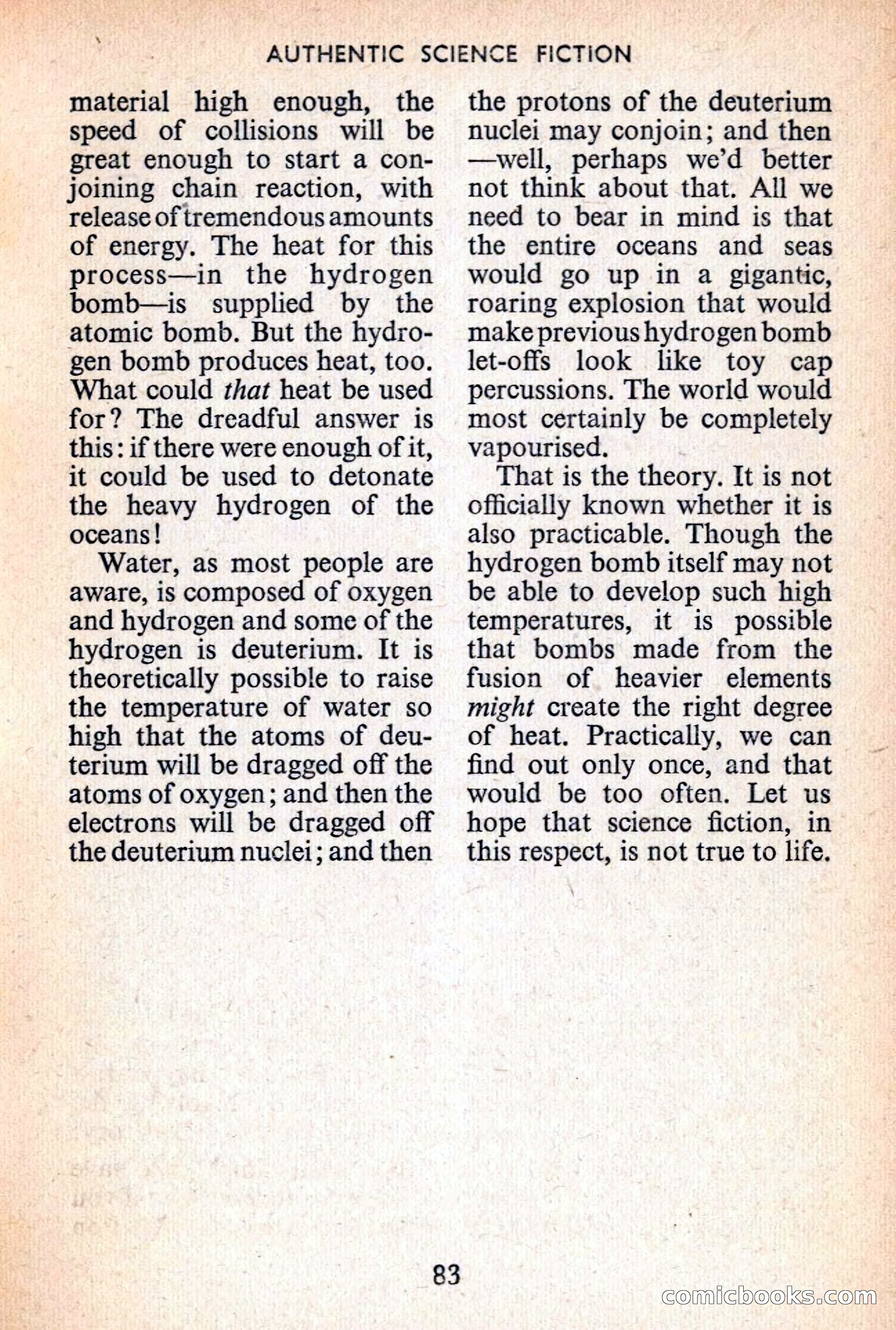
A restored page from Pulp Fiction, 1954. Page through the whole issue in the reader above.
📄 Transcribed text from this page (OCR, searchable)
Machine-transcribed from the original scan — historical spelling and the odd misread are preserved.
‘ material high enough, the speed of collisions will be great enough to start a con- joining chain reaction, with release of tremendous amounts of energy. The heat for this process—in the hydrogen bomb—is supplied by the atomic bomb. But the hydro- gen bomb produces heat, too. What could that heat be used for? The dreadful answer is this: if there were enough of it, it could be used to detonate the heavy hydrogen of the oceans! Water, as most people are aware, is composed of oxygen and hydrogen and some of the hydrogen is deuterium. It is theoretically possible to raise the temperature of water so high that the atoms of deu- terium will be dragged off the atoms of oxygen; and then the electrons will be dragged off the deuterium nuclei; and then 83 AUTHENTIC SCIENCE FICTION the protons of the deuterium nuclei may conjoin; and then —well, perhaps we'd better not think about that. All we need to bear in mind is that the entire oceans and seas would go up in a gigantic, roaring explosion that would make previous hydrogen bomb let-offs look like toy cap percussions. The world would most certainly be completely vapourised. That is the theory. It is not officially known whether it is also practicable. Though the hydrogen bomb itself may not be able to develop such high temperatures, it is possible that bombs made from the fusion of heavier elements might create the right degree of heat. Practically, we can find out only once, and that would be too often. Let us hope that science fiction, in this respect, is not true to life. comiclooks.comn