
Pulp Fiction, 1954 · page 71 of 162
Authentic Science Fiction Monthly No. 46 — page 71: what you’re looking at
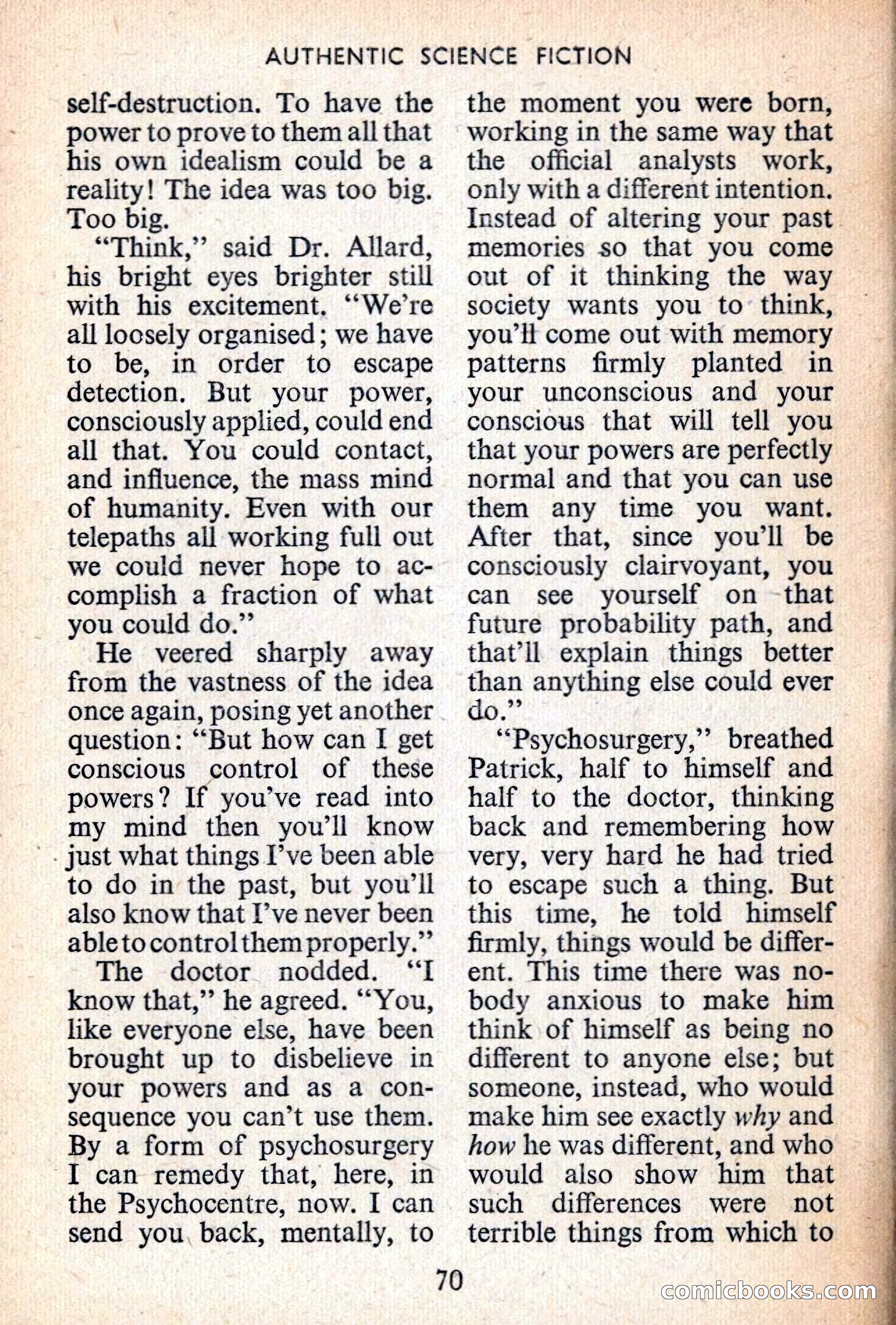
A restored page from Pulp Fiction, 1954. Page through the whole issue in the reader above.
📄 Transcribed text from this page (OCR, searchable)
Machine-transcribed from the original scan — historical spelling and the odd misread are preserved.
AUTHENTIC SCIENCE FICTION self-destruction. To have the power to prove to them all that his own idealism could be a reality! The idea was too big. Too big. “Think,” said Dr. Allard, his bright eyes brighter still with his excitement. “‘We’re all loosely organised; we have to be, in order to escape detection. But your power, consciously applied, could end all that. You could contact, and influence, the mass mind of humanity. Even with our telepaths all working full out we could never hope to ac- complish a fraction of what you could do.” He veered sharply away from the vastness of the idea once again, posing yet another question: ““But how can I get conscious control of these powers? If you’ve read into my mind then you'll know ' . Just what things P’ve been able to do in the past, but you'll also know that I’ve never been abletocontrolthem properly.” The doctor nodded. “I know that,” he agreed. “You, like everyone else, have been brought up to disbelieve in your powers and as a con- sequence you can’t use them. By a form of psychosurgery I can remedy that, here, in the Psychocentre, now. I can send you, back, mentally, to 70 the moment you were born, working in the same way that the official analysts work, only with a different intention. Instead of altering your past. memories so that you come out of it thinking the way society wants you to think, you'll come out with memory patterns firmly planted in your unconscious and your conscious that will tell you that your powers are perfectly normal and that you can use them any time you want. After that, since you'll be consciously clairvoyant, you can see yourself on -that future probability path, and that'll explain things better than anything else could ever ‘““Psychosurgery,”” breathed Patrick, half to himself and half to the doctor, thinking back and remembering how very, very hard he had tried to escape such a thing. But this time, he told himself firmly, things would be differ- ent. This time there was no- body anxious to make him think of himself as being no different to anyone else; but someone, instead, who would make him see exactly why and how he was different, and who would also show him that such differences were not terrible things from which to Comicbooks.comny