
Pulp Fiction, 1954 · page 62 of 162
Authentic Science Fiction Monthly No. 46 — page 62: what you’re looking at
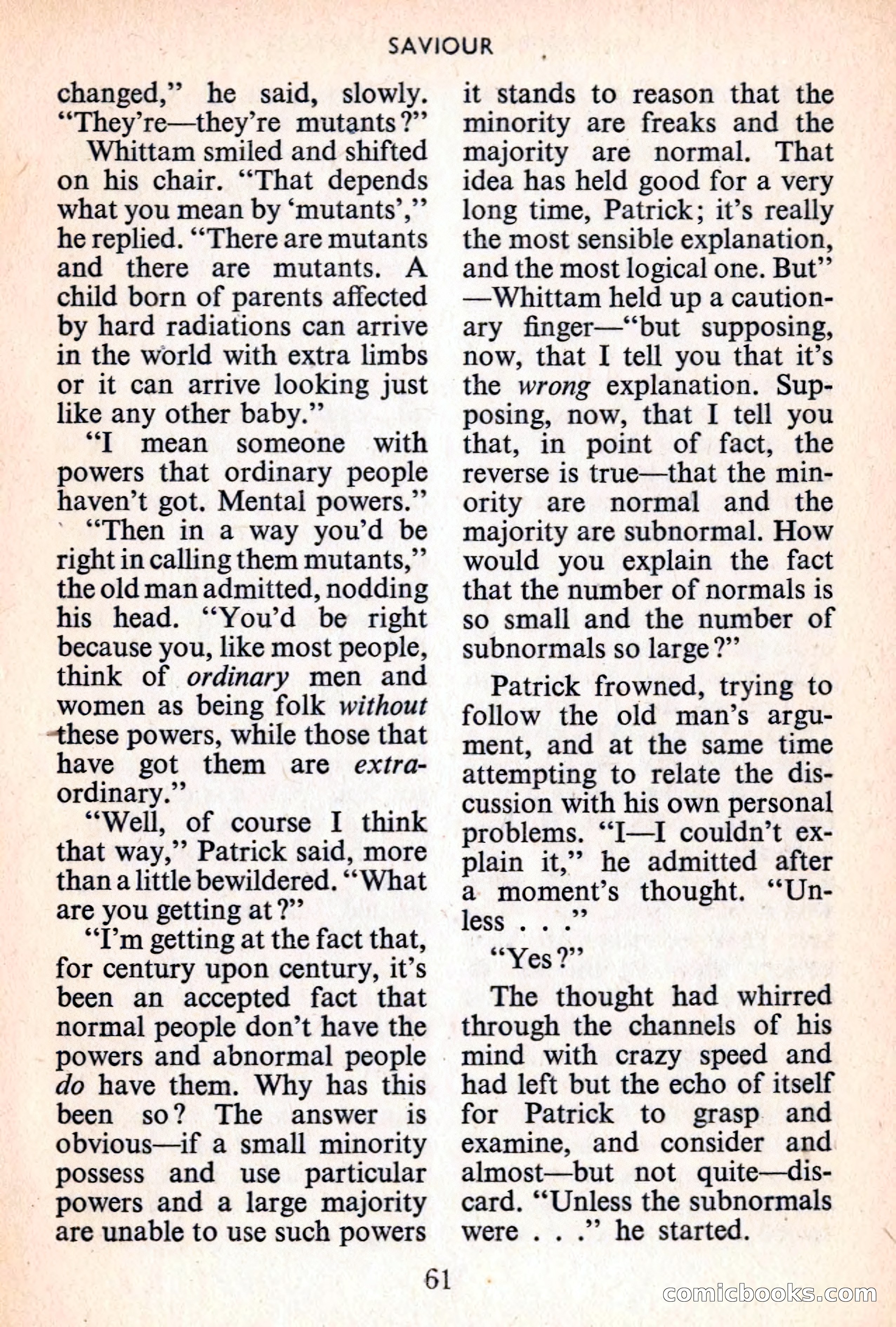
A restored page from Pulp Fiction, 1954. Page through the whole issue in the reader above.
📄 Transcribed text from this page (OCR, searchable)
Machine-transcribed from the original scan — historical spelling and the odd misread are preserved.
SAVIOUR changed,” he said, slowly. “They re—they’re mutants ?”’ Whittam smiled and shifted on his chair. ““That depends what you mean by ‘mutants’,”’ he replied. ““There are mutants and there are mutants. A child born of parents affected by hard radiations can arrive in the world with extra limbs or it can arrive looking just like any other baby.”’ “I mean someone with powers that ordinary people haven’t got. Mental powers.” “Then in a way you'd be right in calling them mutants,” the old man admitted, nodding his head. “‘You’d be right because you, like most people, think of ordinary men and women as being folk without -these powers, while those that have got them are extra- ordinary.” “Well, of course I think that way,”’ Patrick said, more than a little bewildered. “What are you getting at?” “I’m getting at the fact that, for century upon century, it’s been an accepted fact that normal people don’t have the powers and abnormal people do have them. Why has this been so? The answer is obvious—if a small minority possess and use particular - powers and a large majority are unable to use such powers 61 it stands to reason that the minority are freaks and the majority are normal. That idea has held good for a very long time, Patrick; it’s really the most sensible explanation, and the most logical one. But”’ —Whittam held up a caution- ary finger—‘‘but supposing, now, that I tell you that it’s the wrong explanation. Sup- posing, now, that I tell you that, in point of fact, the reverse is true—that the min- ority are normal and the majority are subnormal. How would you explain the fact that the number of normals is so small and the number of subnormals so large ?”’ Patrick frowned, trying to follow the old man’s argu- ment, and at the same time attempting to relate the dis- cussion with his own personal problems. “‘I—I couldn’t ex- plain it,” he admitted after a moment’s thought. “Un- os... 2 “Yes ?’’ The thought had whirred through the channels of his mind with crazy speed and had left but the echo of itself for Patrick to grasp and examine, and consider and almost—but not quite—dis- card. ‘‘Unless the subnormals were ...” he started. comiclbooks.corn