
Pulp Fiction, 1954 · page 29 of 162
Authentic Science Fiction Monthly No. 46 — page 29: what you’re looking at
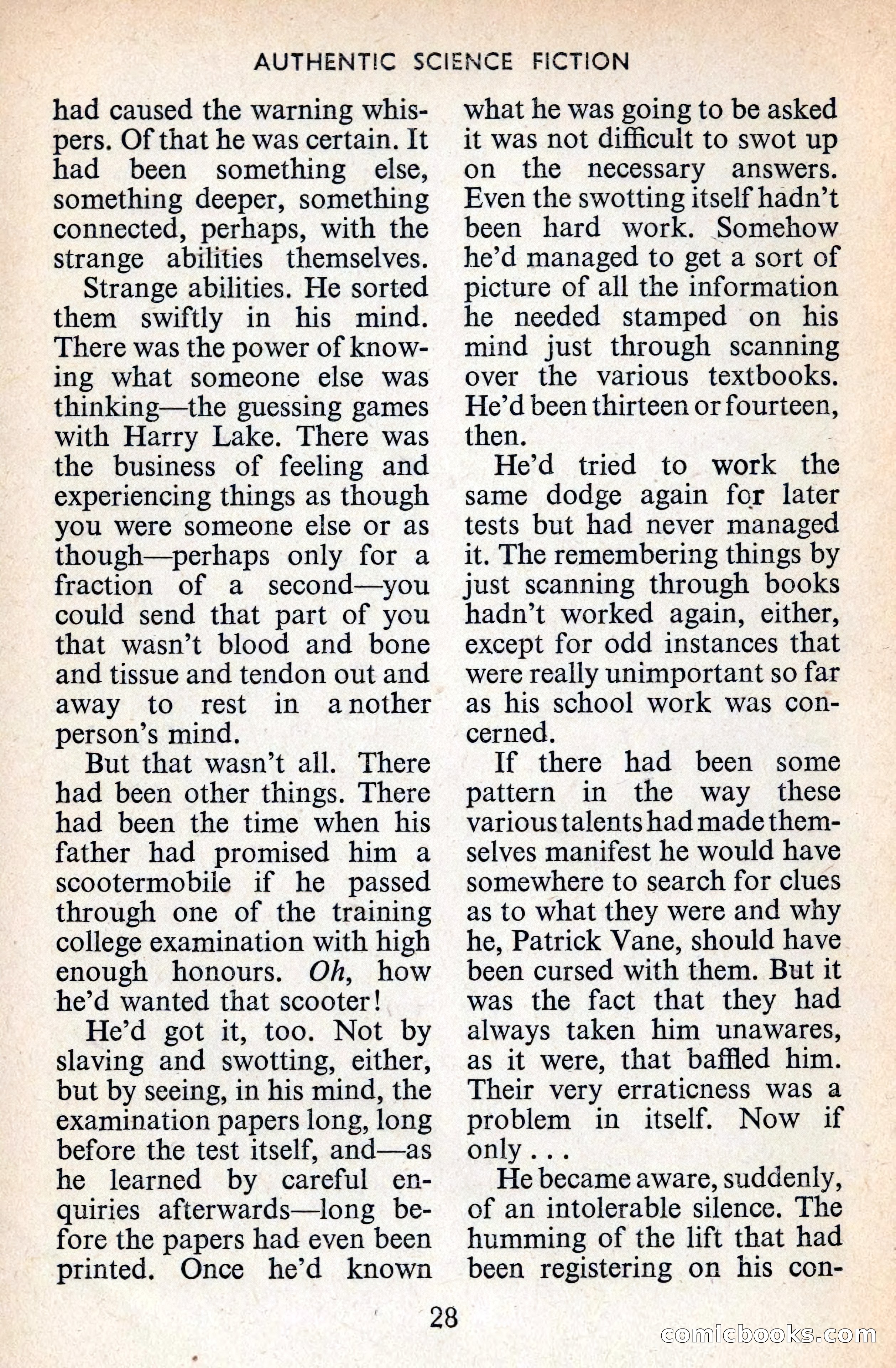
A restored page from Pulp Fiction, 1954. Page through the whole issue in the reader above.
📄 Transcribed text from this page (OCR, searchable)
Machine-transcribed from the original scan — historical spelling and the odd misread are preserved.
AUTHENTIC SCIENCE FICTION had caused the warning whis- pers. Of that he was certain. It had been something else, something deeper, something connected, perhaps, with the strange abilities themselves. Strange abilities. He sorted them swiftly in his mind. There was the power of know- ing what someone else was thinking—the guessing games with Harry Lake. There was the business of feeling and experiencing things as though you were someone else or as though—perhaps only for a fraction of a second—you could send that part of you that wasn’t blood and bone and tissue and tendon out and away to rest in another person’s mind. But that wasn’t all. There had been other things. There had been the time when his father had promised him a scootermobile if he passed through one of the training college examination with high enough honours. Oh, how he’d wanted that scooter! He’d got it, too. Not by slaving and swotting, either, but by seeing, in his mind, the examination papers long, long before the test itself, and—as he learned by careful en- quiries afterwards—long be- fore the papers had even been printed. Once he’d known 28 what he was going to be asked it was not difficult to swot up on the necessary answers. Even the swotting itself hadn’t been hard work. Somehow he’d managed to get a sort of picture of all the information he needed stamped on his mind just through scanning over the various textbooks. He’d been thirteen or fourteen, then. : He’d tried to work the same dodge again for later tests but had never managed it. The remembering things by just scanning through books hadn’t worked again, either, except for odd instances that were really unimportant so far as his school work was con- cerned. If there had been some pattern in the way these various talents had made them- selves manifest he would have somewhere to search for clues as to what they were and why he, Patrick Vane, should have been cursed with them. But it was the fact that they had always taken him unawares, as it were, that baffled him. Their very erraticness was a problem in itself. Now if only .... He became aware, suddenly, of an intolerable silence. The humming of the lift that had been registering on his con- commicloookks.com