
Pulp Fiction, 1954 · page 21 of 162
Authentic Science Fiction Monthly No. 46 — page 21: what you’re looking at
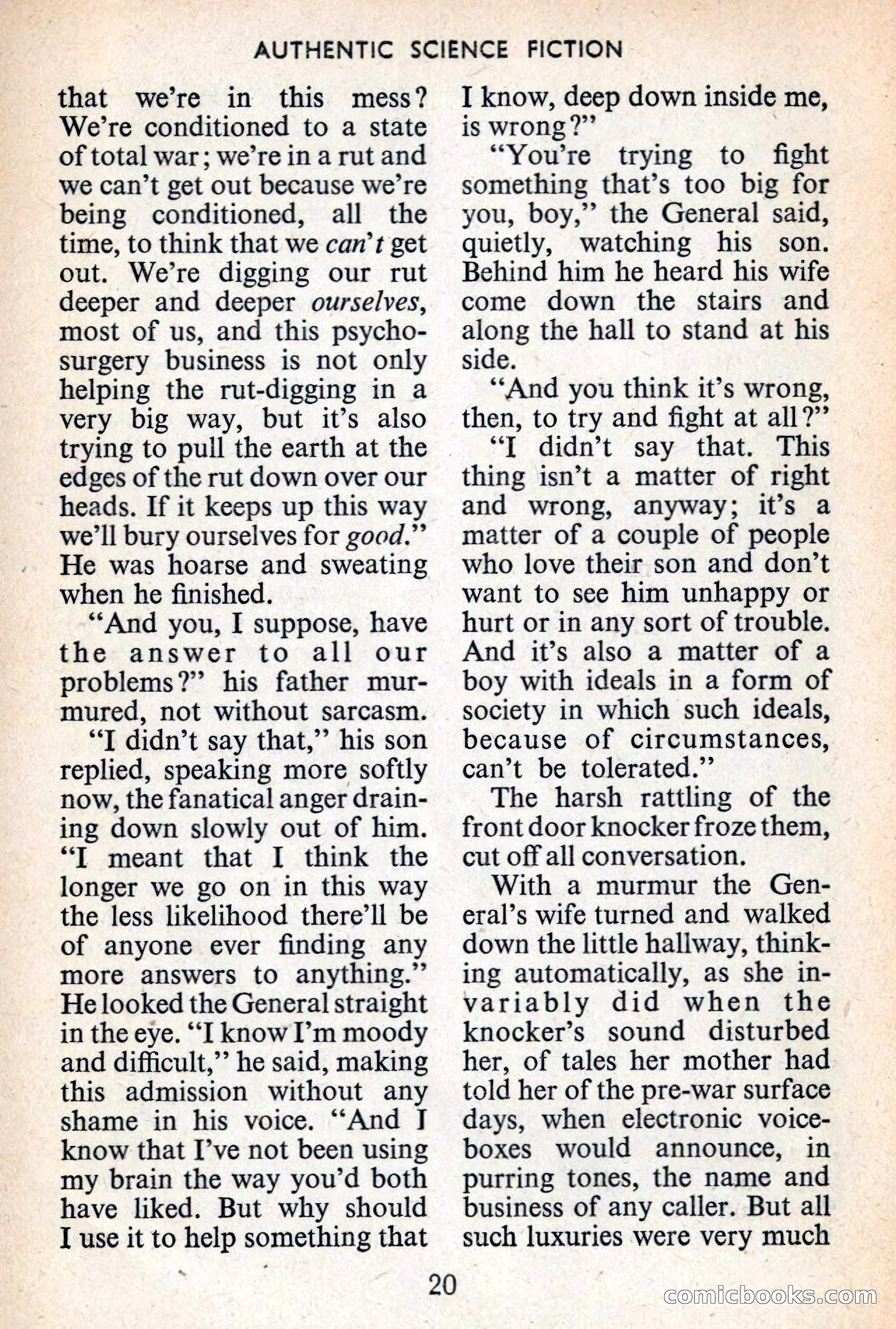
A restored page from Pulp Fiction, 1954. Page through the whole issue in the reader above.
📄 Transcribed text from this page (OCR, searchable)
Machine-transcribed from the original scan — historical spelling and the odd misread are preserved.
AUTHENTIC SCIENCE FICTION that we're in this mess? We’re conditioned to a state of total war; we’re in a rut and we can’t get out because we’re being conditioned, all the time, to think that we can’t get out. We're digging our rut deeper and deeper ourselves, most of us, and this psycho- surgery business is not only helping the rut-digging in a very big way, but it’s also trying to pull the earth at the edges of the rut down over our heads. If it keeps up this way we'll bury ourselves for good.” He was hoarse and sweating when he finished. ““And you, I suppose, have the answer to all our problems?” his father mur- mured, not without sarcasm. “T didn’t say that,”’ his son replied, speaking more softly now, the fanatical anger drain- ing down slowly out of him. “I meant that I think the longer we go on in this way the less likelihood there'll be of anyone ever finding any more answers to anything.” He looked the General straight in the eye. “I know I’m moody and difficult,’’ he said, making this admission without any shame in his voice. ““And J know that I’ve not been using my brain the way you’d both have liked. But why should I use it to help something that 20 I know, deep down inside me, is wrong?” “You're trying to fight something that’s too big for you, boy,” the General said, quietly, watching his son. Behind him he heard his wife come down the stairs and along the hall to stand at his side. ‘And you think it’s wrong, then, to try and fight at all?’ “I didn’t say that. This thing isn’t a matter of right and wrong, anyway; it’s a matter of a couple of people who love their son and don’t want to see him unhappy or hurt or in any sort of trouble. And it’s also a matter of a boy with ideals in a form of society in which such ideals, because of circumstances, can’t be tolerated.” The harsh rattling of the front door knocker froze them, cut off all conversation. With a murmur the Gen- eral’s wife turned and walked down the little hallway, think- ing automatically, as she in- variably did when the knocker’s sound disturbed her, of tales her mother had told her of the pre-war surface days, when electronic voice- boxes would announce, in purring tones, the name and business of any caller. But all such luxuries were very much comiclbooks.conrn