
Pulp Fiction, 1954 · page 113 of 162
Authentic Science Fiction Monthly No. 46 — page 113: what you’re looking at
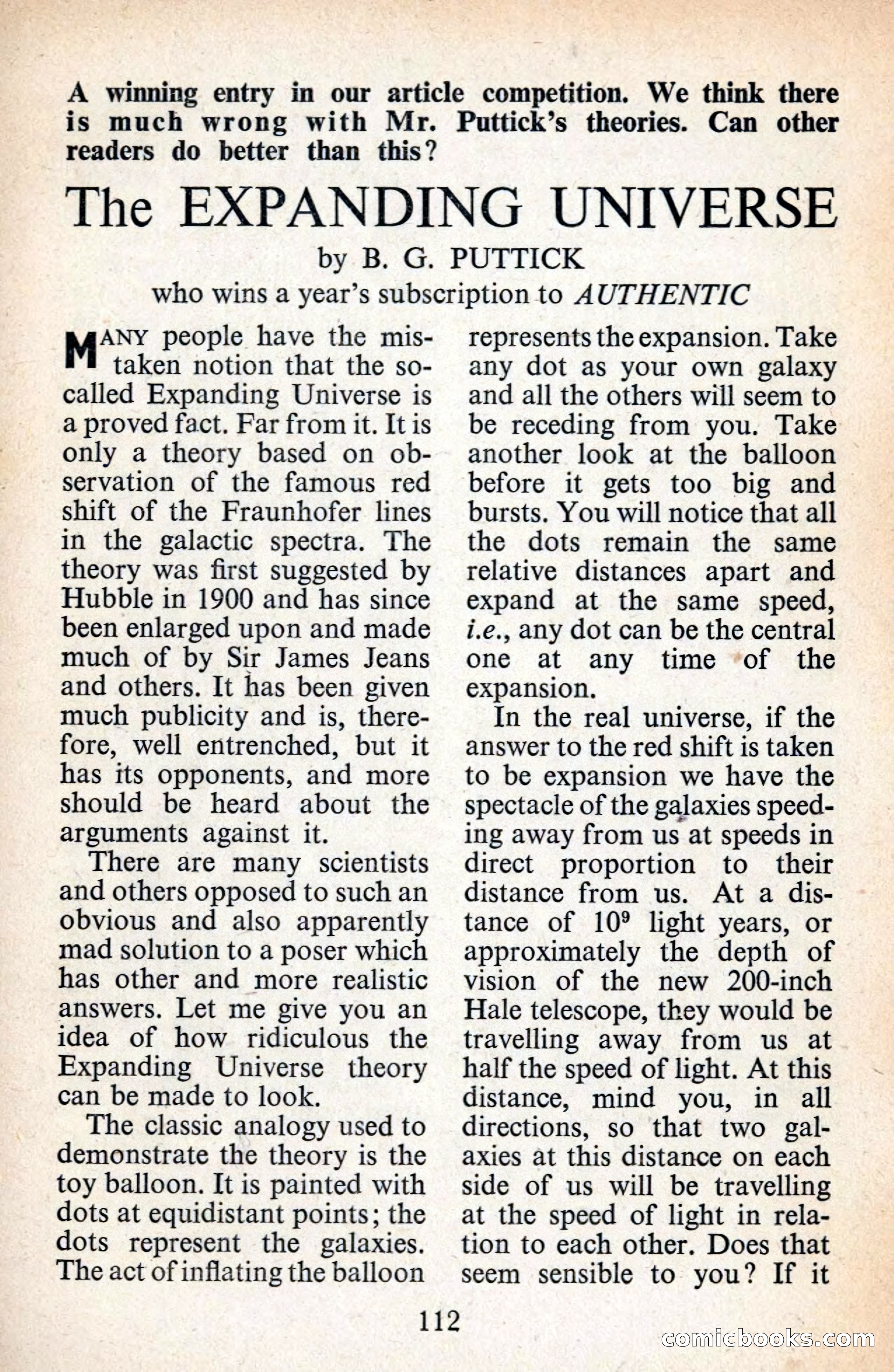
A restored page from Pulp Fiction, 1954. Page through the whole issue in the reader above.
📄 Transcribed text from this page (OCR, searchable)
Machine-transcribed from the original scan — historical spelling and the odd misread are preserved.
A winning entry in our article competition. We think there is much wrong with Mr. Puttick’s theories. Can other readers do better than this? The EXPANDING UNIVERSE by B. G. PUTTICK who wins a year’s subscription to AUTHENTIC M’*Y people have the mis- taken notion that the so- called Expanding Universe is a proved fact. Far from it. It is only a theory based on ob- servation of the famous red shift of the Fraunhofer lines in the galactic spectra. The theory was first suggested by Hubble in 1900 and has since been enlarged upon and made much of by Sir James Jeans and others. It has been given much publicity and is, there- fore, well entrenched, but it has its opponents, and more should be heard about the arguments against it. There are many scientists and others opposed to such an obvious and also apparently mad solution to a poser which has other and more realistic answers. Let me give you an idea of how ridiculous the Expanding Universe theory can be made to look. The classic analogy used to demonstrate the theory is the toy balloon. It is painted with dots at equidistant points; the dots represent the galaxies. The act of inflating the balloon 112 represents the expansion. Take any dot as your own galaxy and all the others will seem to be receding from you. Take another look at the balloon before it gets too big and bursts. You will notice that all the dots remain the same relative distances apart and expand at the same speed, i.e., any dot can be the central one at any time ‘of the expansion. In the real universe, if the answer to the red shift is taken to be expansion we have the spectacle of the galaxies speed- ing away from us at speeds in direct proportion to their distance from us. At a dis- tance of 10° light years, or approximately the depth of vision of the new 200-inch Hale telescope, they would be travelling away from us at half the speed of light. At this distance, mind you, in all directions, so that two gal- axies at this distance on each side of us will be travelling at the speed of light in rela- tion to each other. Does that seem sensible to you? If it comiclbooks.conrn