
Pulp Fiction, 1954 · page 100 of 162
Authentic Science Fiction Monthly No. 46 — page 100: what you’re looking at
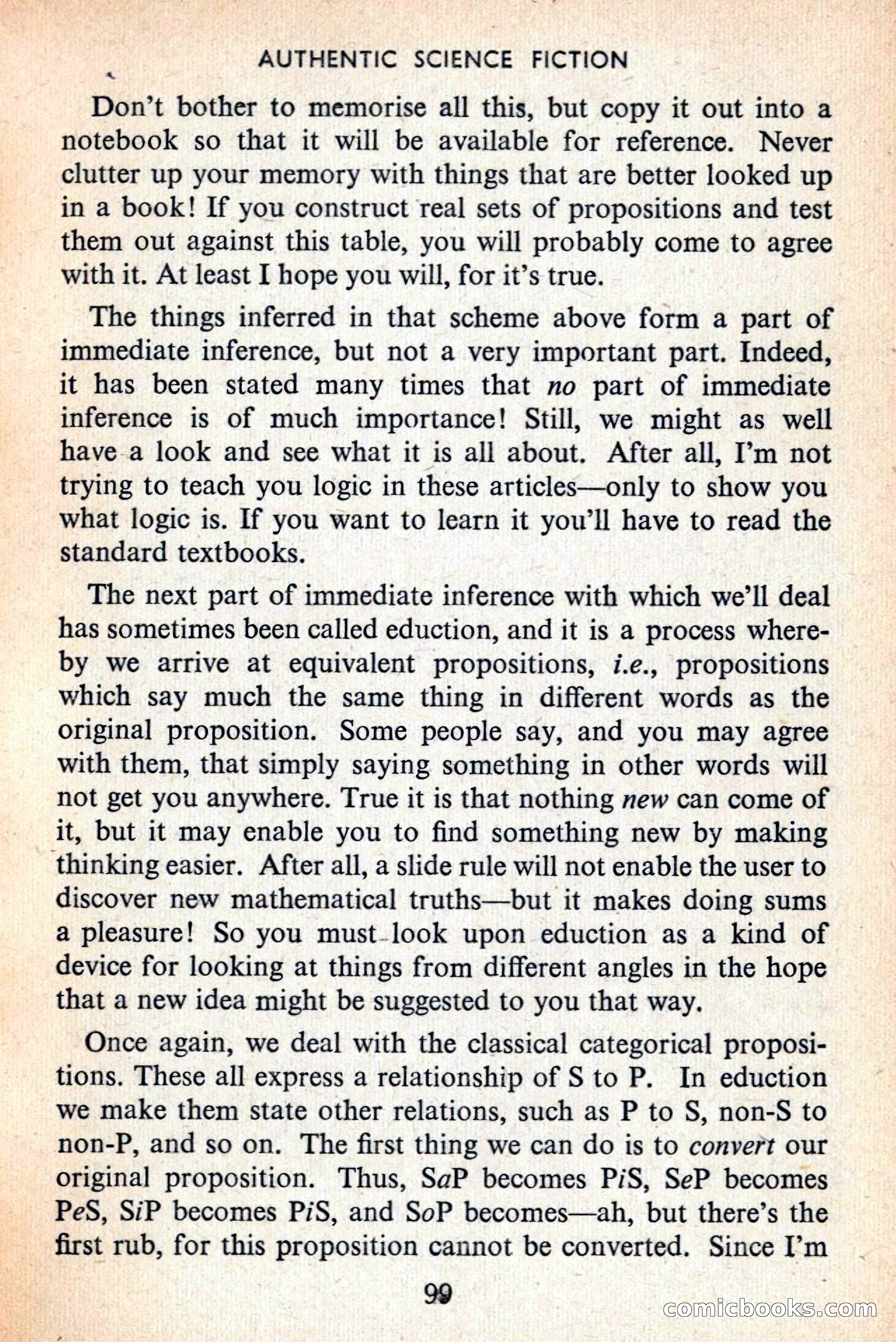
A restored page from Pulp Fiction, 1954. Page through the whole issue in the reader above.
📄 Transcribed text from this page (OCR, searchable)
Machine-transcribed from the original scan — historical spelling and the odd misread are preserved.
AUTHENTIC SCIENCE FICTION Don’t bother to memorise all this, but copy it out into a notebook so that it will be available for reference. Never clutter up your memory with things that are better looked up in a book! If you construct real sets of propositions and test them out against this table, you will probably come to agree with it. At least I hope you will, for it’s true. The things inferred in that scheme above form a part of immediate inference, but not a very important part. Indeed, it has been stated many times that no part of immediate inference is of much importance! Still, we might as well have a look and see what it is all about. After all, I’m not trying to teach you logic in these articles—only to show you what logic is. If you want to learn it you’ll have to read the standard textbooks. The next part of immediate inference with which we’ll deal has sometimes been called eduction, and it is a process where- by we arrive at equivalent propositions, i.e., propositions which say much the same thing in different words as the Original proposition. Some people say, and you may agree with them, that simply saying something in other words will not get you anywhere. True it is that nothing new can come of it, but it may enable you to find something new by making thinking easier. After all, a slide rule will not enable the user to discover new mathematical truths—but it makes doing sums a pleasure! So you must-look upon eduction as a kind of device for looking at things from different angles in the hope that a new idea might be suggested to you that way. Once again, we deal with the classical categorical proposi- tions. These all express a relationship of Sto P. In eduction we make them state other relations, such as P to S, non-S to non-P, and so on. The first thing we can do is to convert our original proposition. Thus, SaP becomes PiS, SeP becomes PeS, SiP becomes PiS, and SoP becomes—ah, but there’s the first rub, for this proposition cannot be converted. Since I’m 99 comiclooks.cormn