
Pulp Fiction, 1954 · page 94 of 162
Authentic Science Fiction Monthly, Issue 45 — page 94: what you’re looking at
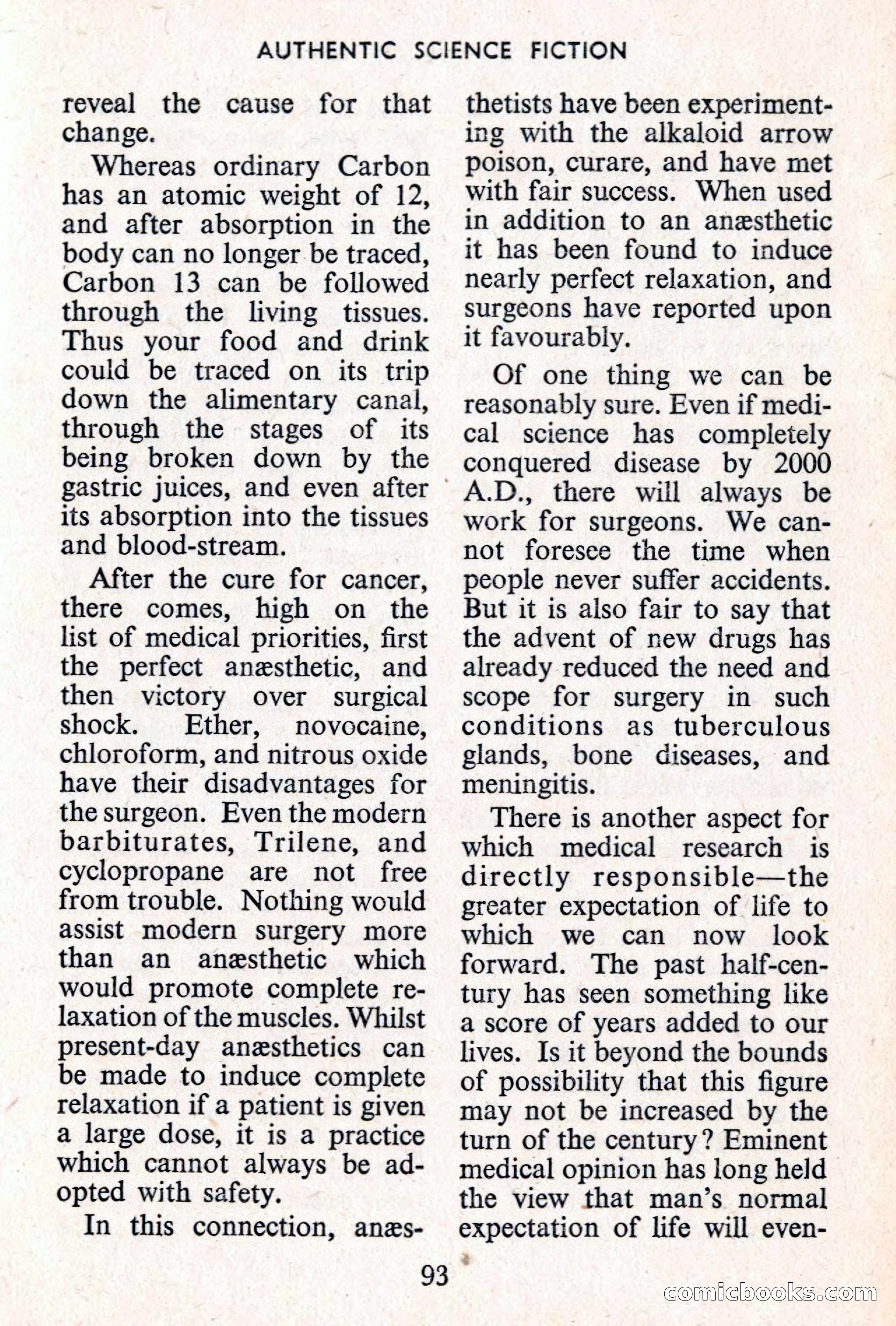
A restored page from Pulp Fiction, 1954. Page through the whole issue in the reader above.
📄 Transcribed text from this page (OCR, searchable)
Machine-transcribed from the original scan — historical spelling and the odd misread are preserved.
AUTHENTIC SCIENCE FICTION reveal the cause for that change. Whereas ordinary Carbon has an atomic weight of 12, and after absorption in the body can no longer be traced, Carbon 13 can be followed through the living tissues. Thus your food and drink could be traced on its trip down the alimentary canal, through the stages of its being broken down by the gastric juices, and even after ~ its absorption into the tissues and blood-stream. After the cure for cancer, there comes, high on the list of medical priorities, first the perfect anesthetic, and then victory over surgical shock. Ether, novocaine, chloroform, and nitrous oxide have their disadvantages for the surgeon. Even the modern barbiturates, Trilene, and cyclopropane are not free from trouble. Nothing would assist modern surgery more than an anesthetic which would promote complete re- laxation of the muscles. Whilst present-day anesthetics can be made to induce complete relaxation if a patient is given a large dose, it is a practice which cannot always be ad- opted with safety. In this connection, anes- 93 thetists have been experiment- ing with the alkaloid arrow poison, curare, and have met with fair success. When used in addition to an anesthetic it has been found to induce nearly perfect relaxation, and surgeons have reported upon it favourably. Of one thing we can be reasonably sure. Even if medi- cal science has completely conquered disease by 2000 A.D., there will always be work for surgeons. We can- not foresee the time when people never suffer accidents. But it is also fair to say that the advent of new drugs has already reduced the need and scope for surgery in such conditions as tuberculous glands, bone diseases, and meningitis. There is another aspect for which medical research is directly responsible—the greater expectation of life to which we can now look forward. The past half-cen- tury has seen something like a score of years added to our lives. Is it beyond the bounds of possibility that this figure may not be increased by the turn of the century? Eminent medical opinion has long held the view that man’s normal expectation of life will even- : comiclooks.corn