
Pulp Fiction, 1954 · page 4 of 162
Authentic Science Fiction Monthly, Issue 45 — page 4: what you’re looking at
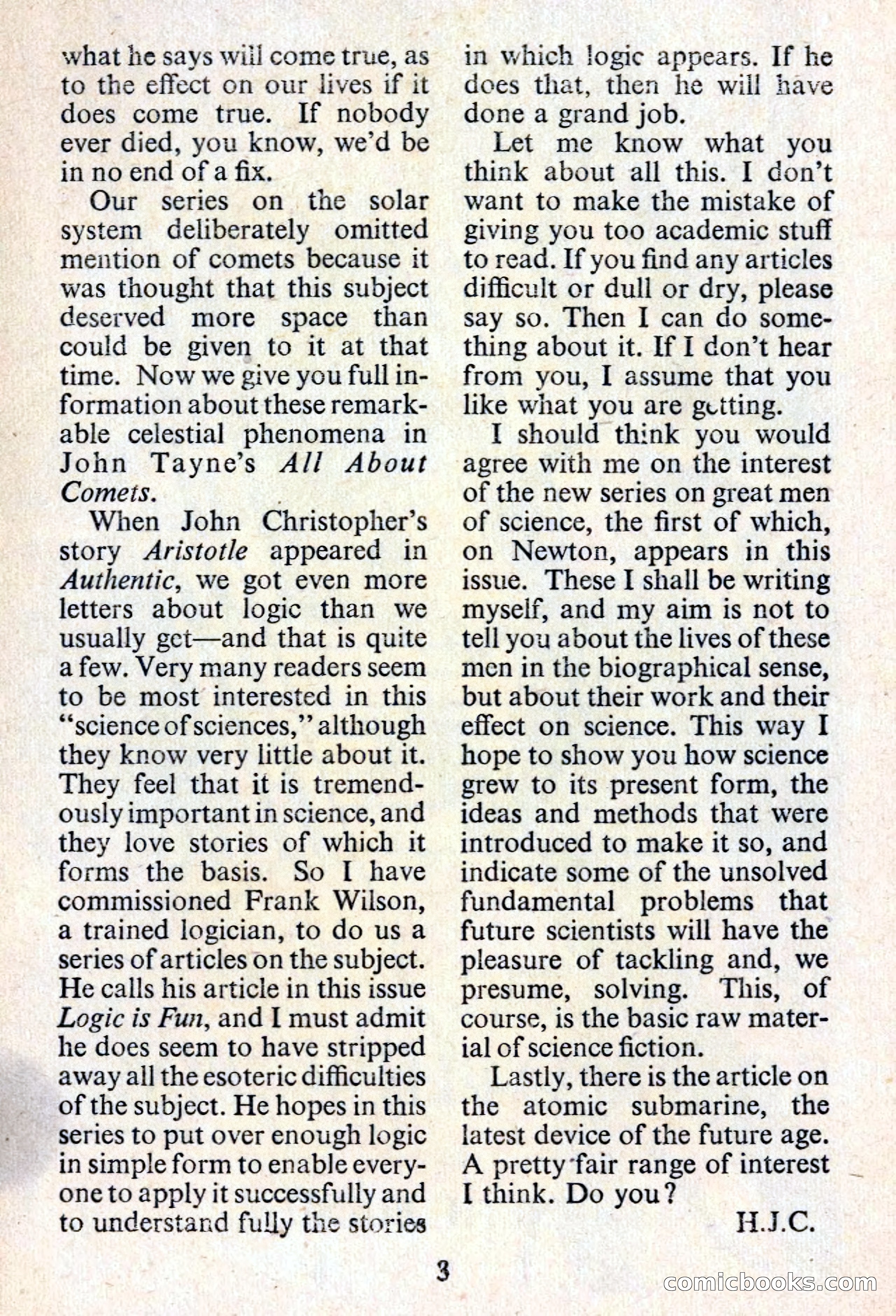
A restored page from Pulp Fiction, 1954. Page through the whole issue in the reader above.
📄 Transcribed text from this page (OCR, searchable)
Machine-transcribed from the original scan — historical spelling and the odd misread are preserved.
what he says wiil come true, as to the effect on our lives if it does come true. If nobody ever died, you know, we'd be in no end of a fix. Our series on the solar system deliberately omitted mention of comets because it was thought that this subject deserved more space than could be given to it at that time. Now we give you full in- formation about these remark- able celestial phenomena in John Tayne’s All About Comets. When John Christopher’s story Aristotle appeared in Authentic, we got even more letters about logic than we usually get—and that is quite afew. Very many readers seem to be most interested in this ““science of sciences,” although they know very little about it. They feel that it is tremend- ously important in science, and they love stories of which it forms the basis. So I have commissioned Frank Wilson, a trained logician, to do us a series of articles on the subject. He calls his article in this issue Logic is Fun, and I must admit he does seem to have stripped away all the esoteric difficulties of the subject. He hopes in this series to put over enough logic in simple form to enable every- one to apply it successfully and to understand fully the stories in which logic appears. If he does that, then he will have done a grand job. Let me know what you think about all this. I don’t want to make the mistake of giving you too academic stuff to read. If you find any articles difficult or dull or dry, please say so. Then I can do some- thing about it. If I don’t hear from you, I assume that you like what you are gciting. I should think you would agree with me on the interest of the new series on great men of science, the first of which, on Newton, appears in this issue. These I shall be writing myself, and my aim is not to tell you about the lives of these men in the biographical sense, but about their work and their effect on science. This way I hope to show you how science grew to its present form, the ideas and methods that were introduced to make it so, and indicate some of the unsolved fundamental problems that future scientists will have the pleasure of tackling and, we presume, solving. This, of course, is the basic raw mater- ial of science fiction. Lastly, there is the article on the atomic submarine, the latest device of the future age. A pretty fair range of interest _ I think. Do you? H.J.C. comiclooks.corn