
Pulp Fiction, 1954 · page 126 of 162
Authentic Science Fiction Monthly, Issue 45 — page 126: what you’re looking at
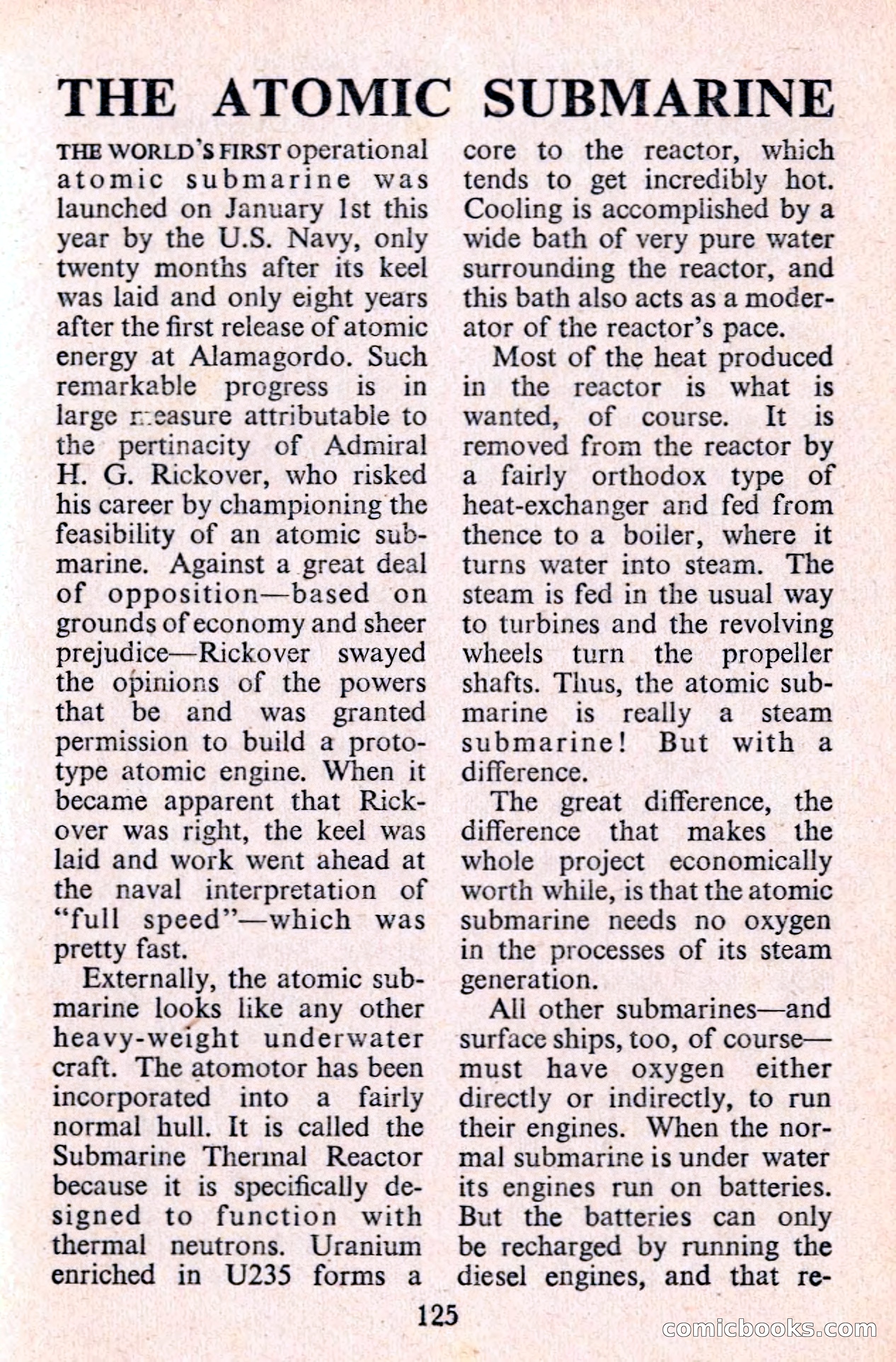
A restored page from Pulp Fiction, 1954. Page through the whole issue in the reader above.
📄 Transcribed text from this page (OCR, searchable)
Machine-transcribed from the original scan — historical spelling and the odd misread are preserved.
THE ATOMIC SUBMARINE THE WORLD'S FIRST operational atomic submarine was launched on January Ist this year by the U.S. Navy, only twenty months after its keel was laid and only eight years after the first release of atomic energy at Alamagordo. Such remarkable progress is in large r-easure attributable to the pertinacity of Admiral H. G. Rickover, who risked his career by championing the feasibility of an atomic sub- marine. Against a great deal of opposition—based on grounds of economy and sheer prejudice—Rickover swayed the opinions of the powers that be and was granted permission to build a proto- type atomic engine. When it became apparent that Rick- over was right, the keel was laid and work went ahead at the naval interpretation of “full speed’”—which was pretty fast. Externally, the atomic sub- marine looks like any other heavy-weight underwater craft. The atomotor has been incorporated into a fairly normal hull. It is called the Submarine Thermal Reactor because it is specifically de- signed to function with thermal neutrons. Uranium enriched in U235 forms a 125 core to the reactor, which tends to get incredibly hot. Cooling is accomplished by a wide bath of very pure water surrounding the reactor, and this bath also acts as a moder- ator of the reactor’s pace. Most of the heat produced in the reactor is what is wanted, of course. It is removed from the reactor by a fairly orthodox type of heat-exchanger and fed from thence to a boiler, where it turns water into steam. The steam is fed in the usual way to turbines and the revolving wheels turn the _ propeller shafts. Thus, the atomic sub- marine is really a steam submarine! But with a difference. The great difference, the difference that makes the whole project economically worth while, is that the atomic submarine needs no oxygen in the processes of its steam generation. All other submarines—and surface ships, too, of course— must have oxygen either directly or indirectly, to run their engines. When the nor- mal submarine is under water its engines run on batteries. But the batteries can only be recharged by running the diesel engines, and that re- conmmiclooolkks.Ccom