
Pulp Fiction, 1954 · page 76 of 162
Authentic Science Fiction Monthly No. 44 — page 76: what you’re looking at
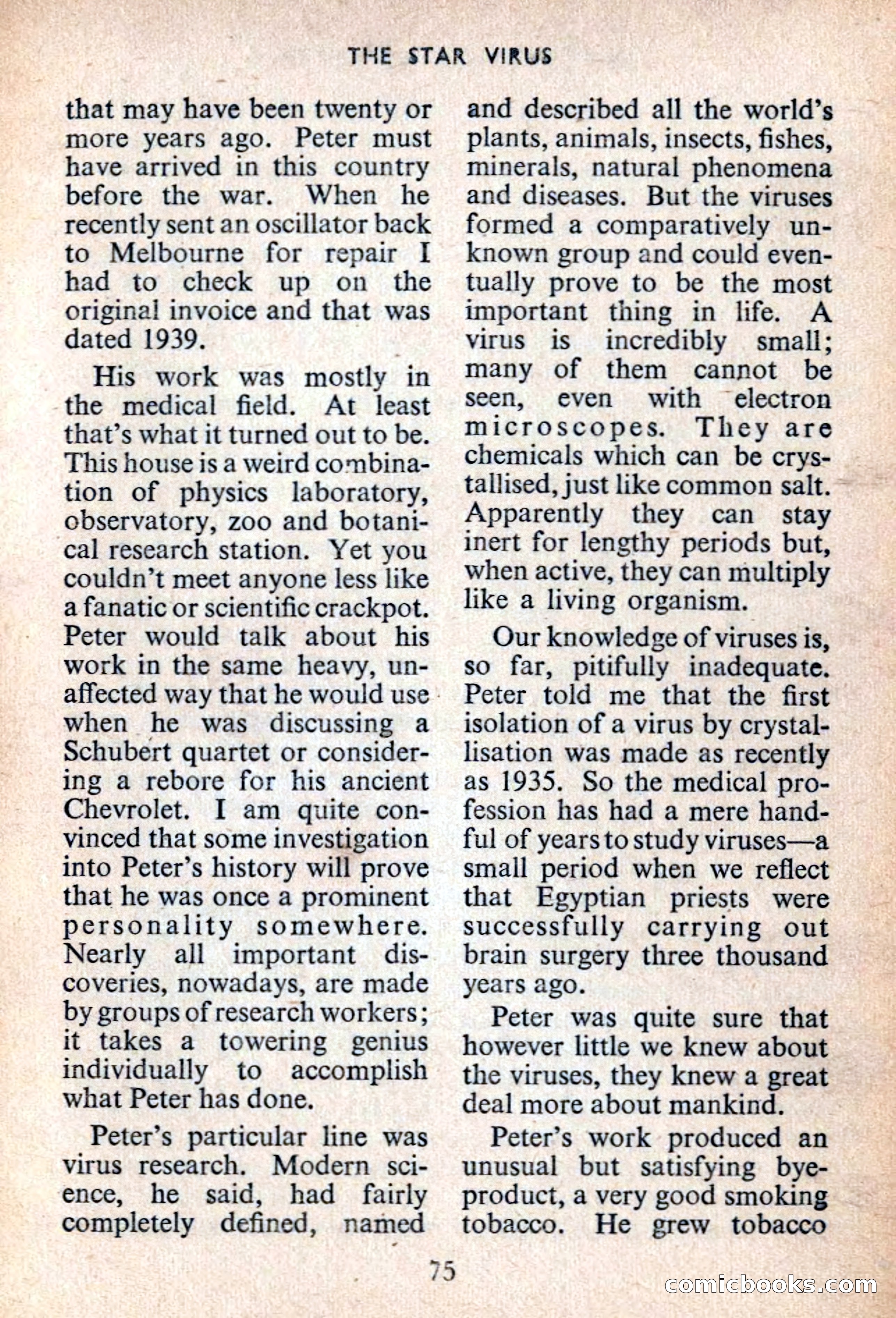
A restored page from Pulp Fiction, 1954. Page through the whole issue in the reader above.
📄 Transcribed text from this page (OCR, searchable)
Machine-transcribed from the original scan — historical spelling and the odd misread are preserved.
THE STAR VIRUS that may have been twenty or more years ago. Peter must have arrived in this country before the war. When he recently sent an oscillator back to Melbourne for repair I had to check up on the original invoice and that was dated 1939. His work was mostly in the medical field. At least that’s what it turned out to be. This house is a weird combina- tion of physics laboratory, observatory, zoo and botani- cal research station. Yet you couldn’t meet anyone less like a fanatic or scientific crackpot. Peter would talk about his work in the same heavy, un- affected way that he would use - when he was discussing a Schubert quartet or consider- ing a rebore for his ancient Chevrolet. I am quite con- vinced that some investigation into Peter’s history will prove that he was once a prominent personality somewhere. Nearly all important dis- coveries, nowadays, are made by groups of research workers; it takes a towering genius individually to accomplish what Peter has done. Peter’s particular line was virus research. Modern sci- ence, he said, had fairly completely defined, named 75 and described all the world’s plants, animals, insects, fishes, minerals, natural phenomena and diseases. But the viruses formed a comparatively un- known group and could even- tually prove to be the most important thing in life. A virus is incredibly small; many of them cannot be seen, even with electron microscopes. They are chemicals which can be crys- tallised, just like common salt. ~ Apparently they can stay inert for lengthy periods but, when active, they can multiply like a living organism. Our knowledge of viruses is, so far, pitifully inadequate. Peter told me that the first isolation of a virus by crystal- lisation was made as recently as 1935. So the medical pro- fession has had a mere hand- ful of years to study viruses—a small period when we reflect that Egyptian priests were successfully carrying out brain surgery three thousand years ago. Peter was quite sure that however little we knew about the viruses, they knew a great deal more about mankind. Peter’s work produced an unusual but satisfying bye- product, a very good smoking tobacco. He grew tobacco Comiuiciooksscom):,