
Pulp Fiction, 1954 · page 103 of 162
Authentic Science Fiction Monthly No. 44 — page 103: what you’re looking at
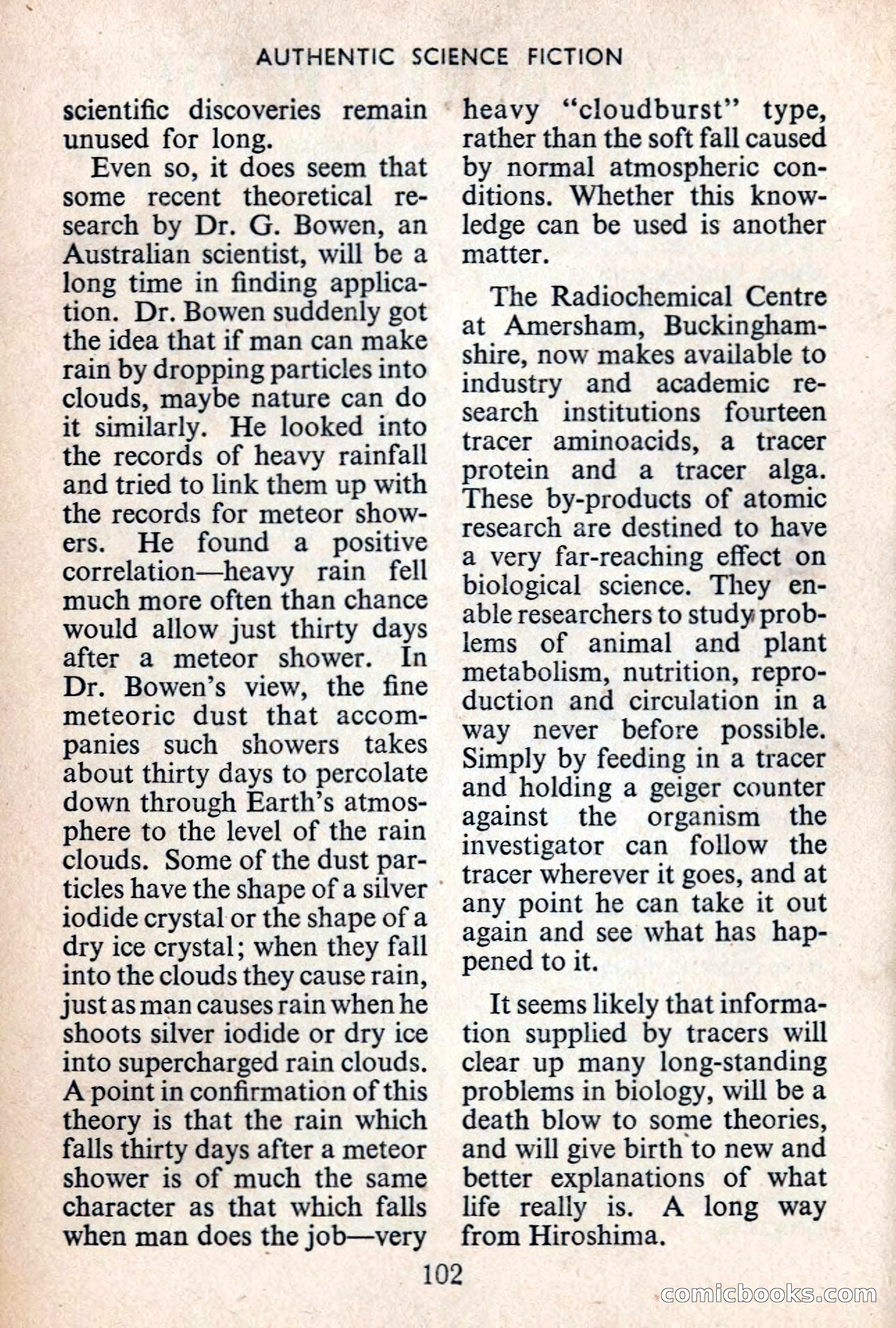
A restored page from Pulp Fiction, 1954. Page through the whole issue in the reader above.
📄 Transcribed text from this page (OCR, searchable)
Machine-transcribed from the original scan — historical spelling and the odd misread are preserved.
AUTHENTIC SCIENCE FICTION scientific discoveries remain unused for long. Even so, it does seem that some recent theoretical re- search by Dr. G. Bowen, an Australian scientist, will be a long time in finding applica- tion. Dr. Bowen suddenly got the idea that if man can make rain by dropping particles into clouds, maybe nature can do it similarly. He looked into the records of heavy rainfall and tried to link them up with the records for meteor show- ers. He found a positive correlation—heavy rain fell much more often than chance would allow just thirty days after a meteor shower. In Dr. Bowen’s view, the fine meteoric dust that accom- panies such showers takes about thirty days to percolate down through Earth’s atmos- phere to the level of the rain clouds. Some of the dust par- ticles have the shape of a silver ° iodide crystal or the shape of a dry ice crystal; when they fall into the clouds they cause rain, just as man causes rain when he shoots silver iodide or dry ice into supercharged rain clouds. A point in confirmation of this theory is that the rain which falls thirty days after a meteor shower is of much the same character as that which falls when man does the job—very heavy ‘“‘cloudburst’’ type, rather than the soft fall caused by normal atmospheric con- ditions. Whether this know- ledge can be used is another matter. The Radiochemical Centre at Amersham, Buckingham- shire, now makes available to industry and academic re- search institutions fourteen tracer aminoacids, a tracer protein and a tracer alga. These by-products of atomic research are destined to have a very far-reaching effect on biological science. They en- able researchers to study prob- lems of animal and plant metabolism, nutrition, repro- duction and circulation in a way never before possible. Simply by feeding in a tracer and holding a geiger counter against the organism the investigator can follow the tracer wherever it goes, and at any point he can take it out again and see what has hap- pened to it. It seems likely that informa- tion supplied by tracers will clear up many long-standing problems in biology, will be a death blow to some theories, and will give birth to new and better explanations of what life really is. A long way from Hiroshima. 102 comicloooks.com