
Pulp Fiction, 1954 · page 93 of 162
Authentic Science Fiction Monthly No. 43 — page 93: what you’re looking at
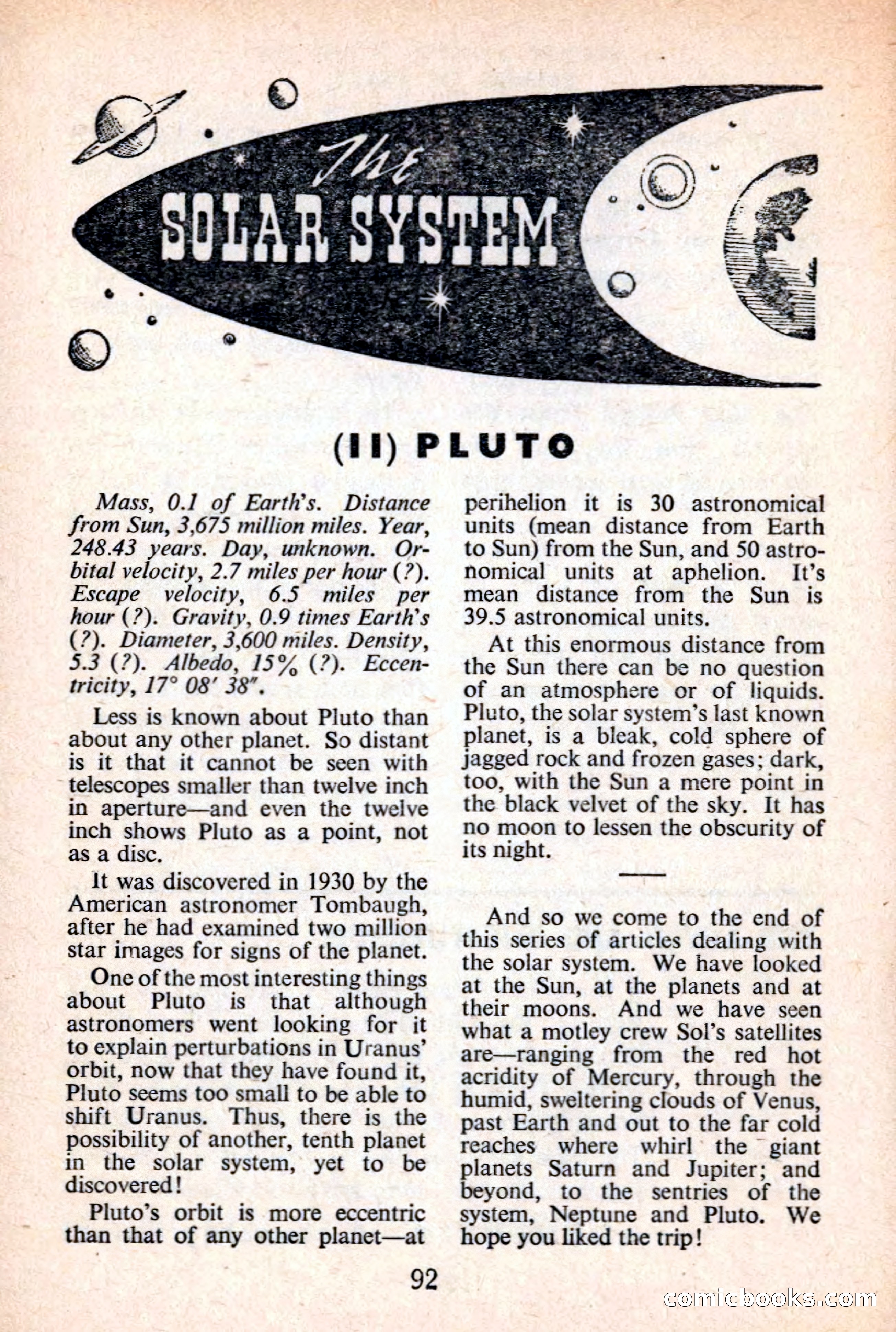
A restored page from Pulp Fiction, 1954. Page through the whole issue in the reader above.
📄 Transcribed text from this page (OCR, searchable)
Machine-transcribed from the original scan — historical spelling and the odd misread are preserved.
(Il) PLUTO Mass, 0.1 of Earth's. Distance from Sun, 3,675 million miles. Year, 248.43 years. Day, unknown. Or- bital velocity, 2.7 miles per hour (?). Escape velocity, 6.5 miles per hour (?). Gravity, 0.9 times Earth's (7). Diameter, 3,600 miles. Density, 5.3 (7). Albedo, 15% (?). Eccen- tricity, 17° 08’ 38”. Less is known about Pluto than about any other planet. So distant is it that it cannot be seen with telescopes smaller than twelve inch in aperture—and even the twelve inch shows Pluto as a point, not as a disc. it was discovered in 1930 by the American astronomer Tombaugh, after he had examined two million star images for signs of the planet. One of the most interesting things about Pluto is that although astronomers went looking for it to explain perturbations in Uranus’ orbit, now that they have found it, Pluto seems too small to be able to shift Uranus. Thus, there is the possibility of another, tenth planet in the solar system, yet to be discovered! Pluto’s orbit is more eccentric than that of any other planet—at 92 perihelion it is 30 astronomical units (mean distance from Earth to Sun) from the Sun, and 50 astro- nomical units at aphelion. It’s mean distance from the Sun is 39.5 astronomical units. At this enormous distance from the Sun there can be no question of an atmosphere or of liquids. Pluto, the solar system’s last known planet, is a bleak, cold sphere of jagged rock and frozen gases; dark, too, with the Sun a mere point in the black velvet of the sky. It has no moon to lessen the obscurity of its night. And so we come to the end of this series of articles dealing with the solar system. We have looked at the Sun, at the planets and at their moons. And we have seen what a motley crew Sol’s satellites are—ranging from the red hot acridity of Mercury, through the humid, sweltering clouds of Venus, past Earth and out to the far cold reaches where whirl the giant planets Saturn and Jupiter; and beyond, to the sentries of the system, Neptune and Pluto. We hope you liked the trip! connicloooks.com