
Pulp Fiction, 1954 · page 151 of 162
Authentic Science Fiction Monthly No. 43 — page 151: what you’re looking at
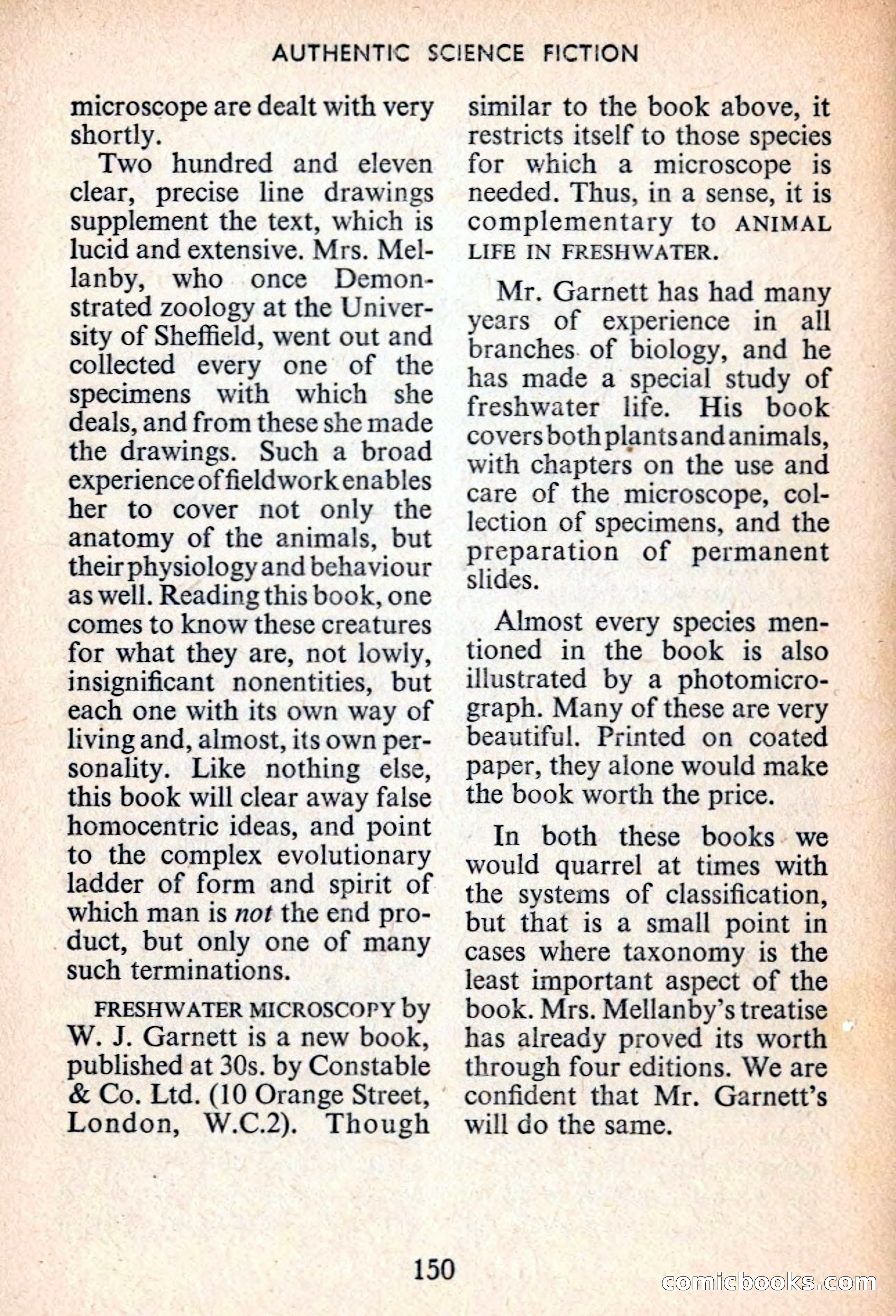
A restored page from Pulp Fiction, 1954. Page through the whole issue in the reader above.
📄 Transcribed text from this page (OCR, searchable)
Machine-transcribed from the original scan — historical spelling and the odd misread are preserved.
AUTHENTIC SCIENCE FICTION microscope are dealt with very shortly. Two hundred and eleven clear, precise line drawings supplement the text, which is lucid and extensive. Mrs. Mel- lanby, who once Demon- strated zoology at the Univer- sity of Sheffield, went out and collected every one of the specimens with which she deals, and from these she made the drawings. Such a broad experience of fieldwork enables her to cover not only the anatomy of the animals, but their physiology and behaviour as well. Reading this book, one comes to know these creatures for what they are, not lowly, insignificant nonentities, but each one with its own way of living and, almost, its own per- sonality. Like nothing else, this book will clear away false homocentric ideas, and point to the complex evolutionary ladder of form and spirit of which man is not the end pro- duct, but only one of many such terminations. FRESHWATER MICROSCOPY by W. J. Garnett is a new book, published at 30s. by Constable & Co. Ltd. (10 Orange Street, London, W.C.2). Though 150 similar to the book above, it restricts itself to those species for which a microscope is needed. Thus, in a sense, it is complementary to ANIMAL LIFE IN FRESHWATER. Mr. Garnett has had many years of experience in all branches. of biology, and he has made a special study of freshwater life. His book covers both plantsand animals, with chapters on the use and care of the microscope, col- lection of specimens, and the preparation of permanent slides. Almost every species men- tioned in the book is also illustrated by a photomicro- graph. Many of these are very beautiful. Printed on coated paper, they alone would make the book worth the price. In both these books. we would quarrel at times with the systems of classification, but that is a small point in cases where taxonomy is the least important aspect of the book. Mrs. Mellanby’s treatise has already proved its worth through four editions. We are confident that Mr. Garnett’s will do the same. conmicloooks.comn