
Pulp Fiction, 1954 · page 89 of 162
Authentic Science Fiction Monthly No. 42 — page 89: what you’re looking at
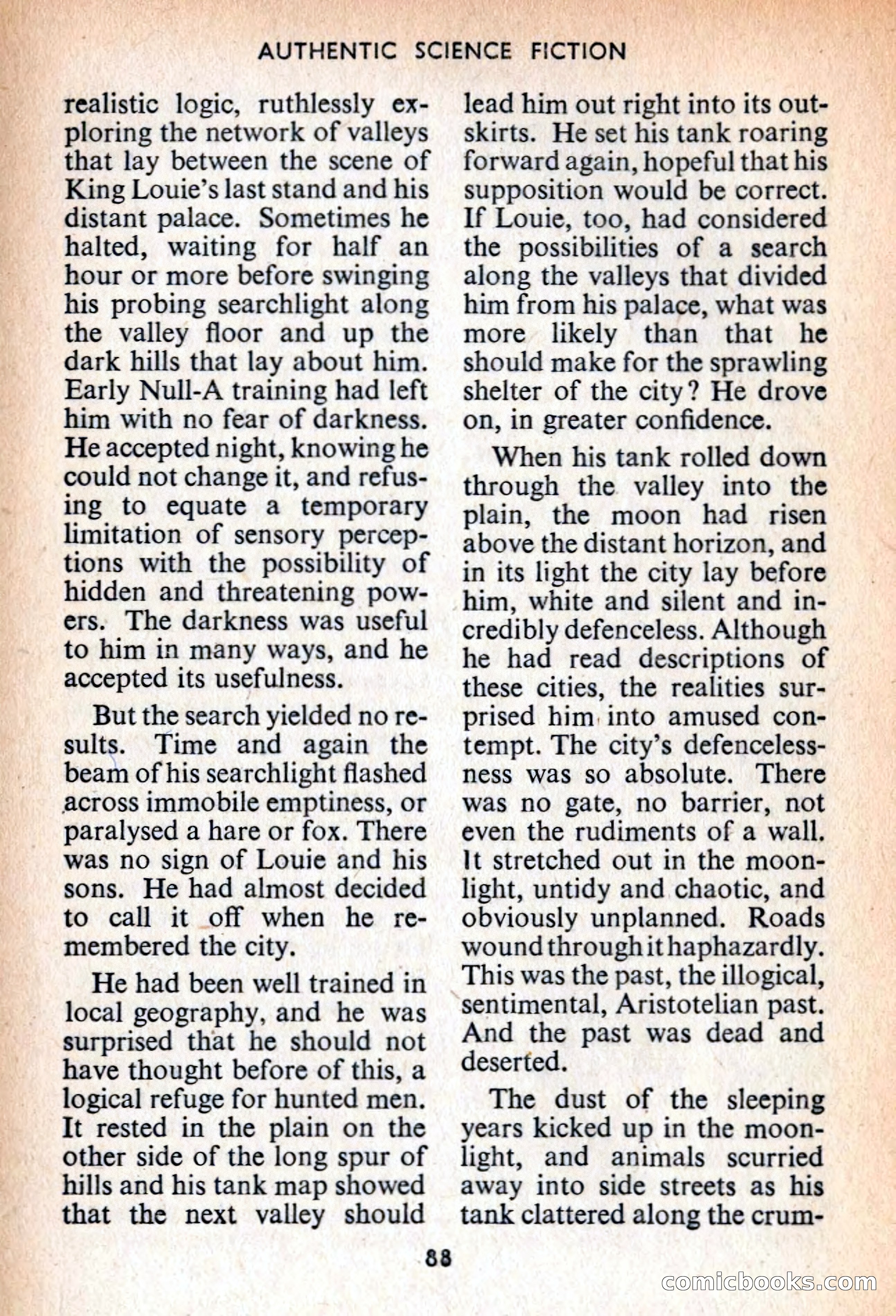
A restored page from Pulp Fiction, 1954. Page through the whole issue in the reader above.
📄 Transcribed text from this page (OCR, searchable)
Machine-transcribed from the original scan — historical spelling and the odd misread are preserved.
AUTHENTIC SCIENCE FICTION realistic logic, ruthlessly ex- ploring the network of valleys that lay between the scene of King Louie’s last stand and his distant palace. Sometimes he halted, waiting for half an hour or more before swinging his probing searchlight along the valley floor and up the dark hills that lay about him. Early Null-A training had left him with no fear of darkness. He accepted night, knowing he could not change it, and refus- ing to equate a temporary limitation of sensory percep- tions with the possibility of hidden and threatening pow- ers. The darkness was useful to him in many ways, and he accepted its usefulness. But the search yielded no re- sults. Time and again the beam of his searchlight flashed across immobile emptiness, or paralysed a hare or fox. There was no sign of Louie and his sons. He had almost decided to call it off when he re- membered the city. He had been well trained in local geography, and he was surprised that he should not have thought before of this, a logical refuge for hunted men. It rested in the plain on the other side of the long spur of hills and his tank map showed that the next valley should 88 lead him out right into its out- skirts. He set his tank roaring forward again, hopeful that his supposition would be correct. If Louie, too, had considered the possibilities of a search along the valleys that divided him from his palace, what was more likely than that he should make for the sprawling shelter of the city? He drove on, in greater confidence. When his tank rolled down through the valley into the plain, the moon had risen above the distant horizon, and in its light the city lay before him, white and silent and in- credibly defenceless. Although he had read descriptions of these cities, the realities sur- prised him: into amused con- tempt. The city’s defenceless- ness was so absolute. There was no gate, no barrier, not even the rudiments of a wall. It stretched out in the moon- light, untidy and chaotic, and obviously unplanned. Roads wound throughit haphazardly. This was the past, the illogical, sentimental, Aristotelian past. And the past was dead and deserted. The dust of the sleeping years kicked up in the moon- light, and animals scurried away into side streets as his tank clattered along the crum- comicloooks.com