
Pulp Fiction, 1954 · page 100 of 162
Authentic Science Fiction Monthly No. 42 — page 100: what you’re looking at
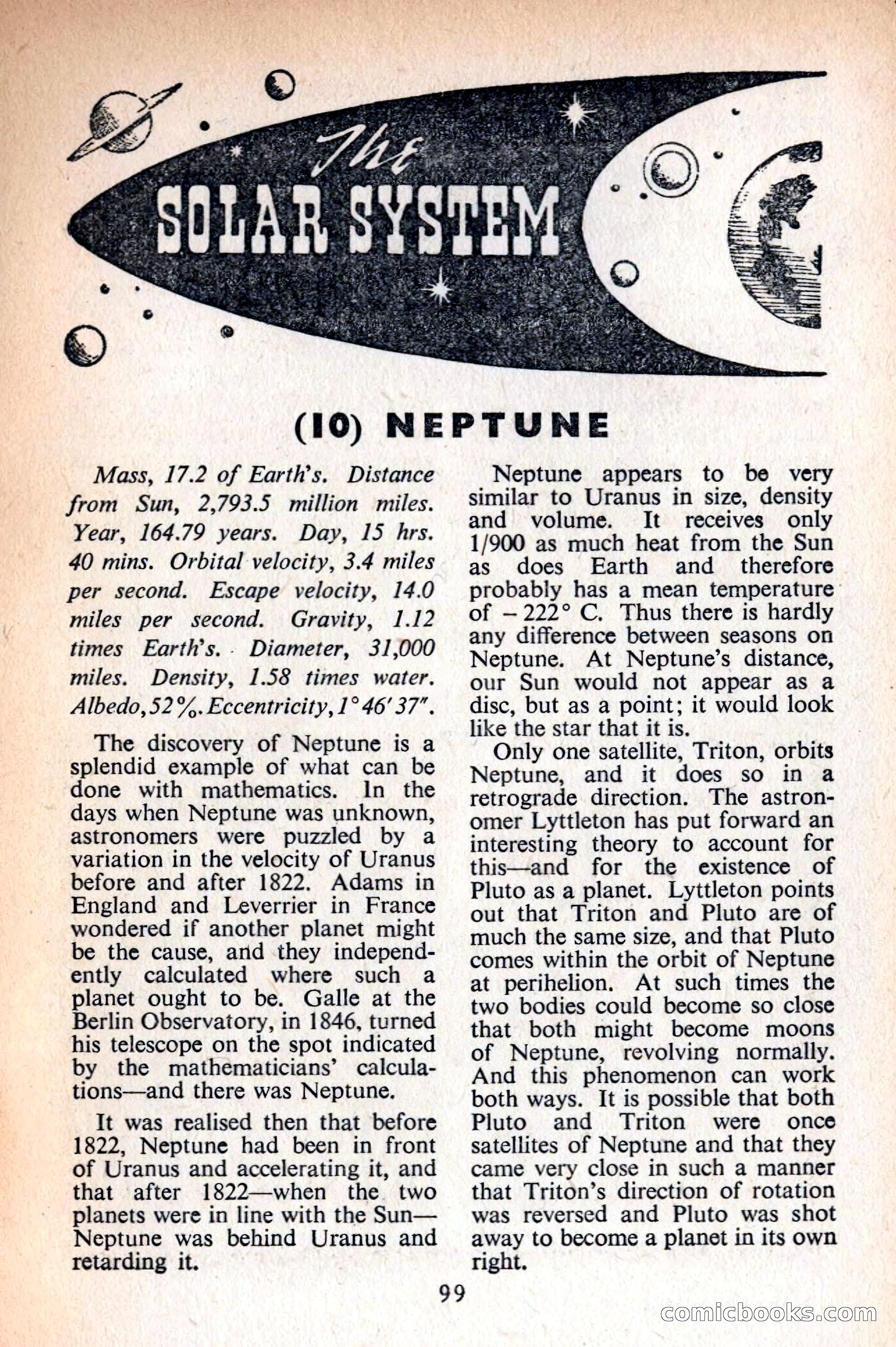
A restored page from Pulp Fiction, 1954. Page through the whole issue in the reader above.
📄 Transcribed text from this page (OCR, searchable)
Machine-transcribed from the original scan — historical spelling and the odd misread are preserved.
SOLAR etal + a * . z (10) NEPTUNE Mass, 17.2 of Earth’s. Distance from Sun, 2,793.5 million miles. Year, 164.79 years. Day, 15 hrs. 40 mins. Orbital velocity, 3.4 miles per second. Escape velocity, 14.0 miles per second. Gravity, 1.12 times Earth’s.. Diameter, 31,000 miles. Density, 1.58 times water. Albedo, 52°%. Eccentricity, 1° 46’ 37”. The discovery of Neptune is a splendid example of what can be done with mathematics. In the days when Neptune was unknown, astronomers were puzzled by a variation in the velocity of Uranus before and after 1822. Adams in England and Leverrier in France wondered if another planet might be the cause, ard they independ- ently calculated where such a planet ought to be. Galle at the Berlin Observatory, in 1846, turned his telescope on the spot indicated by the mathematicians’ calcula- tions—and there was Neptune. It was realised then that before 1822, Neptune had been in front of Uranus and accelerating it, and that after 1822—when the two planets were in line with the Sun— Neptune was behind Uranus and retarding it. 99 Neptune appears to be very similar to Uranus in size, density and volume. It receives only 1/900 as much heat from the Sun as does Earth and_ therefore probably has a mean temperature of —222° C. Thus there is hardly any difference between seasons on Neptune. At Neptune’s distance, our Sun would not appear as a disc, but as a point; it would look like the star that it is. Only one satellite, Triton, orbits Neptune, and it does so in a retrograde direction. The astron- omer Lyttleton has put forward an interesting theory to account for this—and for the existence of Pluto as a planet. Lyttleton points out that Triton and Pluto are of much the same size, and that Pluto comes within the orbit of Neptune at perihelion. At such times the two bodies could become so close that both might become moons of Neptune, revolving normally. And this phenomenon can work both ways. It is possible that both Pluto and Triton were once satellites of Neptune and that they came very close in such a manner that Triton’s direction of rotation was reversed and Pluto was shot away to become a planet in its own right. comiclooks.com