
Pulp Fiction, 1954 · page 97 of 162
Authentic Science Fiction Monthly No. 41 — page 97: what you’re looking at
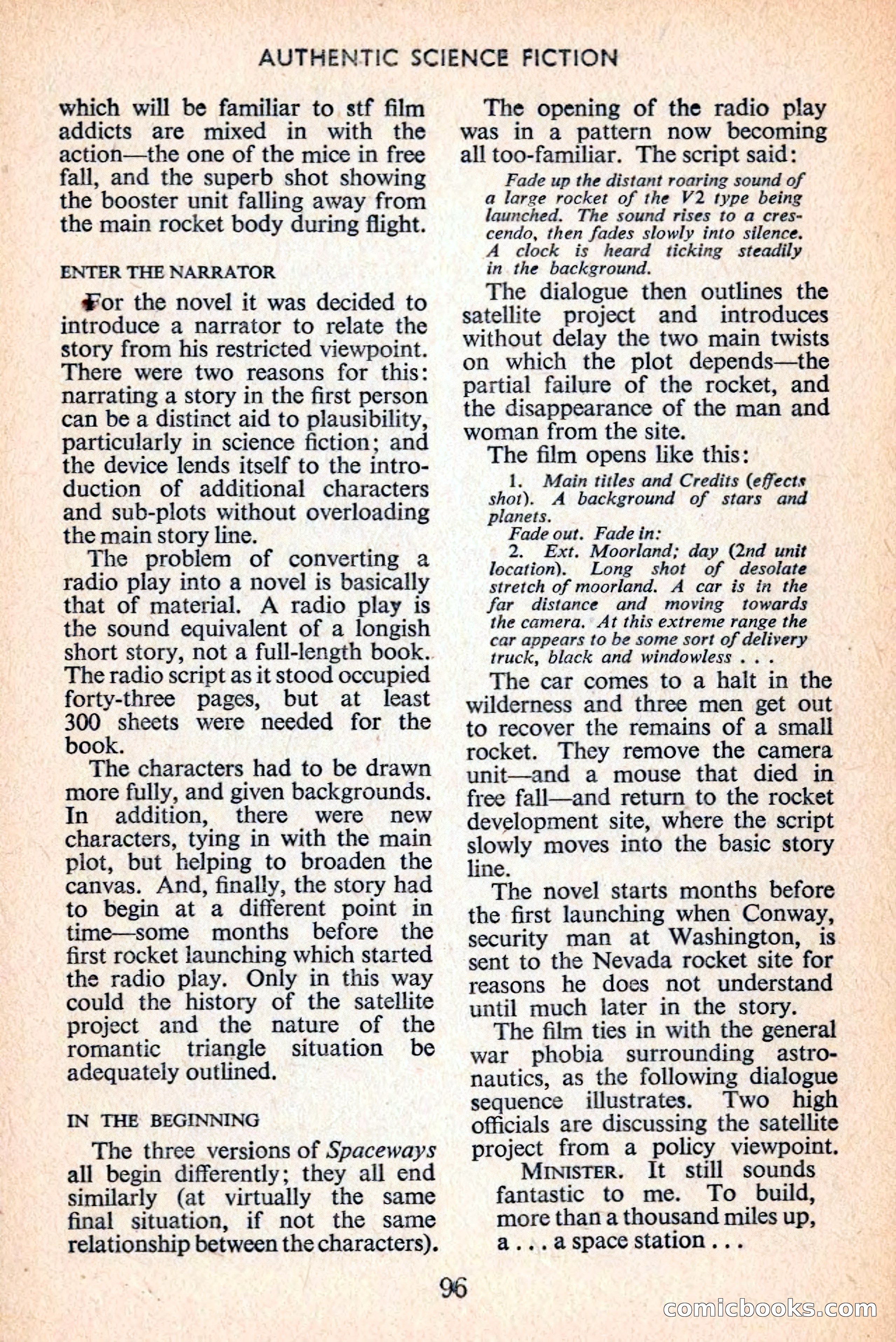
A restored page from Pulp Fiction, 1954. Page through the whole issue in the reader above.
📄 Transcribed text from this page (OCR, searchable)
Machine-transcribed from the original scan — historical spelling and the odd misread are preserved.
AUTHENTIC SCIENCE FICTION which will be familiar to stf film addicts are mixed in with the action—the one of the mice in free fall, and the superb shot showing the booster unit falling away from the main rocket body during flight. ENTER THE NARRATOR #or the novel it was decided to introduce a narrator to relate the story from his restricted viewpoint. There were two reasons for this: narrating a story in the first person can be a distinct aid to plausibility, particularly in science fiction; and the device lends itself to the intro- duction of additional characters and sub-plots without overloading the main story line. The problem of converting a radio play into a novel is basically that of material. A radio play is the sound equivalent of a longish short story, not a full-length book. The radio script as it stood occupied forty-three pages, but at least 300 sheets were needed for the book. The characters had to be drawn more fully, and given backgrounds. In addition, there were new characters, tying in with the main plot, but helping to broaden the canvas. And, finally, the story had to begin at a different point in time—some months before the first rocket launching which started the radio play. Only in this way could the history of the satellite project and the nature of the romantic triangle situation be adequately outlined. IN THE BEGINNING The three versions of Spaceways all begin differently; they all end similarly (at virtually the same final situation, if not the same relationship between the characters). 96 The opening of the radio play was in a pattern now becoming all too-familiar. The script said: Fade up the distant roaring sound of a larze rocket of the V2 type being launched. The sound rises to a cres- cendo, then fades slowly into silence. A clock is heard ticking steadily in the background. The dialogue then outlines the satellite project and introduces without delay the two main twists on which the plot depends—the partial failure of the rocket, and the disappearance of the man and woman from the site. The film opens like this: 1. Main titles and Credits (effects shot). A background of stars and planets. Fade out. Fade in: 2. Ext. Moorland; day (2nd unit location). Long shot of desolate stretch of moorland. A car is in the far distance and moving towards the camera, At this extreme range the car appears to be some sort of delivery truck, black and windowless . The car comes to a halt in the wilderness and three men get out to recover the remains of a small rocket. They remove the camera unit—and a mouse that died in free fall—and return to the rocket development site, where the script slowly moves into the basic story line. The novel starts months before the first launching when Conway, security man at Washington, is sent to the Nevada rocket site for reasons he does not understand until much later in the story. The film ties in with the general war phobia surrounding astro- nautics, as the following dialogue sequence illustrates. Two high officials are discussing the satellite project from a policy viewpoint. MINisTER. It still sounds fantastic to me. To build, more than a thousand miles up, a...aspace station... comiclbooks.corn