
Pulp Fiction, 1954 · page 95 of 162
Authentic Science Fiction Monthly No. 41 — page 95: what you’re looking at
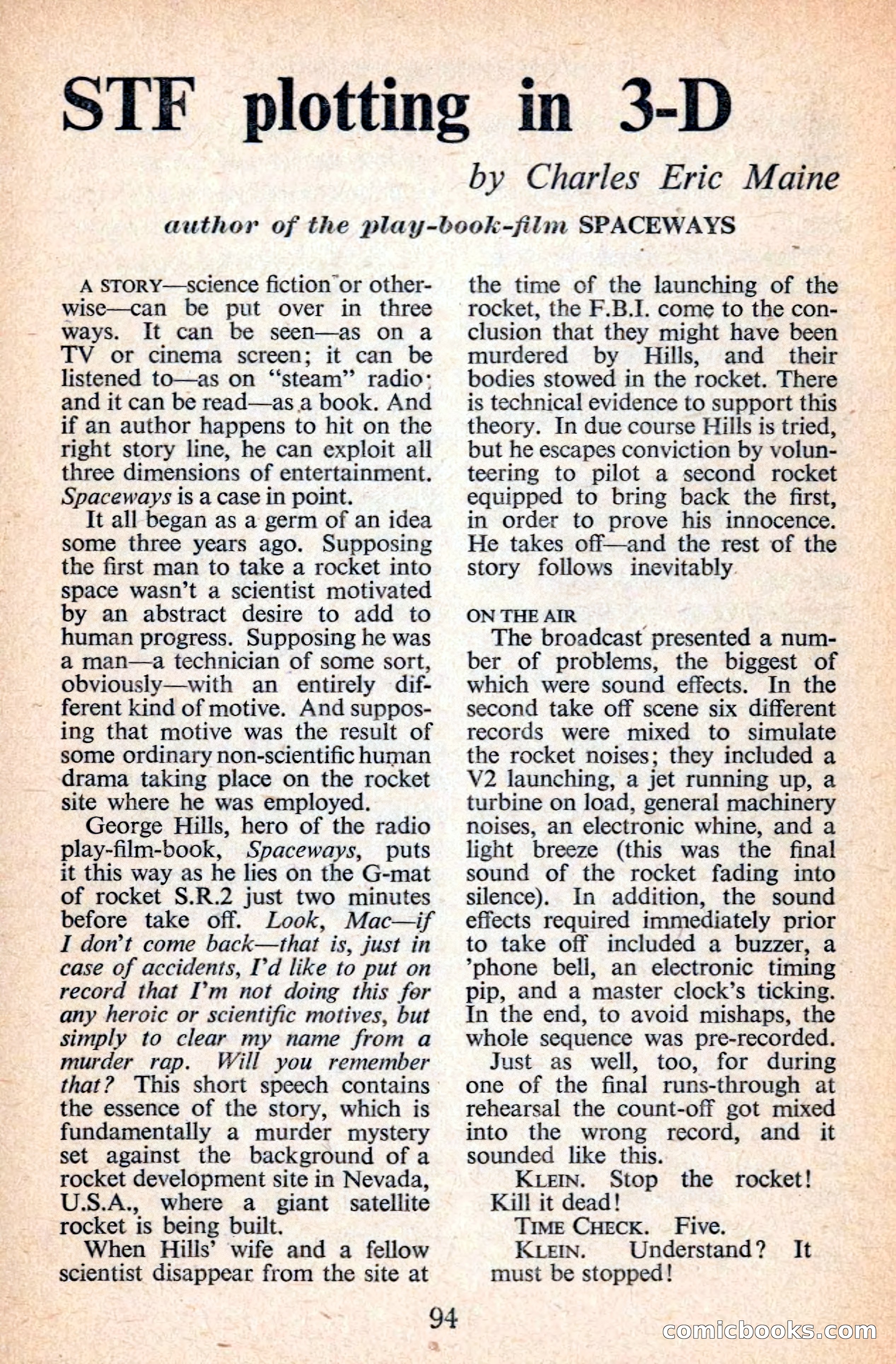
A restored page from Pulp Fiction, 1954. Page through the whole issue in the reader above.
📄 Transcribed text from this page (OCR, searchable)
Machine-transcribed from the original scan — historical spelling and the odd misread are preserved.
STF plotting in 3-D author of the play-book-film SPACEWAYS A STORY—science fiction or other- wise—can be put over in three ways. It can be seen—as on a TV or cinema screen; it can be listened to—as on “‘steam”’ radio: and it can be read—as a book. And if an author happens to hit on the right story line, he can exploit all three dimensions of entertainment. Spaceways is a case in point. It all began as a germ of an idea some three years ago. Supposing the first man to take a rocket into space wasn’t a scientist motivated by an abstract desire to add to human progress. Supposing he was a man—a technician of some sort, obviously—with an entirely dif- - ferent kind of motive. And suppos- ing that motive was the result of some ordinary non-scientific human drama taking place on the rocket site where he was employed. George Hills, hero of the radio play-film-book, Spaceways, puts it this way as he lies on the G-mat of rocket S.R.2 just two minutes before take off. Look, Mac—if I don’t come back—that is, just in case of accidents, I'd like to put on record that I’m not doing this for any heroic or scientific motives, but simply to clear my name from a murder rap. Will you remember that? This short speech contains the essence of the story, which is fundamentally a murder mystery set against the background of a rocket development site in Nevada, U.S.A., where a giant satellite rocket is being built. When Hills’ wife and a fellow scientist disappear from the site at 94 = 2 by Charles Eric Maine ~ the time of the launching of the rocket, the F.B.I. come to the con- clusion that they might have been murdered by Hills, and _ their bodies stowed in the rocket. There is technical evidence to support this - theory. In due course Hills is tried, but he escapes conviction by volun- teering to pilot a second rocket equipped to bring back the first, in order to prove his innocence. He takes off—and the rest of the story follows inevitably. ON THE AIR The broadcast presented a num- ber of problems, the biggest of which were sound effects. In the second take off scene six different records were mixed to simulate the rocket noises; they included a V2 launching, a jet running up, a turbine on load, general machinery noises, an electronic whine, and a light breeze (this was the final sound of the rocket fading into silence). In addition, the sound effects required immediately prior to take off included a buzzer, a *phone bell, an electronic timing pip, and a master clock’s ticking. In the end, to avoid mishaps, the whole sequence was pre-recorded. Just as well, too, for during one of the final runs-through at rehearsal the count-off got mixed into the wrong record, and it sounded like this. KLEIN. Stop the rocket! Kill it dead! TIME CHECK. Five. KLEIN. | Understand? It must be stopped! econmmiclooolkks.com