
Pulp Fiction, 1954 · page 67 of 162
Authentic Science Fiction Monthly No. 41 — page 67: what you’re looking at
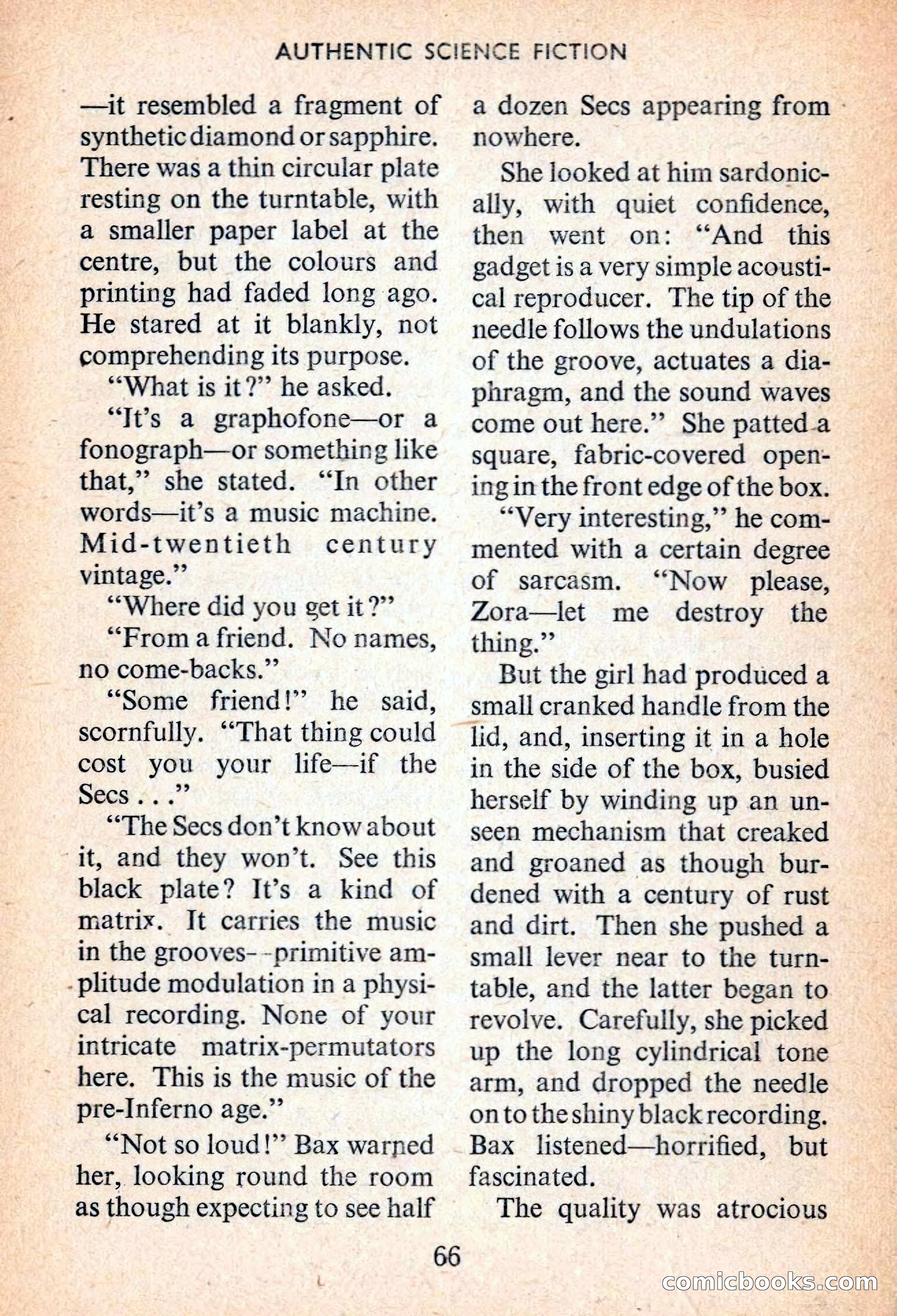
A restored page from Pulp Fiction, 1954. Page through the whole issue in the reader above.
📄 Transcribed text from this page (OCR, searchable)
Machine-transcribed from the original scan — historical spelling and the odd misread are preserved.
AUTHENTIC SCIENCE FICTION —it resembled a fragment of synthetic diamond or sapphire. There was a thin circular plate resting on the turntable, with a smaller paper label at the centre, but the colours and printing had faded long ago. He stared at it blankly, not comprehending its purpose. “What is it?’”’ he asked. “It’s a graphofone—or a fonograph—or something like that,” she stated. “In other words—it’s a music machine. Mid-twentieth century vintage.” “Where did you get it ?”’ “From a friend. No names, no come-backs.”’ “Some friend!’ he said, scornfully. ““That thing could cost you your life—if the eee Aa” “The Secs don’t know about ‘It, and they won’t. See this black plate? It’s a kind of matrix. It carries the music in the grooves- -primitive am- - plitude modulation in a physi- cal recording. None of your intricate matrix-permutators here. This is the music of the pre-Inferno age.” *“Not so loud!”’ Bax warned her, looking round the room as though expecting to see half 66 a dozen Secs appearing from - nowhere. She looked at him sardonic- ally, with quiet confidence, then went on: “And this gadget is a very simple acousti- cal reproducer. The tip of the needle follows the undulations of the groove, actuates a dia- phragm, and the sound waves come out here.”” She patted-a square, fabric-covered open- ing in the front edge of the box. “Very interesting,’ he com- mented with a certain degree of sarcasm. ‘“‘Now please, Zora—let me destroy the thing.” But the girl had produced a small cranked handle from the lid, and, inserting it in a hole in the side of the box, busied herself by winding up an un- seen mechanism that creaked and groaned as though bur- dened with a century of rust and dirt. Then she pushed a small lever near to the turn- table, and the latter began to revolve. Carefully, she picked up the long cylindrical tone arm, and dropped the needle onto theshiny black recording. Bax listened—horrified, but fascinated. The quality was atrocious commicoooks.comn)